


Polyurethane is a finicky finish. It dries fast, hates lap marks, and punishes anyone trying to brush a tabletop or cabinet door with the patience of a saint. The right spray gun turns that same job into a few smooth passes with a glass-clear film that levels out before you blink. The wrong setup, on the other hand, spits orange peel, sags on vertical surfaces, and clogs the moment you look away.
A quick word on the technology. HVLP (High Volume, Low Pressure) guns move a lot of air at lower pressure, which means softer atomization and less bounce-back on your workpiece. LVLP (Low Volume, Low Pressure) guns sip air and pair well with smaller compressors. Airless systems push finish at high pressure through a tiny tip, ideal for big surfaces but heavier to control. Each approach has trade-offs worth knowing before you spend.
Below, nine spray guns that handle polyurethane well, from garage-shop favorites to full turbine systems, each matched to a real kind of project and a real kind of user.
The Lineup, Simplified

Fuji Spray 2202 Semi-PRO 2 HVLP Spray System

Wagner Spraytech Control Pro 130 HEA Sprayer

Titan Capspray Maxum II HVLP Spray Gun

RRJ R500 LVLP Spray Gun Kit

RRJ R500 LVLP Spray Gun with Air Regulator

RRJ R500 LVLP Spray Gun with Mixing Cups
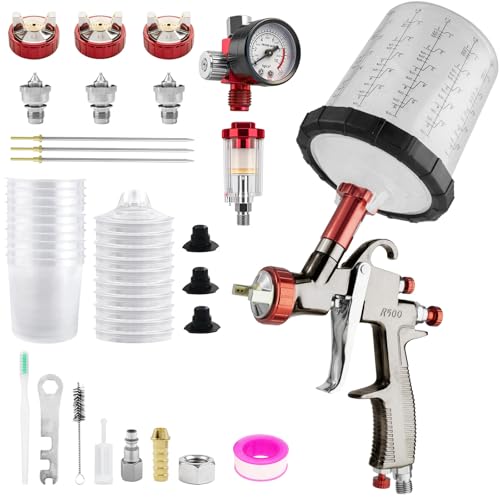
RRJ R500 LVLP Spray Gun (1.3/1.5/1.7mm)

Wagner Control Spray QX2 HVLP Stain Sprayer

Wagner FLEXiO 570 HVLP Paint and Stain Sprayer
A Closer Look At Each Pick
The Fuji Spray 2202 Semi-PRO 2 is a turbine-driven HVLP system aimed at woodworkers who want clean, controlled atomization without dragging a bulky compressor out of the corner. It pairs a metal turbine case with a 1.3mm air cap set and a one-quart bottom-feed cup, which means less stooping to refill during long runs on a dining table or a run of cabinet doors.
Compared to the Titan Maxum II covered later, the Fuji trades raw professional refinement for plug-and-play convenience. You bring the outlet, the gun does the rest. For most hobbyist and intermediate shops finishing furniture indoors, that trade feels like a win.
Strong Points
- Adjustable pattern fan control helps you dial a tight pencil for edges or a wide fan for doors and panels.
- Bottom-feed cup keeps the gun lighter in hand, which matters during a four-hour refinishing session.
- 25-foot hose with integrated air control valve limits overspray bounce-back on inside corners.
- Turbine system means you don’t need a separate compressor to get a clean, even film.
- Non-bleed gun design cuts trigger lag for more predictable starts and stops.
Things To Consider
- Turbine systems are louder than a compressor-fed gun, so earplugs help on long jobs.
- Cleanup means flushing finish through the gun right after use to keep the passages clear.
Right Fit For
Intermediate woodworkers finishing furniture or cabinets who want pro-style results without investing in a large compressor setup.
Swap It Out When
The Wagner Control Pro 130 HEA Sprayer suits you better when you’re coating broad exterior surfaces like siding or a full deck where airless throughput beats HVLP finesse.
The Control Pro 130 sits in a different lane than every HVLP on this list. It’s an airless sprayer, specifically a High Efficiency Airless (HEA) model, designed to push a high volume of finish through a small tip. That translates to fast coverage on large areas and the ability to spray unthinned paints and stains straight from the can.
It works well for medium to large interior and exterior jobs, from staining a wraparound deck to painting the full exterior of a home. The trade is precision: this is not the gun you reach for when finishing a delicate jewelry box. Most homeowners who tackle a fence or a long run of trim will appreciate the speed.
Positive Takeaways
- Low-overspray HEA technology reduces drift on breezy outdoor days.
- Continuous painting flow speeds up large projects compared to brushing or rolling.
- Quick setup with minimal learning curve for first-time airless users.
Worth Noting
- Airless guns demand careful tip cleaning to prevent clogs between coats.
- Heavier in hand than handheld HVLP units, so fatigue shows up on long ceilings.
- Less suited to fine furniture detail where the Fuji 2202 Semi-PRO 2 excels.
Made For
Homeowners staining a full deck, painting exterior siding, or coating fences where throughput matters more than fine atomization.
Look Elsewhere When
The Titan Capspray Maxum II HVLP Spray Gun is a better match when the work calls for a controlled, glass-smooth finish on smaller refinishing projects.
The Titan Capspray Maxum II is a gravity-feed HVLP gun built around stainless steel internals and oversized internal air passages, which is engineer-speak for “it atomizes cleanly and won’t choke on thicker coatings.” You bring a compatible turbine or compressor; Titan designed the gun body, not the air supply.
For finishers chasing that piano-grade topcoat, this is the kind of tool that earns a permanent spot on the bench. It’s the one to reach for on heirloom furniture, refinished cabinetry, or any project where a single visible flaw means starting over.
Where It Delivers
- Large air passages handle a wide range of coating viscosities without breakup issues.
- Stainless steel internals resist corrosion from water-based and solvent-based finishes alike.
- Gravity-feed cup keeps the gun balanced during extended trigger time.
- Adjustable fan pattern suits everything from narrow rails to wide panels.
Trade Offs
- Requires a separately purchased turbine or compressor to operate.
- Higher learning curve than entry-level kits for users new to HVLP.
Feature Snapshot
Who It Suits Best
Serious hobbyists and pro finishers working on heirloom furniture, custom cabinetry, or detailed refinishing jobs where a flawless topcoat is the whole point.
A Better Fit Elsewhere
The Wagner FLEXiO 570 HVLP Paint and Stain Sprayer serves you better for whole-room interior projects where you’d rather skip the bench and spray walls and trim in one go.
The RRJ R500 Kit is built for the person standing in the garage realizing a brush is going to ruin a perfectly good weekend. It includes four nozzle sizes (1.3, 1.5, 1.7, and 2.0mm), a 600ml reusable cup, a stack of 650ml disposable cups, and an air regulator to dial in your compressor output.
That’s a lot of gear to start with, and the four-nozzle spread means you can spray everything from clear polyurethane to thicker primers without swapping the whole gun. Compared to the Fuji 2202, the R500 asks you to bring the compressor but rewards you with finer control and a much lower entry cost.
Notable Gains
- Three-control valve system adjusts paint flow, fan width, and air pressure independently.
- Multiple nozzle sizes let you match the gun to thin poly or thicker primers without compromise.
- Disposable cup supply keeps cleanup to a quick swap and toss.
- Air regulator included means you don’t need to chase down a separate inline gauge.
Soft Spots
- Requires a compressor capable of steady airflow at LVLP volumes.
- Some users may find the included regulator bulkier than expected on smaller compressors.
Best Suited To
First-time finishers setting up a home shop who want a complete kit without piecing together accessories from three different orders.
Consider Something Else When
The Wagner Control Spray QX2 HVLP Stain Sprayer fits better for outdoor weekend staining where a self-contained unit is more practical than dragging a compressor outside.
This RRJ R500 variant leans into the spec sheet: one-piece forged aluminum body with a Teflon coating, four stainless steel nozzles, and claimed paint transfer efficiency above 65%. The Teflon finish matters more than it sounds because it helps the gun resist the kind of finish buildup that ruins a Saturday afternoon.
It’s the same R500 platform as the kit version above but with a different bundled accessory set. The 1/4-inch inlet is standard, the working pressure range fits most home compressors, and the air consumption stays manageable for garage setups. Best fit when the project list spans a car hood, a kitchen cabinet, and a backyard fence.
Strengths Worth Knowing
- Teflon-coated body resists finish adhesion, which makes cleanup faster.
- Four nozzle sizes cover a wide spread from fine clears to heavier primers.
- Forged aluminum construction adds confidence in daily workshop use.
- Stainless steel nozzles hold tolerances through repeated solvent cleanings.
Honest Caveats
- Working pressure range requires a compressor with a tank large enough to avoid constant cycling.
- Air consumption of 3.0 to 3.9 CFM rules out small pancake compressors for sustained use.
Perfect Match For
Auto detailers and home woodworkers who split their finishing time between cars, furniture, and exterior trim and want one gun that handles all three.
Another Choice May Suit
The Titan Capspray Maxum II HVLP Spray Gun is a smarter pick when a stainless steel internals build and pro-grade atomization are higher priorities than included accessories.
This R500 bundle is the cup-supply version of the same gun platform. You get a 650ml mixing cup and a pack of 10 disposable cups alongside the 1.3, 1.7, and 2.0mm nozzles. For anyone who hates cleaning a reusable cup between color changes, that stack of disposables is the real value here.
It’s a practical pick for budget-conscious shops that spray polyurethane often enough to wear through a few cups a week. You give up the 1.5mm nozzle that the previous R500 kit includes, but for most home finishing, 1.3 and 1.7 cover the sweet spot.
Practical Advantages
- Disposable cup supply cuts cleanup time and reduces solvent use.
- Teflon-coated forged aluminum body holds up to repeated use and cleaning.
- Low air consumption suits mid-size compressors in home workshops.
- Nickel-plated internals resist wear from solvent-based finishes.
Minor Gripes
- Missing the 1.5mm nozzle that the broader R500 kit includes.
- Disposable cups add a small ongoing cost for regular finishers.
Who Will Love This
DIY finishers on a budget who want a complete starter setup with enough disposable cups to handle a weekend of color changes without washing up.
Where Another Pick Suits Better
The Fuji Spray 2202 Semi-PRO 2 HVLP Spray System is worth the stretch when you want a turbine-driven setup that removes the compressor from the equation entirely.
The third R500 variant keeps the 1.3, 1.5, and 1.7mm nozzles and skips the 2.0mm, which makes it a slightly more refined pick for the kind of work most home users actually do. That 1.5mm size sits right in the middle of the range and handles most water-based and oil-based polyurethanes without thinning.
The Teflon-coated body and quick-disassembly design make this a sensible workhorse. It’s the gun you leave on the bench and grab for the next project without much ceremony.
A Few Strong Suits
- Three mid-range nozzles cover the most common finishing viscosities.
- Quick-disassembly design speeds cleaning between coats and projects.
- Low pressure operation reduces overspray on interior trim work.
Small Caveats
- No 2.0mm nozzle for thicker primer or high-build coatings.
- Requires a steady compressor supply at LVLP volumes for best results.
Whose Shelf It Belongs On
DIYers and home refinishers who want a reliable, easy-to-clean gun for furniture, doors, and trim without paying for nozzles they won’t use.
Reach For A Different Pick When
The Wagner Spraytech Control Pro 130 HEA Sprayer makes more sense for anyone staining a full deck or painting an entire room where airless speed outpaces HVLP finesse.
The Wagner QX2 is a self-contained HVLP stain sprayer built for the kind of outdoor projects where dragging out a brush and roller feels like punishment. It ships with three spray patterns so you can adjust the fan for fence pickets, deck boards, or lattice work without swapping tips.
It’s aimed squarely at homeowners, not finishers, which means simpler controls, faster learning curve, and enough throughput to make a full deck stain feel like an afternoon instead of a week. Compared to the Fuji 2202, the QX2 is more portable but trades turbine power for a lighter, more casual workflow.
Useful Touches
- Three spray patterns (horizontal, vertical, narrow) cover most outdoor project shapes.
- Self-contained design means no compressor, hose, or turbine to manage.
- Lightweight body reduces arm fatigue on overhead pergola or lattice work.
Where It Is Less Suited
- Built for stains and sealers more than fine furniture finishes.
- Smaller turbine output limits atomization quality on thicker coatings.
Feature Snapshot
The Right Fit
Homeowners staining a deck, refreshing a fence, or sealing outdoor furniture who want a simple, no-compressor setup that works on a weekend morning.
Where A Sibling Pick Shines
The Wagner FLEXiO 570 HVLP Paint and Stain Sprayer fits when the work jumps between interior and exterior projects and you want a detachable handheld for detail areas.
The FLEXiO 570 is the most flexible system in Wagner’s home line. It pairs a stationary base with a detachable handheld, so you can spray broad walls and ceilings with the iSpray nozzle or pop the gun off for detail work on furniture or crafts. It’s a genuinely different shape from any other entry on this list.
For homeowners whose project list sprawls across rooms, it removes the need to commit to one tool or another. The trade-off is that the FLEXiO doesn’t atomize as finely as a dedicated HVLP turbine system, so a true finisher chasing piano-grade surfaces will feel the difference. Most DIYers won’t.
Useful Strengths
- Detachable handheld for trim, furniture, and tight spaces without dismantling the whole rig.
- Sprays most unthinned paints and stains straight from the container.
- X-Boost turbine delivers enough power for broad walls and ceilings.
- Removable parts make cleaning faster than brushes or rollers.
Where It May Fall Short
- Atomization falls short of pro-grade turbine systems like the Fuji 2202 Semi-PRO 2.
- Larger footprint than handheld-only units in a small workshop.
Built With In Mind
DIYers juggling interior walls, ceilings, exterior trim, and the occasional piece of furniture who want one rig to cover the spread without owning three tools.
Not Your Match When
The Titan Capspray Maxum II HVLP Spray Gun is a better fit when the priority is fine atomization on furniture or cabinetry and you’re willing to bring a separate compressor to the job.
What To Weigh Before Choosing A Spray Gun For Polyurethane
Matching the gun to the project makes the difference between a finish that levels out like glass and one that sags on the first vertical surface.
Atomization Technology
HVLP guns use high air volume at low pressure for softer spray patterns that are kind to interior work. LVLP guns use even less air, which suits smaller compressors and smaller projects. Airless systems push finish at high pressure, ideal for broad exterior coverage. Polyurethane is thin enough for HVLP and LVLP, and many water-based formulas spray without thinning. For most home and small shop projects, HVLP is the safest pick.
Viscosity And Nozzle Match
Nozzle size controls how much finish flows per pass. Thin water-based polyurethanes spray well through 1.0 to 1.3mm nozzles, while thicker oil-based formulas and primers need 1.5 to 2.0mm. Multi-nozzle kits like the RRJ R500 series help you match the gun to the finish instead of the other way around.
Air Supply Reality
Turbine systems like the Fuji 2202 bring their own air, so the only constraint is outlet access. Compressor-fed guns demand a tank and CFM rating that can keep up. LVLP guns sip air at 3.0 to 3.9 CFM, which most home compressors handle. Airless units like the Wagner Control Pro 130 don’t use compressor air at all, but require outlet power and a more involved cleanup routine.
Ergonomics And Cleanup
Trigger pull weight, cup position, and grip shape decide how the gun feels during a three-hour session. Gravity-feed designs balance better in hand than bottom-feed, and quick-disassembly air caps save real time on cleanup day. Polyurethane cures fast, so any feature that speeds the post-job flush pays for itself within a season.
Key Considerations Across These Picks
Common Shopping Slip Ups
The biggest mistake is matching nozzle to gun and finish without checking first. Buying a 1.0mm setup for thick oil-based polyurethane leads to constant clogs and frustration. The flip side also hurts: a 2.0mm nozzle on thin water-based poly floods the surface and sags on verticals. Match the kit to the finishes you actually use most, not the widest range you can imagine.
Another trap is underestimating air requirements. A small pancake compressor might list a peak CFM that looks fine, but its sustained output tells a different story once the gun is open. Plan for sustained airflow, not peak numbers, or expect pressure drop and inconsistent atomization on long passes.
What The Higher Tier Buys
Stepping up to a system like the Fuji 2202 or the Titan Maxum II buys you stainless internals, finer atomization, and the kind of pattern control that makes a topcoat disappear. The construction difference is real: forged aluminum bodies, tighter tolerance nozzles, and non-bleed gun designs all add up to fewer surprises mid-coat.
The upgrade is worth it when the project justifies the time investment: a dining table that took 40 hours to build deserves a finish system that won’t undercut the effort. For a one-off garden bench, the entry-level R500 kits deliver nearly all the visible result at a fraction of the cost. Match the spend to the project, not the other way around.
Frequently Asked Questions
Can I spray polyurethane with an HVLP gun?
Yes, HVLP guns are a strong match for most polyurethanes, especially water-based formulas that spray cleanly without thinning. Adjust the air pressure to the gun’s spec and start with the smallest nozzle recommended for your finish. Practice on scrap before pointing it at a finished piece.
What nozzle size works best for polyurethane?
For thin water-based polyurethane, 1.0 to 1.3mm gives the cleanest pattern with minimal overspray. For oil-based polyurethane, 1.3 to 1.5mm handles the higher viscosity without constant thinning. Heavier finishes and primers need 1.7 to 2.0mm and accept a slightly coarser pattern.
Do I need a separate compressor for these spray guns?
Turbine-driven systems like the Fuji 2202 Semi-PRO 2 run on their own air supply, so no compressor is needed. HVLP and LVLP guns like the RRJ R500 series do require a compressor that can deliver steady airflow at LVLP volumes, typically 3.0 to 3.9 CFM. Airless sprayers like the Wagner Control Pro 130 run on household power without a compressor.
How do I clean a spray gun after using polyurethane?
Flush the gun with the appropriate solvent (water for water-based poly, mineral spirits or paint thinner for oil-based) right after finishing. Disassemble the air cap and nozzle, soak any passages that show finish buildup, and reassemble. Skipping the immediate flush is the fastest way to ruin a gun, since cured polyurethane is nearly impossible to fully remove from internal passages.
What is the difference between HVLP and LVLP spray guns?
HVLP (High Volume, Low Pressure) guns use a lot of air at lower pressure for soft, controlled atomization that minimizes overspray. LVLP (Low Volume, Low Pressure) guns use even less air at similarly low pressure, which makes them a better fit for smaller compressors. Both produce a quality finish, with LVLP trading a touch of atomization finesse for compressor compatibility.




