


A fresh coat on interior walls is one of the highest-impact upgrades you can do at home, and the right spray tool turns what would be a two-day cut-in job into a single afternoon. Choosing between a HVLP handheld, a full airless system, and a compressor-fed LVLP gun matters more than people expect, because each fits a different room size, paint type, and skill level. This roundup covers eight current options for homeowners and DIYers who want even coverage on walls, trim, fences, and furniture without renting pro gear.
A Fast Comparison Of The Options

Wagner Control Pro 130 HEA Paint & Stain Sprayer

VAVCURAA 1000W House Paint Sprayer (Green)

RRJ R500 LVLP Automotive Spray Gun Kit

RRJ R500 LVLP Spray Gun with Air Regulator

RRJ R500 LVLP Spray Gun with Mixing Cups
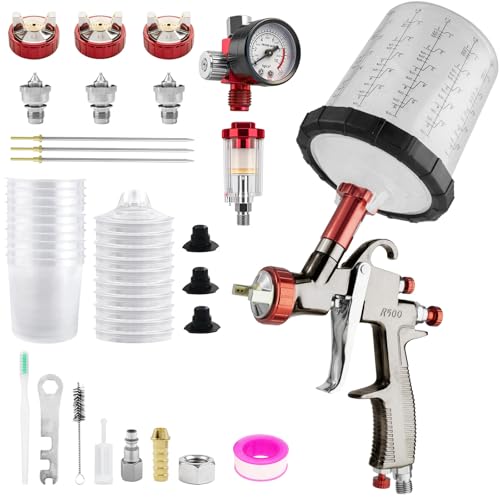
RRJ R500 LVLP Spray Gun 1.3/1.5/1.7mm

Wagner Control Spray QX2 HVLP Stain Sprayer

Wagner FLEXiO 570 HVLP Paint & Stain Sprayer
The Details Behind The Selections
The Control Pro 130 is a stationary airless sprayer, meaning it pressurizes paint directly without needing an air compressor. HEA (High Efficiency Airless) technology aims to soften the spray pattern and reduce the fine mist that drifts onto trim and ceilings. For most homeowners repainting a living room or a full exterior, that lower overspray means noticeably less masking time.
Setup is straightforward: prime the intake, dial in pressure, and you’re coating. It handles unthinned latex and stain straight from the can, which removes a frustrating extra step that handheld HVLP units often require. You may find the hose and base unit heavier than the portable picks below, so plan a spot near an outlet.
Positive Points
- Airless design sprays unthinned paint, cutting prep time on interior walls
- HEA nozzle reduces bounce-back and airborne mist, so masking stays lighter
- Stationary base keeps consistent pressure for long runs across big rooms
- Stain and paint compatible, useful for exterior siding and fences
- Faster coverage than a roller on smooth drywall in our view
Things To Consider
- Bulkier than handheld HVLP options, which matters for tight closets or single rooms
- Cleanup of the intake line takes longer than a handheld cup system
Feature Snapshot
Made For
Homeowners repainting entire rooms or full exteriors in a single weekend with minimal masking patience.
Consider Something Else When
Pick the Wagner FLEXiO 570 if you need a portable handheld for one accent wall and a small fence in the same week.
The VAVCURAA is a handheld HVLP-style sprayer, where HVLP stands for High Volume Low Pressure, a method that uses a strong airflow at reduced pressure to atomize paint into a soft, controllable fan. The 1000W motor is the heart of the unit, sized for small to medium wall sections rather than whole-house exteriors. The bright green body makes it easy to spot in a crowded garage.
This is the kind of tool a first-time DIYer can pull out of the box, load with thinned latex, and start spraying a bedroom within minutes. It’s a solid match for refresh projects, not heavy production. Owners commonly find the included viscosity cup helpful for getting paint thin enough to spray without clogging.
Features That Help
- Compact handheld form, easier on stairs and ladders than airless bases
- 1000W motor provides enough airflow for smooth wall coverage
- Adjustable flow knob lets you dial output for trim versus broad walls
- Quick-detach cup simplifies color changes between rooms
Worth Noting
- Latex paint typically needs thinning, which adds a step before spraying
- Smaller reservoir means more frequent refills on large walls
- Pattern consistency can vary depending on paint thickness, depending on your mix
Right Fit For
First-time DIYers refreshing a single bedroom, small office, or piece of furniture over a weekend.
Look Elsewhere When
Reach for the Wagner Control Pro 130 if your project spans multiple rooms and you want to skip thinning paint entirely.
The R500 is an LVLP gun, which stands for Low Volume Low Pressure, a system that atomizes paint using less compressed air than traditional guns, making it easier to control on smaller projects. This particular kit ships with four nozzle sizes (1.3, 1.5, 1.7, and 2.0mm), a 600ml reusable cup, a stack of 650ml disposable cups, and an inline air regulator. The included regulator is the real value add, since it lets you tune atomization without walking back to the compressor.
You will need a compressor that can deliver 3.0 to 3.9 CFM (cubic feet per minute, a measure of how much air the compressor can push out) at working pressure, which most homeowner units in the 6-gallon range handle. It’s a comfortable fit for furniture, cabinets, doors, and trim work where roller marks would show.
The Practical Payoff
- Four nozzle sizes cover everything from fine detail to broad walls
- Inline regulator means fewer trips back to the compressor tank
- Disposable cup liners reduce solvent use during color swaps
- Forged aluminum body holds up to repeated disassembly for cleaning
Trade Offs
- Requires a separate air compressor, which adds cost and storage space
- Not a plug-and-play choice for first-time sprayers, setup takes patience
- Hose and gun balance takes practice on long wall runs
Quick Facts
Best Suited To
Homeowners who already own a compressor and want pro-style control for cabinets, furniture, or trim.
Swap It Out When
Choose the VAVCURAA handheld instead if you don’t have a compressor and only need to spray one room.
This RRJ R500 configuration leans hard into versatility. The same four-nozzle kit covers primers, base coats, varnish, and top coat, and the bundled air regulator with gauge lets you fine-tune pressure on the fly. Working pressure lands between roughly 28.8 and 51 PSI, well below the 100 PSI ceiling where spray quality starts to suffer.
The Teflon-coated aluminum body shrugs off the solvents used in lacquer and varnish, which shortens cleanup time. One-piece forged construction also tends to resist the stress fractures that show up on cheaper cast bodies. It’s a thoughtful match for someone who finishes furniture, paints interior doors, and tackles fences in the same season.
Points In Its Favor
- Nozzle range handles primers through top coats without buying extras
- Teflon-coated body simplifies cleanup after solvent-based finishes
- Stainless-steel fluid passages support long-term corrosion resistance
- Reported paint transfer efficiency above 65%, meaning less wasted material
Room For Improvement
- Requires learning to read PSI on the gauge, which can slow first-time users
- No disposable cup liners in this kit, so washing the 600ml cup is on you
Who Should Grab It
Multi-surface DIYers who switch between latex walls, solvent stains, and varnish finishes on the same compressor.
A Better Fit Elsewhere
Pick the RRJ R500 kit with disposable cups if you change colors often and want to skip the cup-washing step.
This R500 bundle swaps the 1.5mm nozzle for a different trio (1.3, 1.7, and 2.0mm) and stacks in a 650ml mixing cup plus ten disposable liners. For someone mixing small custom batches or switching between stain and paint, disposable liners cut the rinse cycle to nearly zero. You mix, spray, peel, and toss.
The gun itself uses low pressure in the 2.0 to 3.5 bar range, which minimizes overspray and helps in a tight garage. The nickel-plated stainless internals are built for solvent exposure, and the quick-disassembly design tends to make end-of-day cleaning much faster. It’s a satisfying pick when your project list is a series of short, varied tasks rather than one massive job.
Standout Benefits
- Ten disposable cup liners speed up color changes during batch work
- Low-pressure operation keeps mist contained in smaller workspaces
- Quick-disassembly design shortens solvent cleanup time
- Forged aluminum body holds up to repeated handling and cleaning
Points To Keep In Mind
- Disposable liners add a small recurring cost per project
- Still requires a compressor capable of 3.0 CFM or more
At A Glance
Who It Suits Best
Weekend finishers who rotate through stains, paints, and varnish on furniture and small wall projects.
Another Choice May Suit
Pick the Wagner FLEXiO 570 instead if you want a plug-in handheld with no compressor to manage.
The third RRJ configuration in this list narrows the nozzle spread to 1.3, 1.5, and 1.7mm, all fine-orifice choices that favor atomization quality over raw output. For craft projects, model finishing, and detailed cabinet work, that smaller range produces tighter spray patterns with less halo around the work.
You still get the 650ml mixing cup and ten disposable liners, so swapping between clear coats and color coats stays fast. Owners commonly report the quick-disassembly design is the deciding factor for hobbyists who clean the gun after every session.
Strong Points
- Tighter nozzle range tuned for detail and finish work
- Disposable liners reduce solvent waste during color changes
- Low CFM draw pairs well with smaller workshop compressors
- Teflon-coated body holds up to repeated lacquer and varnish use
Honest Caveats
- Smaller orifices struggle with thick latex wall paint without thinning
- Not the right tool for broad wall coverage on whole rooms
Whose Shelf It Belongs On
Craft and hobby finishers working on small furniture, models, and detailed trim who value atomization precision over volume.
Reach For A Different Pick When
Choose the RRJ R500 with the 2.0mm nozzle instead for fence and exterior wall work where flow matters more than detail.
The QX2 is purpose-built for stain, which means thinner finishes and a handheld HVLP design. Three spray patterns (horizontal, vertical, and detail) cover the typical motions needed for fence pickets, deck boards, and lattice. A handheld tool this light makes long outdoor sessions far less tiring than wrestling an airless base around the yard.
It is a reasonable match for exterior staining projects and indoor furniture refinishing, but it is not designed for thick latex wall paint. You may find that detail pattern especially useful on spindles and decorative woodwork where a wide fan would waste material.
Real-World Strengths
- Three spray patterns handle fence rails, deck boards, and detail spindles
- Lightweight handheld form reduces fatigue during long outdoor sessions
- Variable flow control adapts to different stain viscosities
- Setup is quick enough to start and stop across weekend segments
Potential Drawbacks
- Not suited for thick latex wall paint, stain and sealer territory only
- Smaller cup capacity than the FLEXiO 570, more refills on big decks
Built With In Mind
Homeowners staining decks, fences, and outdoor furniture who want handheld portability over production volume.
Where A Sibling Pick Shines
Pick the Wagner FLEXiO 570 when you need to handle both stain outdoors and latex paint on interior walls with one tool.
The FLEXiO 570 sits in the middle of Wagner’s handheld HVLP line, and the iSpray nozzle is the headliner. It widens the pattern and increases flow compared to a standard detail nozzle, so you can cover broad surfaces like siding, garage walls, and ceilings without spending all day. The separate detail nozzle handles the small stuff when you switch tasks.
For someone who needs one tool to handle both an interior accent wall and an outdoor staining project in the same week, this is the most flexible pick on the list. Cleanup involves a few removable parts and a bucket of warm soapy water, which is a noticeable time-saver compared to an airless intake line.
Everyday Wins
- iSpray nozzle widens the pattern for fast coverage on broad walls
- Interchangeable nozzles switch between broad and detail work
- Sprays most unthinned paints, removing a prep step for many wall jobs
- User-tunable airflow and material knobs support steady control
Some Limits To Know
- Handheld weight can wear you out on long ceiling runs
- Cup capacity is smaller than a stationary airless system
Feature Card
Who Will Love This
All-around DIYers who want one handheld tool that handles interior wall paint one day and exterior stain the next.
Not Your Match When
Choose the Wagner Control Pro 130 if you need a stationary system for an entire house exterior in one continuous push.
What To Weigh Before Choosing A Wall Paint Sprayer
Match The Sprayer Type To The Project
Airless systems like the Control Pro 130 push unthinned paint at high pressure, which is fast on big walls but creates more overspray. HVLP handhelds like the FLEXiO 570 or the QX2 use high-volume air at lower pressure for finer control, which suits thinner finishes and detail work. LVLP guns like the RRJ R500 need a compressor but give the most precise atomization for furniture and trim. For a single interior room, a handheld HVLP is often enough. For a whole-house repaint, an airless base pays for itself in time saved.
Nozzle Size And Paint Viscosity Matter
Nozzle orifice (the size of the spray tip opening) controls how much paint leaves the gun per pass. Smaller orifices (1.0 to 1.5mm) atomize thin stains and clears with minimal waste. Larger orifices (1.7 to 2.0mm and up) push thicker latex and primer. Paint viscosity, meaning how thick or thin the liquid is, also plays a role, and thicker paint may need thinning or a bigger nozzle to avoid clogging. Always check the sprayer’s recommended tip size against the paint type on the can.
Air Supply And Power Requirements
Compressor-fed LVLP guns need a unit that can sustain 3.0 to 3.9 CFM, which most 6-gallon pancake compressors handle for short bursts but not for marathon sessions. Electric handheld sprayers only need a standard outlet, which makes them easier to set up on a porch or in a room without nearby power. Match the tool’s appetite to what your shop or job site can provide.
Portability Versus Coverage Speed
Handhelds win on stairs, ladders, and tight closets, but they slow down on wide-open walls. Stationary airless units cover broad surfaces faster, yet you drag a hose around and need a place to set the base. If your project list mixes small touch-ups and full-room work, a hybrid handheld like the FLEXiO 570 strikes a useful middle ground.
Key Considerations Across These Picks
Pitfalls Shoppers Hit
A common slip is choosing a sprayer with an orifice too small for the paint being used, which leads to clogging and frustration within minutes. Another mistake is skipping the viscosity check, which determines how runny the paint needs to be to flow through the gun, and ending up with orange peel texture (a bumpy, uneven finish resembling citrus skin) on the wall. Spraying in poor ventilation or without proper masking also creates cleanup headaches that can double the project time.
When Paying More Pays Off
Higher-tier models like the Wagner Control Pro 130 cost more because they include pressure controls, durable seals, and HEA nozzles that reduce overspray. The upgrade is worth it when you paint multiple large rooms or tackle exterior siding, where time saved on masking and extra coats adds up. For one small bedroom refresh, a budget handheld delivers comparable results without the extra spend.
Frequently Asked Questions
Can a handheld paint sprayer handle interior walls?
Yes, handheld HVLP sprayers like the Wagner FLEXiO 570 and the VAVCURAA 1000W can coat interior walls evenly when the paint is thinned to the right viscosity. The trade-off is speed, since handhelds cover less area per minute than stationary airless systems.
What is the difference between HVLP and airless paint sprayers?
HVLP (High Volume Low Pressure) uses a strong airflow at lower pressure to atomize paint, producing a softer spray with less overspray, which suits thinner finishes and detail work. Airless sprayers pressurize paint directly without air, which moves more material faster but creates more bounce-back on interior walls.
Do LVLP spray guns need an air compressor?
Yes, LVLP (Low Volume Low Pressure) guns require an external compressor that can deliver the specified CFM at working pressure. Most homeowner compressors in the 6-gallon range can handle short sessions, but for marathon spraying you may want a larger tank.
How do I prevent orange peel texture when spraying walls?
Orange peel happens when paint is too thick, the gun is too close, or air pressure is set too low. Thin paint to the recommended viscosity, hold the gun 6 to 10 inches from the wall, and adjust pressure until the spray pattern is a smooth oval.
Can I spray latex wall paint without thinning it?
Some sprayers, particularly airless systems like the Wagner Control Pro 130, are designed for unthinned latex. Most HVLP and LVLP guns require thinning to avoid clogging, so always check the manufacturer’s guidance for the specific paint and tool combination.




