A benchtop drilling setup pays for itself the first time you need a clean, perpendicular hole in a board, a blank, or a small metal plate. Freehand drilling drifts, handheld rotary tools tire your hand, and a floor-standing press hogs space most home workshops don’t have. A good table drill press gives you repeatable accuracy, controlled speed, and a real work surface without taking over the room.
This list covers nine options across the spectrum: full drill press machines sized for small shops, mini presses aimed at jewelry and craft work, and the supporting gear (tables, vises, jaw pads) that turns a basic press into a precision station. Whether you’re drilling printed circuit boards, doweling cabinet face frames, or reaming pen blanks, one of these belongs on your bench.
A Fast Comparison Of The Options

Woodpeckers Drill Press Table Package, Kit 3
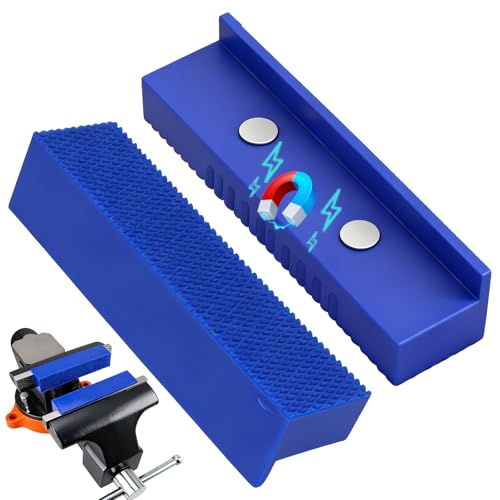
SEDY 2-Piece 4.5″ Magnetic Vise Jaw Pads

IOENC Portable Jewelry Drill Press 340W
Bonvoisin Mini Benchtop Drill Press 1200W

SEDY Heavy Duty Bench Vise 4.5 Inch
VEVOR 10-Inch Benchtop Drill Press 600W

JET 12-Inch Variable-Speed Drill Press with WEN Table

PROXXON Table Drill No. 28128

SEDY 6-Inch Bench Vise with Jaw Pads
Taking A Closer Look At The Options
If your drill press came with a thin factory table and you’re tired of clamping fences to bare metal, this kit is the upgrade that finally feels intentional. The 16 by 23 inch surface sits on a stable MDF (medium-density fiberboard) core, laminated on both sides with a micro-dot texture that gently grips workpieces so they don’t skate when the bit breaks through.
Two anodized (a hard-coat finish that resists wear) T-tracks run across the top, giving you mounting points for the included 36 inch fence, six stainless flip stops, and two knuckle clamps. The measurement scales are laser engraved, so they don’t rub off after a season of shavings. It’s sized for presses 12 inches and larger, so smaller benchtop units won’t have the swing room to use it well.
The Upside
- Micro-dot laminate reduces skate, especially on small or polished parts.
- Anodized T-tracks resist galling and keep their markings over time.
- Six flip stops support repeatable production runs without re-measuring.
- Fence clamps rigidly enough for accurate, repeatable edge work.
- 16 by 23 inch work area handles cabinet doors and longer boards.
Things To Consider
- Not a fit for presses with a swing under 12 inches, so measure first.
- The MDF core, while stable, dislikes standing water; wipe spills quickly.
Feature Snapshot
Whose Bench It Belongs On
Woodworkers running mid-size benchtop presses who want cabinet-grade accuracy and repeatable setups.
Look Elsewhere When
The VEVOR 10-Inch Benchtop Drill Press is the better starting point if you don’t yet own a press and need the machine itself.
You don’t need a new vise, you need to stop crushing the finishes on the parts you already clamp. These TPU (thermoplastic polyurethane, a flexible rubber-like material) pads stick to your steel jaws with built-in magnets and stay put while you work. The waffle texture on the face increases grip on round tubing, hex bar, and odd-shaped castings without biting into soft metals or finished wood.
They cover 4.5 inch jaws, which is the size on most small to mid-range bench vises. If you routinely swap between raw stock and pre-finished parts, leaving one set on the vise means you never scrape a coat of paint or anodizing again.
Everyday Advantages
- TPU protects polished, painted, or anodized surfaces from vise marks.
- Waffle face holds round and hex stock more securely than smooth rubber.
- Magnetic attachment means no adhesive residue and quick swaps between jobs.
- Soft pads damp vibration during drilling, helping bit accuracy on small parts.
Worth Noting
- Only fits 4.5 inch jaws, so larger shop vises need bigger pads.
- Magnets can attract steel filings; a quick brush-off between uses keeps the surface clean.
Right Fit For
Makers who finish parts before drilling or assembly and want to protect those surfaces from clamp damage.
Skip It When
The SEDY 6-Inch Bench Vise is the better call if you need the vise itself rather than accessories for an existing one.
A floor-standing press is overkill when you’re drilling holes in sheet metal charms or hardwood pen blanks, and a hand rotary tool tires your wrist. The IOENC sits in the middle: a true benchtop press with a 340W motor and a speed range that climbs to 16,000 RPM, which is the territory where small-diameter bits actually cut clean holes instead of skating.
The collet (a precision sleeve that grips round-shank tools by tightening around them) takes bits from roughly 0.04 to 0.39 inches, so it covers everything from tiny jewelry drills to the small Forstner bits you’d use on a craft box lid. It’s compact enough to live on a craft table and quiet enough for a shared workspace.
Strengths Worth Knowing
- Speed tops out where small bits perform best, no more burned holes.
- Wide collet range covers jewelry, model-making, and small wood craft.
- Benchtop footprint fits where a full press simply won’t.
- 340W motor handles brief metal work without bogging down.
Points To Note
- Not built for thick steel or large-diameter hole saws.
- Drill bits are not included, so plan a starter bit set on the side.
Best Suited To
Jewelry makers, modelers, and hobbyists drilling small parts in metal, wood, and plastic.
Consider Something Else When
The PROXXON Table Drill No. 28128 suits you better if you want a quieter, more refined European-built bench press for fine work.
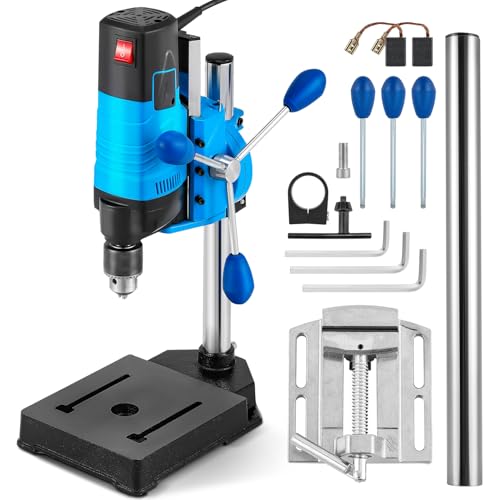
What makes the Bonvoisin stand out is the swiveling head. Instead of just dropping a bit straight down, you can rotate the entire drilling head 90 degrees and use the unit as a horizontal grinder or sander. Six speed settings up to 2800 RPM (revolutions per minute, the speed at which the spindle turns) give you room to slow down for larger bits in hardwood or speed up for sanding drums.
Three extended cranks (the long handles you turn to feed the spindle down) make a real difference when you’re cranking through a stack of boards; you get more leverage with less hand travel. For a small shop where one tool has to cover drilling, grinding, and detail sanding, this flexibility is genuinely useful.
The Helpful Details
- 90 degree head rotation adds grinding and sanding without a second tool.
- Six speed steps cover wood, soft metal, and finishing accessories.
- 1200W motor handles sustained use without thermal cutoffs in most projects.
- Three extended cranks reduce fatigue on repetitive work.
Honest Caveats
- Top speed of 2800 RPM is low for small jewelry bits.
- Switching between drill and grind mode takes a deliberate re-setup.
Feature Rundown
Who It Suits Best
Small-shop hobbyists who want one bench unit to handle drilling, light grinding, and detail sanding.
A Better Fit Elsewhere
The VEVOR 10-Inch Benchtop Drill Press is the smarter pick if you mostly need straight-down drilling and want a tilting worktable plus laser guide.
Any drill press gets better when paired with a real vise underneath it, and this 4.5 inch unit earns its bench space. The body is gray iron (a dense, vibration-damping cast metal used in machine tools), so the mass keeps the vise from walking when you lean into a cut. A multi-jaw design (different jaw faces that handle flat, round, and pipe stock) means you can clamp a board, a dowel, or a length of copper without swapping fixtures.
The slide-and-cross adjustment lets you reposition the jaw along the ways (the machined rails the jaw rides on) so longer workpieces sit centered without crowding the column. Owners commonly mount it directly to a drill press table or a dedicated workbench station near the press.
The Case For It
- Gray iron body resists walking during heavy cuts.
- Multi-jaw setup handles flat boards, round stock, and pipe.
- Sliding jaw adjusts along the ways for centered clamping of longer parts.
- Compact 4.5 inch footprint fits smaller benches and press tables.
Small Caveats
- Not ideal for very large pipe diameters or oversized assemblies.
Made For
Woodworkers and metalworkers who need a sturdy clamp station beside the drill press for repeatable part holding.
Not Your Match When
The SEDY 6-Inch Bench Vise with Jaw Pads makes more sense if you regularly work with thicker stock that needs higher clamping force.
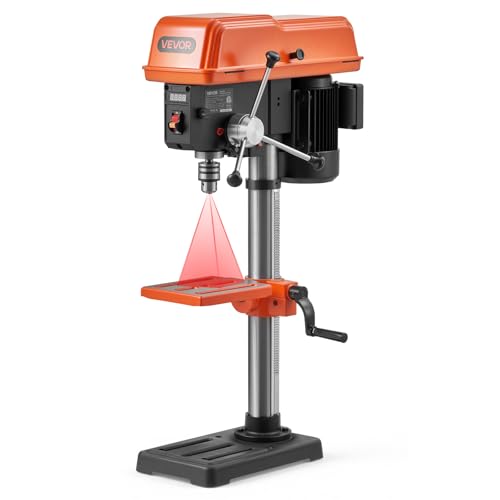
The VEVOR is a sensible starter press for someone setting up a first bench. A 0.8 HP motor drives speeds from 530 to 3140 RPM, and the worktable tilts up to 45 degrees for angled holes, a feature you usually don’t see at this size. A laser crosses the workpiece to show where the bit will land, and an LED light ring brightens the cut zone, so you spend less time squinting under a desk lamp.
With a 10 inch swing (the largest diameter of workpiece that fits between the column and the spindle center), it covers the kind of projects a home woodworker or hobbyist machinist actually runs: cabinet parts, small jigs, light metal brackets, and the occasional aluminum plate.
Reasons It Performs
- Variable speed plus digital readout means you match RPM to bit and material quickly.
- Laser guide lines up holes without test scribing.
- LED work light improves visibility on dark or small parts.
- Tilting table handles angled holes for furniture joinery or prototyping.
Points To Keep In Mind
- 10 inch swing limits very large workpieces.
- Laser alignment is a guide, not a substitute for measuring critical holes.
Quick Facts
Perfect Match For
First-time press shoppers building a hobby station for woodworking, light metalwork, and DIY home projects.
Swap It Out When
The JET 12-Inch Variable-Speed Drill Press with WEN Table earns its place if you need more swing capacity and a larger table for serious production work.
This bundle pairs a serious drill press with a serious table, and the combination is the point. The JET JWDP-12 runs on a 1/2 HP induction motor (an induction motor uses electromagnetic fields rather than brushes to drive the spindle, so it runs cooler and lasts longer) and offers more than 3 inches of spindle travel, which matters when you need to drill through thick hardwood or stacked layers without pecking (lifting the bit to clear chips and cool down). The cast iron base and oversized ergonomic knobs are the kind of details that show up after a year of daily use, not just on the first day.
The bundled WEN table is 24 by 12 inches, with an adjustable fence and a stop block. Compared to the Woodpeckers Kit 3 earlier in this list, the WEN table is bigger and simpler: fewer flip stops, but more raw surface for long boards. The X-shaped XACTA laser lines up the cut quickly.
Strong Points
- 1/2 HP induction motor handles hardwood and metal with consistent torque.
- Over 3 inches of spindle travel reduces peck drilling on thick stock.
- Cast iron base and oversized knobs make adjustments positive and repeatable.
- 24 inch WEN table expands the work surface far beyond the factory press table.
Less Ideal Details
- Heavier than most benchtop units, so plan where it will live before unboxing.
- Premium pricing, so weigh whether you’ll use the extra swing and travel.
Feature Card
Who Should Grab It
Serious hobbyists and small-shop owners who want cast-iron rigidity and a larger table from day one.
Reach For A Different Pick When
The VEVOR 10-Inch Benchtop Drill Press is the better fit if your projects stay small and your budget is the priority.
PROXXON has built a quiet reputation among scale modelers and electronics hobbyists, and the 28128 is the bench press that reputation rests on. The work table is die-cast aluminum (aluminum poured into a mold under pressure, producing a dense, dimensionally stable surface) and plane-milled flat, which matters when you’re drilling printed circuit boards or brass parts where a 0.1 mm error shows. A solid 20 mm steel column keeps the head from deflecting, even when you lean into a small bit.
The motor is VDE-rated (a European electrical safety standard) and notably quiet for a bench press. Speed changes happen via a triple-pulley flat belt system (a flat rubber belt running between different-sized grooved wheels to step the speed up or down), which feels old-school but lets you drop to a much lower RPM than most electronic variable-speed competitors. If you’ve ever burned a tiny drill bit by spinning it too fast, you already know why that matters.
Positive Points
- Die-cast aluminum table is precision-milled for true flatness.
- Triple-pulley speed system reaches low RPMs that protect small bits.
- Solid steel column minimizes head deflection under pressure.
- Quiet induction motor suits apartments and shared workspaces.
Practical Considerations
- Compact capacity, so not the right tool for cabinet-scale work.
- Belts need periodic re-tensioning, which is normal for this design.
Who Will Love This
Model railroaders, electronics hobbyists, and small-parts craftspeople who need precision and low-RPM control over raw power.
Where Another Pick Suits Better
The IOENC Portable Jewelry Drill Press is the better value if you want similar small-bits capability at a friendlier cost.
When your bench needs real clamping muscle, this 6 inch vise delivers up to 4500 pounds of force from a 60,000 PSI ductile iron body. Ductile iron (an alloyed cast iron that flexes slightly before breaking rather than shattering) handles the shock of repeated heavy clamping better than gray iron, especially around the anvil where you tap parts flat. The 360 degree swivel base with twin locking handles makes it easy to swing the jaw out of the way when you’re working on a different part of the bench.
Jaw pads come included, so on day one you’re already protecting finished surfaces. The wider 6 inch jaw opening also gives you room for thicker stock and pipe, things the smaller SEDY 4.5 inch vise earlier in this list can’t reach.
The Practical Payoff
- 4500 lb clamping force handles larger workpieces without slipping.
- Ductile iron body absorbs impact from heavy use.
- Swivel base with dual locks keeps the jaw solidly where you set it.
- Included jaw pads protect finished surfaces from day one.
Things To Weigh
- Larger footprint than a 4.5 inch vise, so it demands a real bench.
- Mass and clamping force may be overkill for light craft or jewelry work.
Quick Technical Notes
Built With In Mind
Shop owners and serious woodworkers clamping heavy stock, pipe, and assemblies on a real workbench.
Another Choice May Suit
The SEDY Heavy Duty 4.5 Inch Bench Vise is the better match for smaller benches and lighter hobby work.
Choosing The Right Table Drill Press For Your Bench
A table drill press is more than a motor and a column; it’s a system of swing, speed, and holding that has to match what you actually build. Swing (the distance from the column to the spindle center, doubled to give the largest workpiece the press can handle) is the first filter. Measure your largest common workpiece, double it, and any press with a swing at or above that number will clear it without awkward repositioning. Speed range is the next filter, because bits and materials have very different comfort zones. A 16,000 RPM ceiling lets small jewelry drills cut clean, while a 530 RPM low end lets big Forstner bits chew through hardwood without burning. Look for a press that covers the low end of your most common work, not just the high end.
Worktable and fence quality matter more than people expect. A flat, sizable table with T-tracks (extruded aluminum channels with a T-shaped slot for clamping hardware) lets you build real jigs instead of clamping a ruler to the factory plate. Tilting tables handle angled holes without a custom fixture. For the drill press table upgrades like the Woodpeckers Kit 3 or the WEN DPA2412T, you’ll see immediate accuracy gains on repeat cuts. Vises and jaw pads are the other half of accuracy. A vise that doesn’t walk under load and pads that don’t mar finishes turn a drill press from “good enough” into “trusted.”
Finally, think about power, weight, and noise. Induction motors (found in JET and PROXXON) last longer and run quieter than brush motors (which use carbon blocks that physically contact the spinning commutator and wear out over time), but weigh more. Variable-speed electronic drives are convenient; belt-driven speed changes are lower at the bottom end and quieter overall. Match these to your bench, your neighbors, and your tolerance for tool maintenance.
Picking Smarter Across These Options
Common Buying Slip Ups
The most common mistake is buying a press sized to the project you have today instead of the one you’ll have in a year. Hobbyists who start with jewelry usually expand into small woodworking, and woodworkers who start with face frames eventually want to drill metal brackets. A press with modest extra swing and a wider speed range is easier to grow into than a perfectly tuned tool you outgrow in three months. Another slip is treating the factory table as a permanent surface. Most stock tables are undersized and lack real fixturing points; budgeting for a real drill press table or a clamp-and-fence setup multiplies the value of whatever press you choose. Finally, don’t skip the vise. A press without solid workholding is only half a tool, and the cheap vises drift under load, which makes even a great press look inaccurate.
What The Higher Tier Buys
The jump from a budget bench press to a premium one is mostly about mass, motor quality, and table real estate. Cast iron bases and thicker columns damp vibration, so holes come out rounder and bits last longer. Induction motors run cooler and survive years of daily use where brush motors may need service. A larger, more rigid table with proper T-tracks lets you mount fences and stops solidly, which is what actually drives repeatable accuracy. You pay more, but in return the press stays in spec longer, sounds calmer in the workshop, and turns into the tool you reach for instead of the one you work around.