


A table saw only cuts as true as the setup around it. Woodworkers chasing tighter joints and cleaner edges eventually land on the same realization: blade height, fence position, and miter angles all need a reliable reference. A dedicated table saw alignment gauge takes the guesswork out of those adjustments and replaces trial-and-error cuts with repeatable measurements. The picks below cover the common alignment jobs in a home shop, from dial-in setup blocks to extendable miter gauges and a safety-focused push block. Read the breakdowns, match them to your workflow, and your next project will thank you for the straight, square cuts.
The Lineup, Simplified

GOINGMAKE Table Saw Miter Gauge with Long Extensible Fence
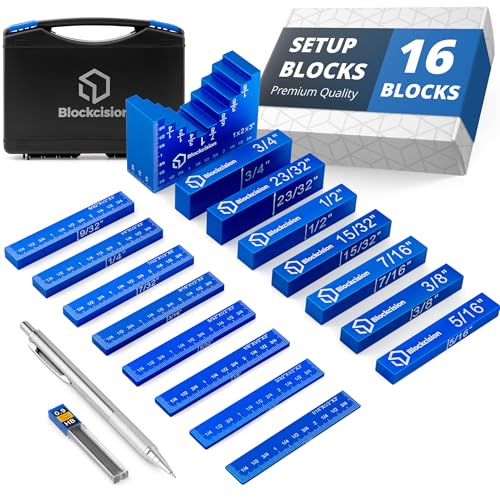
ELEON Blockcision Setup Blocks Woodworking Tools 16 PCS

POWERTEC Router Setup Blocks & Table Saw Gauge 7PC Set

Milescraft 3406 GrabberPRO Push Block

Dreyoo Table Saw Height Gauge, Aluminum, Blue

SIIIXS 14-Piece Precision Router Table Setup Blocks

KAGYIFLY 7-Piece Aluminum Setup Blocks Height Gauge Set

GOINGMAKE Table Saw Miter Gauge with Micro Adjust Flip Stop

BOSCH TS1007 Table Saw Dado Cutter Insert
Inside Each Recommended Option
Wide panels and long trim pieces push standard miter gauges past their comfort zone, and that is the gap this GOINGMAKE gauge fills. The aluminum fence telescopes from 21 to 38 inches, so you can support a full sheet of plywood or a long stair tread without improvising a straightedge. It fits a common 3/8″ by 3/4″ miter slot, and thirteen preset angle holes let you lock in standard miter positions without eyeballing the head.
Compared to the POWERTEC setup blocks covered later, this is a totally different tool: it is a guided cutting jig rather than a height reference. You trade the precision of a stacked gauge block for the ability to make repeated crosscuts at the same length. For a hobby shop building picture frames, decking, or cabinet face frames, the telescoping reach saves more time than it costs.
Benefits That Matter
- Extendable fence reaches up to 38 inches for full-panel crosscuts.
- Micro-adjust flip stop dial-in gives repeatable cut length.
- Thirteen angle stops remove the guesswork from common miter settings.
- Aluminum body stays rigid under load, so long cuts stay square.
Trade-Offs To Weigh
- Longer reach adds weight, which can be cumbersome on a portable jobsite saw.
- Fit is limited to the 3/8″ by 3/4″ slot size used by many contractor and cabinet saws.
Who It Suits Best
Garage-shop woodworkers and remodelers handling wide stock who want one miter gauge for both short trim and full panels.
Look Elsewhere When
You mostly work on a compact benchtop saw and prefer a lighter cartridge-style gauge, where the GOINGMAKE Table Saw Miter Gauge with Micro Adjust Flip Stop is the better match.
Blockcision brings something the plain aluminum blocks from POWERTEC and KAGYIFLY do not: a stepped, ruler-marked edge that doubles as a built-in scale. Each block in the 16-piece set covers a specific height, and the stepped profile means you can read the exact dimension without flipping the block against a tape. The included case keeps the set organized, so a 1/16-inch increment is never missing when you need it.
For a one-tool approach to setting blade height, bit projection, and fence position, the Blockcision set covers jobs that the Dreyoo height gauge handles only one piece of. The wider size range suits both router bits (small increments) and full dado cuts (larger increments) in a single kit.
Notable Upsides
- Sixteen sizes cover a generous spread of heights for router, blade, and fence work.
- Ruler markings on the blocks remove the need for a separate scale during setup.
- Stepped profile reads the value at a glance, even with a busy workpiece in the way.
- Carrying case protects the set and keeps blocks paired with their labeled slot.
Honest Caveats
- More pieces mean more to track; a single dropped block can leave a gap in the ladder.
- Stepped edges add cost and weight over a flat block set of similar size.
Feature Snapshot
Right Fit For
Woodworkers who re-dial their tools between sessions and want labeled, repeatable setup without stacking three or four loose shims.
Consider Something Else When
You mainly need a single, compact height reference for one table saw, in which case the Dreyoo Table Saw Height Gauge is a simpler match.
The POWERTEC 71579 is a familiar sight in hobby shops for good reason. Seven aluminum blocks step from 1/8″ to 1/2″ in 1/16″ increments, which covers most bit and blade heights without forcing you to stack pieces. Each block is labeled, so the right size is at your fingertips instead of buried in a drawer of unmarked shims.
Against the larger 16-piece ELEON set, POWERTEC trades some size resolution for a smaller, cheaper footprint. For hobbyists who only need a half-inch of adjustment range, that is a fine trade. The thinner block count also makes the kit easier to store alongside a router table fence or table saw accessory drawer.
Where It Excels
- Seven labeled blocks cover the most common bit and blade heights.
- Compact set fits in a shop drawer next to push sticks and featherboards.
- Aluminum construction holds its dimensions over years of shop use.
Worth Noting
- Smaller size range than the 14-piece SIIIXS set, so very fine or very tall setups need stacking.
- Plain sides lack a built-in ruler, so a tape or square is still useful for confirmation.
Made For
Beginners and weekend builders who want a reliable, no-fuss height reference for router bits and table saw blades.
Another Choice May Suit
You regularly set bits below 1/8″ or need finer than 1/16″ resolution, where the SIIIXS 14-Piece Precision Router Table Setup Blocks give you more gradations.
The GrabberPRO is technically a safety tool, not a measuring gauge, but it belongs on a list about table saw alignment because the best setup in the world is useless if the workpiece kicks back. The multi-leg design straddles a saw blade, keeping downward, forward, and inward pressure on the stock through the cut zone. That same hand position helps you track the workpiece against the fence for truer, more consistent cuts.
It pairs naturally with the GOINGMAKE miter gauge: the gauge locks the angle while the GrabberPRO keeps the stock pressed against the fence. On a router table, it gives the same control without putting your fingers anywhere near the bit. The trade-off is bulk, since the wide footprint is less comfortable on narrow trim.
Useful Touches
- Adjustable design works across table saws, router tables, band saws, and jointers.
- Multi-leg stance straddles the blade for steady downward pressure.
- Improves cut consistency by keeping stock flush to the fence.
Points To Keep In Mind
- Not a measuring tool, so it works alongside a setup block set rather than replacing one.
- Wide footprint can feel awkward on narrow stock under about three inches wide.
Best Suited To
Anyone using a table saw or router table regularly who wants better hand control and a safer relationship between the workpiece and the fence.
Where A Sibling Pick Shines
You mainly need height measurement and do not cut small or freehand work, where the POWERTEC Router Setup Blocks & Table Saw Gauge 7PC Set is the more focused tool.
Sometimes a single-purpose tool is the right answer. The Dreyoo height gauge is a single aluminum bar with a clear, easy-to-read scale, designed to set the blade height on a table saw quickly. Two reading ranges are noted in the specs, 1/8″ to 2″ and 1/4″ to 2″, which is more than enough for through cuts, dados, and shallow rabbets. The blue anodized finish stands out on a busy bench.
Stacked block sets like the POWERTEC or ELEON kits can do the same job, but a one-piece gauge is faster to grab, faster to read, and impossible to mis-sort. It trades the resolution of a multi-block ladder for a cleaner, more compact footprint on a small bench or jobsite cart.
Practical Advantages
- Single-piece aluminum gauge reads height at a glance without stacking.
- Range covers typical blade heights for through cuts and shallow dados.
- Compact enough to keep in a small shop drawer or apron pocket.
Small Caveats
- Single fixed range, so very tall or unusually shallow setups fall outside the scale.
- Reads blade height only, not bit projection or fence offsets, which the ELEON Blockcision set covers.
Key Product Details
Who Should Grab It
Shop owners who set the same blade height for a series of cuts and want a fast, dedicated tool instead of a multi-block kit.
Skip It When
You work on a router table or need to set fence offsets as well as blade height, where the KAGYIFLY 7-Piece Aluminum Setup Blocks fit the broader job.
When finer increments matter, more pieces earn their keep. The SIIIXS set spans fourteen sizes from 1/16″ up to 3/4″, with steps like 5/32″ and 7/32″ filling the gaps that the seven-piece POWERTEC kit skips. For decorative bits that ride low, or for dados that need a precise depth, those intermediate steps save you from stacking two blocks and gambling on combined accuracy.
The 14 sizes also work as a square-stacking gauge for fence offsets and a depth reference for through cuts. The noted tolerance is tight enough for joinery work, assuming a clean, burr-free edge on the block. Compared to the KAGYIFLY aluminum set, the SIIIXS range is broader, so the case costs a bit more bench space.
A Strong Showing
- Fourteen sizes include uncommon increments that seven-piece kits skip.
- Functions as a height, depth, and stacking gauge for fence offsets.
- Tight stated tolerance supports joinery-level precision.
A Few Limitations
- Larger set needs more storage space than a single Dreyoo height gauge.
- Plain aluminum sides can mark up over time, so a wiping routine helps with long-term accuracy.
Perfect Match For
Detail-oriented woodworkers setting small bits, decorative profiles, or precise dado depths who want finer height resolution than a starter set offers.
Reach For A Different Pick When
You only need a single daily blade height and want minimal bench clutter, in which case the Dreyoo Table Saw Height Gauge is the cleaner choice.
Stack-friendly design is the calling card of this KAGYIFLY set. Each block has identical thickness, height, and depth proportions, so two or three stacked together stay square and square-stacked, which is exactly what you want when building a non-standard fence offset. Aluminum keeps the weight low and the dimensions stable across shop temperature swings.
Seven pieces is fewer than the SIIIXS 14-piece set, so you give up some fine increments. For most router table work, though, seven sizes cover the common range, and the smaller set costs less bench space. It also doubles as a depth gauge and an angle reference, giving it more roles than a single-purpose height bar.
A Few Strong Suits
- Uniform block dimensions keep stacks square for non-standard setups.
- Lightweight aluminum is easy to carry to a jobsite or shared shop.
- Pulls double duty as a height, depth, and stacking gauge.
Trade-Offs To Consider
- Seven pieces offer less fine resolution than the 14-piece SIIIXS set.
- Plain labels can wear off in a busy shop, so handle with care during daily use.
Whose Shelf It Belongs On
Mobile woodworkers and router-table owners who want a light, stackable gauge they can grab for unusual offsets without hauling a full kit.
Swap It Out When
Your projects demand fine increments or stepped dado work, in which case the SIIIXS 14-Piece Precision Router Table Setup Blocks give you the resolution you need.
The shorter sibling of the long-fence GOINGMAKE gauge, this version focuses on fine stop adjustment. The micro-adjustable flip stop is the centerpiece, with a magnifier glass that helps you read fine scale divisions in low shop light. The locked-in stop is solid, so the gauge does not drift between cuts when you set up a batch of identical rails or face frames.
Where the long-fence GOINGMAKE model stretches out for wide crosscuts, this one is the better match at a standard miter saw station or a contractor saw with a single T-slot. It is also a smart upgrade for anyone whose existing miter gauge has a sloppy flip stop that walks a few thousandths of an inch every time it is bumped.
A Few Highlights
- Micro-adjust flip stop with magnifier aids fine length settings.
- Solid lock-up keeps the stop from drifting between repeat cuts.
- Compact profile suits a single-slot miter station better than the long-fence version.
Less-Strong Areas
- Shorter fence reach than the 21″ to 38″ GOINGMAKE model for wide panels.
- Magnifier glass adds a part to clean and protect from shop dust and resin.
Built With In Mind
Trim carpenters and cabinet builders cutting many pieces to the same length who want repeatable, fine-tuned stop settings.
A Better Fit Elsewhere
You regularly crosscut sheet goods or long stair treads, where the GOINGMAKE Table Saw Miter Gauge with Long Extensible Fence offers the reach you need.
The BOSCH TS1007 is a different animal on this list. It is a steel throat plate, not a measuring tool, but it belongs in a discussion of table saw alignment because zero-clearance support around the blade is what makes dado and rabbet cuts clean. The red-finished plate is shaped to fit the Bosch 4000 and 4100 portable table saws, and its opening accepts a stacked dado set or a rabbeting cutter.
Where a setup block set like the POWERTEC or SIIIXS kit measures the cut before you make it, the TS1007 controls the cut as it happens, supporting the workpiece on both sides of the cutter. Together, they form a practical pairing: set the height with a gauge block, then run the cut with the dedicated insert. The trade-off is obvious: it only fits two specific Bosch models.
Real-World Strengths
- Steel construction with a red finish for the Bosch 4000 and 4100 series.
- Shaped to support stock around a stacked dado or rabbeting cutter.
- Improves cut quality by reducing tearout at the edges of the cut.
Soft Spots
- Model-specific fit means it is not useful for owners of other table saw brands.
- Single-purpose insert does not replace a height gauge for setup tasks.
Who Will Love This
Bosch 4000 and 4100 owners who run dado or rabbet cuts and want a factory-fit insert to control tearout around the blade.
Not Your Match When
You own a different table saw or want a measurement tool rather than a cutting accessory, in which case the GOINGMAKE Table Saw Miter Gauge with Micro Adjust Flip Stop is the relevant pick.
What To Weigh Before Choosing a Table Saw Alignment Gauge
A table saw alignment gauge lives or dies on three things: how it sets the cut, how it stays accurate, and how it fits your saw. Start by deciding whether you need a measurement tool or a guided cutting tool. Setup blocks like the POWERTEC, ELEON, SIIIXS, and KAGYIFLY sets measure bit or blade height before the cut. Miter gauges like the two GOINGMAKE options guide the cut itself. A single-purpose insert like the BOSCH TS1007 is its own category, focused on cut support during dado work.
Material matters more than the marketing suggests. Aluminum blocks and bars stay dimensionally stable and resist rust, which matters in a damp basement shop. Look for labeled sizes or stamped values, because etched markings wear off under repeated handling. For miter gauges, fit the bar to your saw’s slot size before anything else, since a sloppy fit is the most common source of cut drift. Resolution is the next decision: hobby work rarely needs more than 1/16″ steps, while joinery benefits from the finer ladders in the 14-piece sets. Finally, balance safety into the kit. The Milescraft GrabberPRO is a useful companion to any gauge here, because cleaner cuts start with a workpiece held firmly against the fence.
Key Considerations Across These Picks
Wrong Turns To Avoid
A common mistake is buying a setup block set without checking the size range against the bits and blades you actually run. A seven-piece set feels economical until you need a 5/32″ step that is not in the ladder, and you end up stacking anyway. Another trap is treating any miter gauge as universal: the GOINGMAKE gauges fit common 3/8″ by 3/4″ slots, but saws with different T-shapes or widths need a different bar. Skip these slips by reading the size range and slot spec before you commit, and you will save a return trip.
The Case For Spending Up
Higher-tier options in this category usually buy two things: finer adjustment and broader compatibility. A magnifier-equipped micro-adjust stop, like the one on the GOINGMAKE Miter Gauge with Micro Adjust Flip Stop, costs more because the stop holds its setting without drifting, which matters when you cut twenty identical rails. Block sets with more pieces and labeled sizes, like the ELEON Blockcision or the SIIIXS 14-piece set, cost more because they cover increments a starter kit skips, and that range pays off the first time you need an uncommon height. For a hobby shop that runs the same cuts weekly, the upgrade tends to earn itself in saved test cuts and tighter joints.
Frequently Asked Questions
What does a table saw alignment gauge actually do?
A table saw alignment gauge provides a known reference for blade height, bit projection, or miter angle, so you can set up cuts without measuring with a tape and squinting at the scale.
Are setup blocks accurate enough for fine joinery?
Stamped aluminum blocks from established kits hold their dimensions well, and the 14-piece SIIIXS set lists a tight tolerance that suits most joinery work when the edges are clean and free of burrs.
Can one tool handle both miter angles and blade height?
Not really. Miter gauges and height gauges cover different jobs, so most shops end up with a miter gauge for angle work and a separate setup block set for height, as the two GOINGMAKE gauges and the block sets illustrate on this list.
How do I know which slot size my table saw uses?
Measure the slot with calipers or check the manual, and confirm the bar size before buying. The GOINGMAKE miter gauges, for example, are built around the common 3/8″ by 3/4″ T-slot found on many contractor and cabinet saws.
Do I need a specialty insert for dado cuts?
A zero-clearance or dado-specific insert like the BOSCH TS1007 is not required, but it supports the workpiece on both sides of the cutter, which noticeably reduces tearout on dados and rabbets.




