


Shooting clean, square cuts on a table saw usually means fighting the blade for control. A well-made sled solves that problem by locking the workpiece against a fence and sliding it past the blade, so your hands stay clear and your measurements actually hold. The lineup below covers stock kits you can buy off the shelf, premium push blocks that pull double duty as a safety system, and bare-bones hardware for hobbyists who’d rather build their own sled. Whatever your shop looks like, there’s something here that fits the way you actually work.
A Closer Look At The Lineup

Milescraft 3406 GrabberPRO Push Block

BOW Products EVA Featherboard

BOW Products FencePRO FP4 T-Track Featherboard (2-Pack)

BOW Products XT XTENDER T-Track Fence (46″)

BOW Products Portable Saw Featherboard FP5
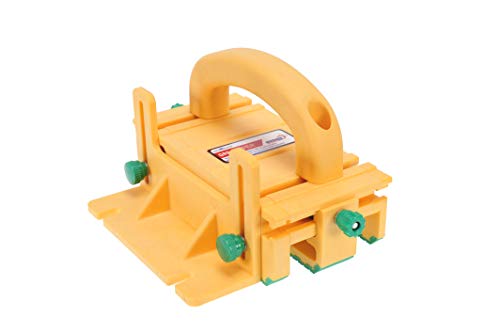
MICROJIG GRR-RIPPER GR-100 3D Pushblock
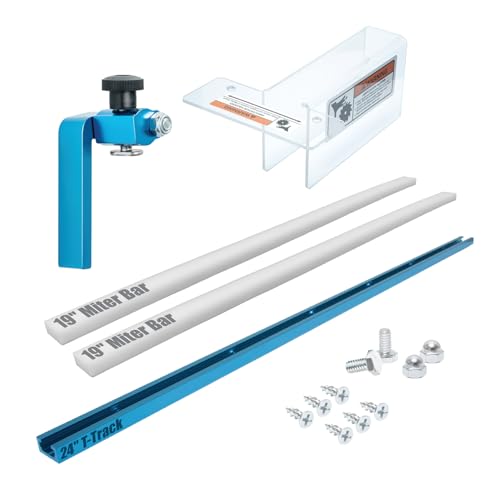
POWERTEC Table Saw Sled Kit (24″ T-Track)
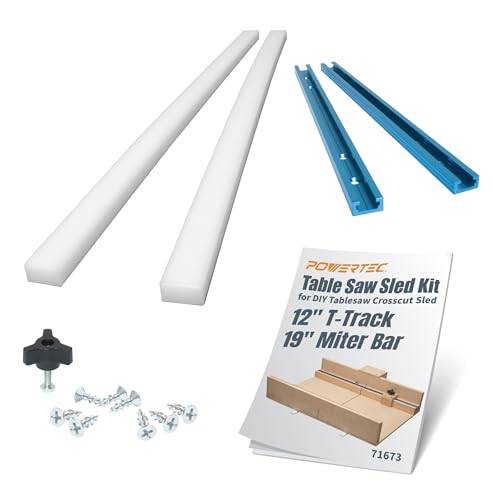
POWERTEC Table Saw Sled Kit (12″ T-Track)

POWERTEC 71395 Taper/Straight Line Jig
What Each Pick Brings To The Table
The Milescraft 3406 GrabberPRO is a push block that earns its keep across more than one machine, which makes it a quiet workhorse in a small shop where every tool has to multitask. Its spread-out leg design lets it straddle the blade while still pressing the workpiece flat, an unusual trick that helps reduce kickback when you’re feeding narrow strips through the saw.
For hobbyists running a table saw, router table, jointer, and bandsaw, owning one block that handles all four means less gear clutter and a faster setup between cuts. It’s not a sled, but pairing it with a basic fence gives similar control for most crosscuts.
The Practical Payoff
- Multi-leg footprint straddles the blade while keeping the workpiece pinned down
- Applies downward, inward, and forward pressure at the same time for steadier cuts
- Works on table saws, router tables, jointers, and bandsaws with no adapter needed
- Reduces the chance of kickback on narrow rips where fingers can’t safely ride the stock
Things To Consider
- Doesn’t replace a sled for perfectly square crosscuts on large panels
- Takes a few cuts to learn the right grip pressure for tricky grain
Who It Suits Best
Anyone running a shared home shop with two or more stationary machines who wants one safety tool to keep on the bench.
Where Another Pick Suits Better
If you’re chasing dead-accurate 90-degree crosscuts on sheet goods, the POWERTEC sled kit is a stronger starting point.
Most featherboards you’ll see in a shop are stiff plastic fingers that dig into the wood. The BOW Products EVA Featherboard flips that script with closed-cell foam fingers, which grip without marring softer stock like pine, cedar, or freshly planed walnut.
On long rip cuts, it presses the workpiece firmly against the fence and absorbs the small vibrations that would otherwise bounce a rigid feather against the wood and leave chatter marks. It mounts to a standard miter gauge or table slot and pulls double duty on router tables too.
What Makes Sense
- Foam fingers resist marring on softwoods and prefinished surfaces
- Dampens vibration that causes chatter on long grain runs
- Higher maximum resistance than typical plastic featherboards
- Swaps between table saw and router table without tools
Trade Offs
- EVA feathers can compress permanently if over-tensioned against thick hardwoods for extended sessions
- Single unit, so you’ll want a second one for tall workpieces
Made For
Finish carpenters and hobbyists who regularly cut softwoods or prefinished stock and want to avoid sanding out feathering marks later.
Skip It When
You already own a BOW FencePRO FP4 setup, since the two are designed to cover overlapping jobs.
Where the standalone EVA featherboard from BOW slides into a miter slot, the FencePRO FP4 is designed to live in the T-track of the matching XTENDER fence. That means it sits above the cut instead of beside it, pressing the workpiece down as much as sideways.
For shops that already run a BOW XTENDER or another T-track style fence, this is the featherboard that lives there permanently. The closed-cell foam gives the same chatter-free grip as the single-unit model, and the two-pack covers tall rips without leaving a gap mid-board.
A Favorable Mix
- Slides directly into T-track fences for tool-free mounting
- Closed-cell EVA absorbs vibration for cleaner rip cuts
- Top-down pressure helps flatten slightly warped stock during the cut
- Two-pack handles tall boards without a second purchase
Room For Improvement
- Requires a T-track style fence to deliver its full value
- Owners commonly replace the foam fingers every few years of heavy use
Right Fit For
Woodworkers who already own a BOW XTENDER fence and want the matched featherboard system without improvising mounts.
Look Elsewhere When
You run a stock steel fence with no T-track. The standalone BOW EVA Featherboard is a better starting point there.
The XT XTENDER is a 46-inch auxiliary fence that bolts onto the existing fence on a portable, contractor, or cabinet saw. It raises the working face by 5 inches, which is enough to keep taller stock from wandering on edge during long rips.
The T-track running along the top accepts the BOW FencePRO featherboards and other sliding fixtures, turning a basic stock fence into a more capable feed system. It’s a sensible upgrade for anyone whose saw came from the factory with a too-short fence face.
Good Reasons To Consider
- 5-inch added face height improves control on tall stock
- Built-in T-track accepts sliding featherboards and stops
- Universal fit across portable, contractor, and cabinet saws
- Clamps to the existing fence with no permanent modification
Worth Noting
- 46-inch length may overhang shorter fence rails on compact benchtop saws
- Add-on clamps may need occasional retightening during heavy use
Best Suited To
Owners of portable and contractor saws whose factory fence is too low to keep plywood or tall hardwood straight during cuts.
Consider Something Else When
You already own a BOW featherboard and just need something to press down on the workpiece. The standalone BOW EVA Featherboard handles that without a full fence swap.
The FP5 is the featherboard for people who take their saw to the driveway, the deck, or the job site. It ships with miter bars for both 5/8-inch and 3/4-inch slots, which covers the most common portable and contractor saws on the market.
Like its siblings, the fingers are EVA foam rather than hard plastic, so they hold the workpiece without bruising soft cedar or leaving compression lines on a freshly milled face. The replaceable fingers are a small detail that extends the working life well past the first set.
What Helps Most
- Comes with both 5/8″ and 3/4″ miter bars in one box
- EVA foam fingers won’t mark softwood or prefinished stock
- Replaceable feather fingers extend the tool’s working life
- Compact enough to toss in a jobsite bag with the saw
Points To Keep In Mind
- Setup takes a couple of minutes the first time you swap the miter bars
- Single unit means tall rips still need a second featherboard or a hold-down
Perfect Match For
Contractors and remodelers running portable saws on site who need featherboard control without dedicating bench space to a permanent setup.
A Better Fit Elsewhere
If you work in a fixed shop with a stationary cabinet saw, the BOW FencePRO FP4 pair offers more permanent mounting options.
The GRR-RIPPER is the pushblock that turned a category of generic safety gear into a real tool. It grips the workpiece on three sides at once: down against the table, in against the fence, and forward into the cut. That triangulation is what makes narrow rips and tiny offcuts feel safe in the hand.
It’s not a sled, but the GR-100 has earned a permanent spot beside the blade for many woodworkers precisely because it handles the cuts where a sled feels like overkill. For a one-block safety upgrade, it’s the most cited name in the category.
Everyday Wins
- Three-direction grip virtually eliminates kickback on narrow strips
- Adjustable stance handles stock from thin veneer to 3/4-inch panels
- Maintains forward feed pressure when your hand would normally pull back
- Yellow body stays visible in a sawdust-covered shop
Honest Caveats
- Heavier and bulkier than basic push blocks, which slows down very short cuts
- Doesn’t substitute for a sled on full panel crosscuts
Who Should Grab It
Anyone ripping narrow strips, cutting small parts, or learning the table saw who wants a serious hand-protection upgrade right away.
Reach For A Different Pick When
You mostly break down sheet goods into panels. The POWERTEC Table Saw Sled Kit is the better tool for repeated square crosscuts on big stock.
This is the kit for the woodworker who’d rather build a sled than buy one ready-made. POWERTEC bundles a 24-inch universal T-track, 19-inch HDPE miter bars, a 3-inch flip stop, a blade guard, and all the hardware you need to assemble a crosscut sled for a standard 3/4-by-3/8 miter slot.
HDPE (high-density polyethylene) is the same slippery plastic the pros use for shop-made sled surfaces, so the runners glide smoothly without lubrication. For a first sled build, having the runners, track, and stop block all matched up saves a fair amount of measuring.
Well-Handled Touches
- Includes 19-inch HDPE miter bars for smooth, low-friction travel
- 24-inch T-track accepts common flip stops and shop-made fixtures
- Bundled blade guard adds a layer of cut-line protection
- Compatible with standard 3/4″ x 3/8″ miter slots on most table saws
Points To Note
- You’ll still need to source plywood and build the base and fence yourself
- 24-inch track may be longer than necessary for smaller benchtop sleds
Whose Shelf It Belongs On
Garage-shop hobbyists who want a custom sled but don’t want to hunt down compatible hardware one piece at a time.
Swap It Out When
You’re working in a tiny shop with limited space for a sled. The smaller POWERTEC 12-inch sled kit may be a more compact starting point.
The smaller sibling of the 24-inch POWERTEC kit trades a chunk of T-track length for a more compact footprint. You get the same 19-inch HDPE miter bars, a 12-inch T-track, a star knob, and the bolts and screws needed to screw a sled body together.
It’s a sensible choice for benchtop saws and small shop footprints where a full-size sled would just collect dust between cuts. The shorter track still handles a flip stop, so you don’t give up repeatable cuts, just the ability to mount multiple stops at once.
Useful Strengths
- Compact parts list keeps the finished sled footprint small
- HDPE runners match the larger POWERTEC kit for consistent glide
- Star knob allows tool-free flip-stop adjustments
- Fits the same 3/4″ x 3/8″ miter slot as the 24-inch version
Worth Bearing In Mind
- No blade guard in the box, so you’ll need to source that separately
- Shorter T-track limits how many stops you can mount at once
Built With In Mind
Workshop hobbyists with benchtop or compact contractor saws who want repeatable crosscuts without dedicating a full bench to a large sled.
Another Choice May Suit
You plan to cut a lot of wide sheet goods and want a flip stop at multiple positions. The 24-inch POWERTEC sled kit covers that better.
The POWERTEC 71395 is a different kind of sled. Instead of running crosscuts, it’s built to make taper cuts (where the workpiece is angled relative to the blade) and straight-line ripping on longer boards. The package includes a 36-inch miter bar, an adjustable fence, hold-down clamps, an abrasive grip strip, and a tape measure.
For chair legs, table legs, and any project where one edge of the board needs to angle inward, a purpose-built taper jig is faster and safer than free-handing the angle on the saw. The abrasive strip holds the workpiece without clamp pressure, which protects the finish.
Positive Takeaways
- Adjustable fence accommodates both taper and straight-line cuts
- Abrasive grip strip secures the workpiece without clamping fragile finishes
- 36-inch miter bar handles longer boards than a typical shop-built jig
- Built-in hold-down clamps add control on thicker stock
Less Ideal Details
- Less suited to standard 90-degree crosscutting than a true sled
- Abrasive strip can lose grip after extended heavy use and may need replacement
Who Will Love This
Furniture builders and chair makers doing tapered legs, splayed sides, or any angled rip that has to come out repeatable.
Not Your Match When
Your main goal is square crosscuts. The POWERTEC Table Saw Sled Kit is the more useful build for that job.
Factors Worth Weighing Before Choosing Table Saw Sleds
The right tool depends a lot on what you actually cut. A dedicated crosscut sled gives you repeatable 90-degree cuts, while a featherboard or push block adds control on long rips without locking you into one type of cut. If you mostly break down plywood and panels, prioritize a sled with HDPE miter bars and a tall fence face. If you spend more time on long-grain rips, a featherboard that lives on the fence will pay off faster than a sled.
Compatibility with your saw matters as much as the sled itself. Check the miter slot dimensions on your table (most are 3/4-inch wide by 3/8-inch deep) and confirm the runners match before ordering. For portable or contractor saws, look for kits that ship with multiple miter bar sizes, since the slot spec is not universal.
A DIY kit only saves time if you actually want to build. Sled kits from POWERTEC include the hardware, but you still need to cut the base and fence from plywood, which means a few hours in the shop. If you’d rather skip the build, a quality push block like the GRR-RIPPER covers the most common safety concerns without a sled at all.
What Separates These Picks From The Rest
Where Shoppers Go Wrong
The most common mistake is buying a sled sized for a cabinet saw when you own a benchtop. Sleds built for 3/4-inch miter slots can be too wide or too tall for compact saws, and the mismatch shows up as binding mid-cut. Match the kit to your saw’s actual miter slot dimensions before anything else.
When Paying More Pays Off
Higher-tier picks in this category tend to spend the money on materials and adjustability. HDPE runners glide longer without slop, EVA featherboards last more cycles before needing feather replacement, and 3D push blocks give you a level of grip that simpler blocks can’t match. Whether that upgrade is worth it depends on how often you cut, and how much variation is in your stock. For occasional weekend projects, a basic kit is plenty. For daily shop use, the smoother glide and longer service life justify the step up.
Frequently Asked Questions
Do I really need a sled if I already use a push block?
A push block like the GRR-RIPPER handles narrow rips and small parts, but it doesn’t lock the workpiece at a fixed angle for repeatable crosscuts. For square cuts on panels, a sled still earns its keep.
Can I use the same sled on a portable saw and a cabinet saw?
Some kits include adjustable miter bars for both, but most sleds are sized to a specific saw class. If you switch machines, look for kits with swappable bar widths before buying.
What’s the benefit of HDPE miter bars over wood?
HDPE is denser and more dimensionally stable than wood, so the runners don’t swell, shrink, or develop slop when humidity changes. That keeps the sled gliding smoothly season after season.
Is a featherboard enough safety for narrow rips?
A featherboard is a strong layer of feed control, but for very narrow strips, pair it with a push block to keep your hands well clear of the blade. The two together handle most cut types safely.
How do I keep a DIY sled square over time?
Periodically check the fence-to-runner relationship with a reliable square and shim if you spot drift. Wood movement in the base is the usual culprit when a once-square sled starts cutting slightly off.




