


Tool pouches live in the gap between digging through a deep toolbox and hauling a full bag. You clip one on, your most-used tools ride at your hip, and your hands stay free for the actual work. The trick is matching the pouch to how you actually move through a job, whether that’s climbing a ladder, crawling through a basement, or running wire across a jobsite.
The eight picks below span open-top bags that swallow whole sets, lean hip pouches that disappear under a jacket, and specialty pouches for fasteners and bits. Each one solves a slightly different problem, and the trade-offs matter more than the spec sheets suggest.
The Picks In Brief

MELOTOUGH Service Open Top Tool Bag with Hard Bottom

MELOTOUGH HVAC Tool Bag with Hard Bottom

MELOTOUGH Service Tech Tool Pouch with Hard Bottom
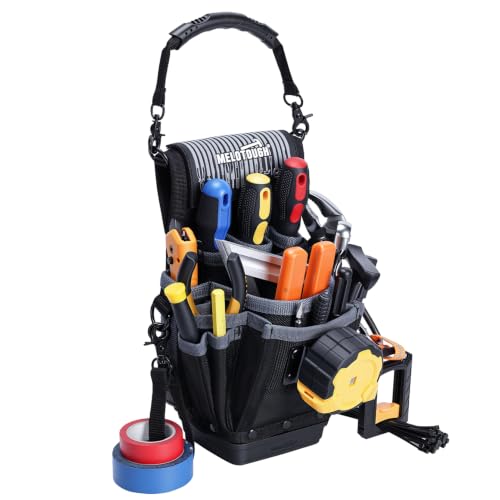
MELOTOUGH Small Electrician Tool Pouch with Hard Bottom

AWP Electrician Tool Pouch Multi-Pocket Organizer

Veto TP-XL Extra Large Tool Pouch

Klein Tools 55569 Stand-Up Zipper Bag 5-Pack

AWP TrapJaw Clip-On Fastener Tool Pouch
What Each Pick Brings To The Table
This open-top bag is built for techs who haul a lot in and out of a truck. The 1680D ballistic fabric shell handles abrasion from job-to-job, while a molded hard bottom keeps the bag standing upright on a flatbed or shop floor. Reflective strips along the outside help the bag stand out in low light, which matters on crowded sites where bags tend to migrate.
The 44-pocket layout gives you a slot for nearly everything without needing to dig. A detachable handle, D-rings, and an aluminum hang hook mean you can carry it, sling a shoulder strap on, or hang it from a ladder rung. For electricians and service techs running a full kit daily, this is the workhorse entry on the list.
Strong Points
- Stands upright on its own, so you stop tipping it over to grab a driver.
- Reinforced metal rivets at stress points, which tend to fail first on cheaper bags.
- Aluminum hang hook keeps tools at arm height on ladders and door frames.
- Front loop panel for morale patches or ID, useful for crews sharing trucks.
Trade Offs
- Open-top design trades security for speed, so it isn’t ideal for crowded public spaces.
- Ballistic fabric handles splashes but isn’t fully waterproof for all-day rain.
- Shoulder strap is sold separately, which is worth budgeting for if you walk long distances.
Who It Suits Best
Full-time electricians and HVAC service techs who need one bag that carries a complete daily kit and stays upright on the truck floor.
Consider Something Else When
The MELOTOUGH Service Tech Tool Pouch with Hard Bottom makes more sense for techs who prefer a hip-only carry and don’t need an open-top bag sitting in their truck.
Functionally, this is a near-twin of the open-top service bag above, with the same 1680D shell, hard molded base, and reflective accent stripes. Where it diverges is the pocket map, which is tuned for HVAC work: manifolds, gauges, and refrigerant tools have places to land rather than floating in a generic cavity. The D-rings, hang hook, and patch panel carry over from the service model.
For HVAC techs running service calls, the upright stance and 44-pocket layout cut the time spent hunting for the right fitting mid-call. You can hang it from a condenser unit, a basement beam, or your truck shelf, and your gauges stay readable and dry. If your days look like crawl spaces in the morning and attic ductwork in the afternoon, this bag earns its keep fast.
A Few Highlights
- Upright hard base keeps the bag from flopping on attic insulation and dusty surfaces.
- Water-resistant shell shrugs off condensation from cold lines and wet callouts.
- HVAC-aware pocket layout that fits gauges, thermometers, and fin tools without crowding.
- Aluminum hook accessible even when the bag is closed, so you can hang it without opening first.
Worth Noting
- Open-top layout means smaller fittings can migrate to the bottom if you haul it rough.
- Same ballistic fabric as the service bag, so heavy rain still needs a rain cover.
- Shoulder strap again runs separately, so plan for that if you walk lots of properties.
Made For
HVAC service techs and refrigeration specialists who carry gauges and specialty hand tools on every call.
Skip It When
The Veto TP-XL Extra Large Tool Pouch is a smarter choice if you also need a built-in tablet pocket and prefer a one-sided closable layout.
This is the hip version of MELOTOUGH’s service lineup: same 1680D ballistic fabric, same rivet reinforcement, but cut as a belt-worn pouch rather than a freestanding bag. The molded hard base still does its job, keeping the pouch upright on flat surfaces and stopping the sag you get when a pouch fills up. A front loop panel accepts the included patches for quick ID on a multi-tech job.
Service techs who climb ladders and crawl through tight spaces tend to prefer pouches over open bags, since the load sits on the hip instead of swinging from a handle. The compact footprint makes it easier to squeeze past ductwork or sit in a truck seat without something constantly bumping your ribs. For residential work, light commercial calls, and apprentices building out a first kit, this pouch makes a strong daily carry.
A Favorable Mix
- Hard base prevents the mid-shift sag that lighter pouches develop under load.
- Compact belt footprint that fits on standard 2-inch work belts.
- Water-resistant fabric keeps the day’s rain from soaking your drivers and testers.
- Patch panel helps apprentices and shop crews mark ownership at a glance.
Points To Note
- Smaller capacity than the open-top bag, so you may end up carrying a separate bag for bigger tools.
- Same fabric family as the larger bags, so extended exposure to standing water is still risky.
Best Suited To
Service techs and electricians who spend the day on a ladder or in tight spaces and want their tools riding on the hip rather than in a carried bag.
Not Your Match When
The MELOTOUGH Service Open Top Tool Bag with Hard Bottom fits better if you want one container that lives in your truck and holds a complete kit without belt space.
The smaller sibling in the MELOTOUGH service line, this pouch is for techs who carry a tight kit and don’t want the bulk of a full-size pouch on their hip. It still uses the 1680D ballistic fabric, metal rivets, and a molded hard base, so the durability story doesn’t change. The trimmed-down pocket count keeps the most-used tools in easy reach without dragging extra weight up a ladder.
For apprentices, residential electricians doing punch-list work, and techs who only need a driver, a stripper, a tester, and a handful of bits, this is a smart size. You pair it with a tool belt for the bigger iron, and the pouch stays out of the way. The loop panel accepts the included patches and any custom morale or ID you want to add.
A Strong Showing
- Lightweight belt carry that doesn’t pull on the hip during long days.
- Hard base keeps the pouch upright when set on a flat surface mid-task.
- Same rivet and fabric construction as the larger MELOTOUGH pouches, so durability carries over.
- Good match for apprentices building a first kit piece by piece.
Honest Caveats
- Limited pocket count means you may outgrow it as your daily kit expands.
- Not designed for larger tools like crimpers or large pliers.
Right Fit For
Residential electricians, apprentices, and techs who keep a lean daily carry and want a hard-bottom pouch without the bulk of a full-size service pouch.
Look Elsewhere When
The AWP Electrician Tool Pouch Multi-Pocket Organizer is a better match if you want a lighter belt-clip pouch with a snap carabiner and a noticeably lower price tag.
AWP takes a simpler approach than the MELOTOUGH lineup: a 7-pocket holster built from water-resistant reinforced polyester, with a belt clip and a carabiner snap hook for keys or small accessories. The interior elastic organization keeps screwdrivers, nut drivers, and a voltage tester in separate sleeves, so nothing ends up rattling around in the bottom. It’s a deliberately minimal tool pouch, and that simplicity is part of the appeal.
For apprentices, DIYers, and homeowners tackling weekend projects, this pouch is a sensible starter piece. It clips on, holds the most common hand tools, and doesn’t get in the way. Compared to the ballistic-fabric MELOTOUGH pouches, the AWP trades some ruggedness for a lower price and a lighter carry, which is the right trade for many people.
What Makes Sense
- Belt clip installs in seconds and removes cleanly at end of day.
- Carabiner snap hook gives you a place for keys, tape, or a small tape measure.
- Water-resistant shell handles sweat, dew, and brief drizzle without soaking through.
- Lower price point makes it an easy add to a starter kit.
Points To Keep In Mind
- Polyester shell is lighter than ballistic fabric and won’t take the same abuse on a busy site.
- No hard bottom, so the pouch slumps when set down on a flat surface.
- Only seven pockets, so larger tools like crimpers or large pliers won’t fit cleanly.
Who Should Grab It
Residential electricians, apprentices, and DIYers who want a lightweight belt-clip pouch for occasional projects without paying for site-grade construction.
Where Another Pick Suits Better
The Klein Tools 55569 Stand-Up Zipper Bag 5-Pack is a better choice if you want color-coded zippered pouches for sorting parts and small components rather than a single belt pouch.
Veto sits in a different tier from most of this list. The TP-XL is a closable one-sided pouch with 30 pockets, a dedicated tablet pocket on the back, and a magnetic screw catcher built into the top. The polypropylene base is designed specifically to block moisture and abrasion, and the YKK zippers are noticeably heavier than what you find on entry-level pouches. There’s a metal T-bar tape chain and a hang-up hook as well.
For pros carrying a meter, a tablet for digital plans, and a wide mix of fasteners, this pouch is a real upgrade. The closable design protects tools in a crowded truck or warehouse, and the bit extension pockets keep the small stuff organized. The over-molded rubber grip makes the pouch comfortable to carry by hand, and the whole build has a refined feel that justifies the higher price for full-time trades.
What Pays Off
- Tablet pocket on the back fits a standard jobsite tablet for plans and specs.
- Magnetic screw catcher grabs dropped fasteners before they disappear into the floor.
- YKK zippers and over-molded grip hold up to daily professional use.
- Polypropylene base protects tools from standing water and rough surfaces.
Practical Considerations
- Priced well above the rest of the list, which may not fit every kit budget.
- Heavier than the fabric pouches, so the load on the hip is noticeable over a long shift.
Whose Shelf It Belongs On
Full-time electricians, low-voltage specialists, and field service pros who carry a meter, a tablet, and a wide variety of fasteners on every call.
Another Choice May Suit
The AWP TrapJaw Clip-On Fastener Tool Pouch is worth a look if you mostly need a fast-access pouch for fasteners and don’t need a built-in tablet sleeve.
Klein takes a different angle with this set: five color-coded zippered bags in different sizes, each with a reinforced gusseted bottom that lets it stand on its own. The 2520d reinforced base is heavier than the typical 1680D you see on competitors, and that’s deliberate, since these bags are designed to take the wear from sharp tools and parts poking through. Each bag has a carabiner clip for hanging on a belt, ladder, or bag.
The real value shows up in organization. You color-code by task: one for wire nuts, one for drill bits, one for fasteners, one for small parts, and one for pliers or specialty tools. Each bag stays upright on the truck floor, so you stop dumping parts onto cardboard. For techs who lose more time to small-part hunting than to anything else, these pouches pay for themselves quickly.
Practical Advantages
- Five sizes and colors make parts and bits instantly identifiable.
- Reinforced gusseted bottoms stand the bags upright on flat surfaces.
- Carabiner clips let you hang bags on a belt, ladder, or a larger tool bag.
- Heavy 2520d base fabric resists puncture from sharp drill bits and fasteners.
Soft Spots
- No hard molded base, so the bags can flex when fully loaded with heavy tools.
Perfect Match For
Techs who handle lots of small parts, bits, and fasteners and want a color-coded system to keep categories separated on the truck and on site.
Reach For A Different Pick When
The Veto TP-XL Extra Large Tool Pouch makes more sense if you want a single closable pouch with a tablet pocket instead of a multi-bag sorting system.
The TrapJaw is built around one feature: a spring-loaded hinge that snaps the pouch wide open with one hand, then closes again to keep fasteners contained. You squeeze the spring, drop a handful of screws or wire nuts in, and the pouch snaps shut until you need them again. The clip-on design attaches to a belt, a tool bag, or even a ladder, so the pouch rides where you need it.
For drywall installers, residential framers, and anyone running large quantities of fasteners, the one-handed open is genuinely useful when the other hand is on a drill or a board. It pairs well with a belt-mounted drill holster, since the open-close action doesn’t require you to set anything down. Compared to the open-top service bags, the closable design keeps fasteners where you put them when the pouch is upside down.
Benefits That Matter
- Spring-loaded hinge gives you true one-handed open and close.
- Closable design prevents fastener spills when you climb or lean over.
- Clip-on mount attaches to belts, tool bags, or ladders without extra hardware.
Trade-Offs To Consider
- Specialized for fasteners, so it isn’t a general-purpose hand tool pouch.
- Spring mechanism can collect dust and grit on dirty job sites, so it benefits from occasional cleaning.
Who Will Love This
Drywall installers, framers, and finish carpenters who carry fasteners by the handful and need one-handed access while the other hand stays on a tool.
Where A Sibling Pick Shines
The MELOTOUGH Service Open Top Tool Bag with Hard Bottom is a better fit if your priority is a large, open-top carrier for a full daily kit rather than a dedicated fastener pouch.
Choosing A Tool Pouch That Actually Fits The Job
The right pouch depends less on the brand and more on how you move through a workday. Start with where the pouch rides: hip, belt, or truck floor, because that single decision shapes every other choice. A pouch that lives on your hip needs to be small enough to sit out of the way under a jacket or harness, while a truck-floor pouch can be as wide as you want.
Capacity is the next call. If you only reach for a driver, a stripper, and a tester, a 7-pocket holster like the AWP is plenty. If you carry meters, gauges, and a full driver set, look at 30-plus pocket designs like the Veto TP-XL. The 44-pocket MELOTOUGH open-top bags are a middle ground for techs who need everything in one open bin.
Material tells you how long the pouch will last. A denier rating is a measure of fabric thread thickness, and higher numbers mean thicker, more abrasion-resistant fabric. Ballistic fabric in the 1680D range is the workhorse standard for daily site use, and reinforced bottoms matter more than the body fabric since that’s where the wear concentrates. Closable pouches protect tools in transit but slow you down on site, while open-top designs trade security for speed.
Look at the mounting system too. Belt clips work for light loads, but heavier kits benefit from a tunnel-style belt loop or D-rings that distribute weight. Hang hooks and D-rings also let you mount a pouch on a ladder or a truck shelf, which is a quiet but real benefit on busy calls. The right combo depends on whether your pouch rides your body or your workspace.
Finally, consider the extras. Patch panels for ID, dedicated meter pockets, tablet sleeves, and color-coded zippered bags all solve specific problems. Match those extras to your daily pain points, and the choice usually narrows on its own.
Key Considerations Across These Picks
Where Shoppers Go Wrong
Treating denier count as the only spec to chase. A 1680D shell on a pouch with cheap stitching fails faster than a 1200D pouch with reinforced seams. Look at the rivets, the base, and the zipper before you chase a higher thread count. Ballistic fabric (a thick, tightly woven nylon originally developed for military flak jackets) handles abrasion, but water resistance comes from the coating, not the fiber, so check that explicitly.
Buying for capacity you’ll never use. A 44-pocket bag sounds appealing, but unused pockets add weight and let tools rattle around. Pick the pocket count that matches your actual daily carry, and add one or two slots for growth rather than doubling up front.
When Paying More Pays Off
Premium pouches like the Veto TP-XL earn their higher price through three upgrades: closer tolerances on the stitching, heavier base materials, and purpose-built features like a magnetic screw catcher or a tablet pocket. For full-time trades, those upgrades pay back in fewer replacements and faster access. For occasional DIY work, a value-tier pouch is a smarter spend since the extra durability is essentially insurance you may not need.
Frequently Asked Questions
What size tool pouch do most electricians need?
Most full-time electricians settle on a mid-size pouch with 15 to 30 pockets, enough for drivers, a stripper, a tester, a few pliers, and a handful of wire nuts. Larger 40-plus pocket bags suit techs who carry a full driver set and a meter on every call.
Hard bottom or soft bottom, and why does it matter?
A hard bottom keeps the pouch upright on a flat surface and prevents the sag that soft-bottom pouches develop when fully loaded. It also adds a layer of moisture protection from wet floors. Soft-bottom pouches are lighter and more comfortable on the hip, but they tend to slump when set down.
Are ballistic fabric pouches worth the cost?
For daily professional use, yes. Ballistic fabric in the 1680D range resists abrasion from concrete, drywall, and metal far better than standard polyester. For weekend DIY use, a polyester pouch is usually fine and saves a noticeable amount of money.
Can a tool pouch hold a tablet or a phone?
Some pouches, like the Veto TP-XL, have a dedicated tablet pocket on the back. Smaller pouches rarely fit a full tablet, though a phone usually fits in an interior elastic sleeve. Check the listed pocket dimensions if a tablet is part of your daily carry.
How do you clean a fabric tool pouch?
Most fabric pouches can be cleaned with a stiff brush, mild soap, and water. Avoid machine washing, since that can stress the seams and degrade any water-resistant coating. Let the pouch air dry fully before loading tools back in to prevent mildew.




