Working with sheet metal means choosing between handheld snips, power shears, and nibblers, each with a clear personality. The right tool depends on how thick the metal runs, how much curve work shows up, and whether you want cordless freedom or a tool that simply feels like an extension of your hand. The picks below cover straight cuts, tight curves, and a couple of cordless options for working away from an outlet.
Your Options, Compared

DEWALT 20V MAX Offset Metal Shear (DCS496B)

VANQUISH 10″ Right-Cut Aviation Tin Snips (3031)

VANQUISH 10″ Left-Cut Offset Tin Snips (3038)

VANQUISH 10″ Left-Cut Aviation Tin Snips (3033)

VANQUISH 10″ Right-Cut Offset Tin Snips (3037)

Makita JN1601 16 Gauge Nibbler
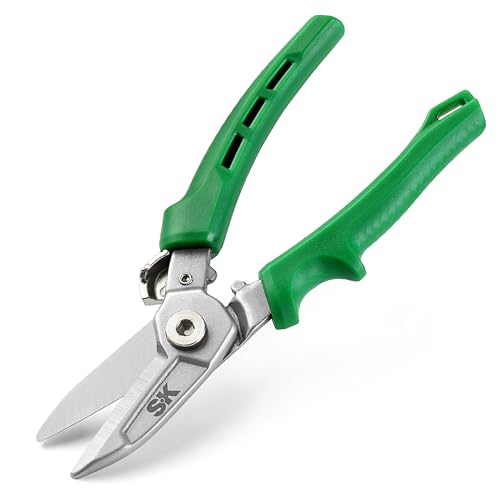
SK 7″ Heavy Duty Industrial Shears (CR-V)
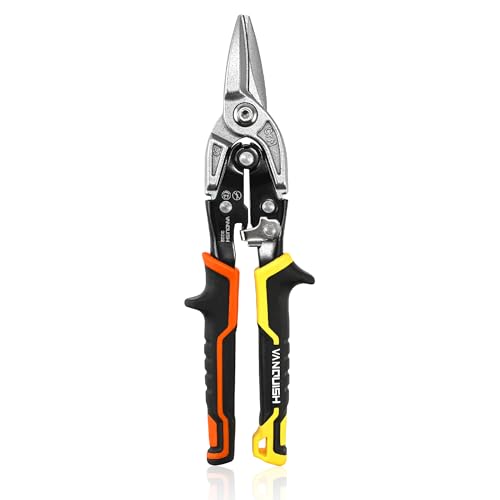
VANQUISH 10″ Straight-Cut Aviation Tin Snips (3032)
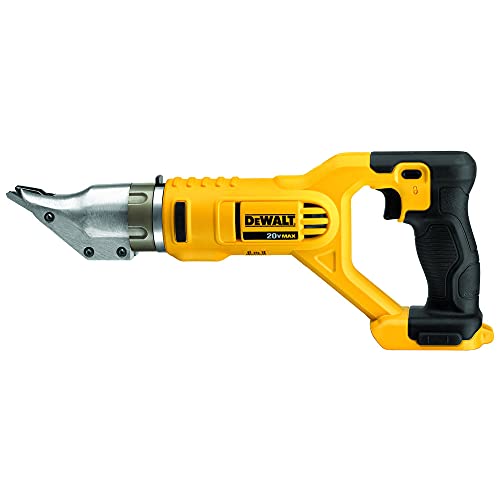
DEWALT 20V MAX Swivel Head Metal Shear (DCS491B)
More On The Choices That Made The List
Trades who work overhead and inside tight duct runs will recognise the value of a cordless shear that can swivel without a tool. The DCS496B pairs an offset cutting head with a 360-degree tool-free rotation, which is the kind of combination that saves a wrist after a long shift on the truck. It’s built around DEWALT’s 20V MAX platform, so the battery and charger situation is likely already sorted on most job sites that own a few yellow tools.
For duct seams and spiral ductwork, this style of shear is often the cleaner choice compared to nibbling away material. A trimmer in a residential HVAC crew should find the runtime reasonable on a standard 5Ah pack, and the head stays accessible in corners where snips can’t physically fit. Compared to the swivel-head DCS491B later in this list, the offset geometry here gives more clearance on right-side applications.
What Helps Most
- Tool-free 360-degree head rotation keeps the handle comfortable when the cut angle changes
- Offset geometry clears spiral duct seams, a common pain point in residential HVAC
- Swaps into existing 20V MAX battery systems without a separate charger or platform
- Cuts up to 18-gauge steel, which covers the majority of HVAC and trim work
Honest Caveats
- Body-only shipping means you’ll need a battery and charger on hand or added separately
- Cutting rate tops out around 2,300 strokes per minute, so heavy plate work belongs with the Makita nibbler instead
Key Specs
Who Will Love This
HVAC installers and duct fabricators who already live inside the DEWALT 20V platform and need a cordless shear that fits tight spots.
Consider Something Else When
The Makita JN1601 16 Gauge Nibbler is the stronger match for shop workers cutting corrugated plate or thicker material.
Right-cut snips walk to the right of the cut line as you push them forward, which suits straight runs and gentle arcs better than left cuts. The VANQUISH 3031 leans hard into the durability story with chrome-molybdenum (CR-MO) forged blades, a tougher alloy than the standard carbon steel you see on most cast snips. For HVAC and roofing crews cutting the same gauge all day, that’s the kind of upgrade that survives a year of use.
The 10-inch body gives a useful amount of leverage without becoming awkward overhead. A reinforced bolt lock keeps the jaws aligned after months of squeezing, and a one-handed metal lock on the handle is a small touch that matters when the other hand is holding a panel in place. Compared to the offset 3037 below, the in-line handle here favours long, straight, accurate cuts rather than overhead seam work.
Points In Its Favor
- CR-MO forged blades are rated for roughly 10 times the cutting life of cast equivalents
- 10-inch handles deliver real leverage for repeated cuts in 22- to 24-gauge stock
- Flush pivot bolt design avoids catching on curves mid-cut
- One-handed metal safety lock and lanyard hole suit roofing and ladder work
Worth Noting
- Right-cut direction means tracing a clockwise circle puts the waste on the wrong side for some patterns
- Dark chrome finish holds up well but can show scuffs on a busy site
Best Suited To
Roofers, HVAC helpers, and metal shop workers running long straight cuts through 18- to 24-gauge sheet.
Not Your Match When
The VANQUISH 3038 offset left-cuts are a smarter call when the job is tight circles or curving the cut against a wall.
Offset snips are the tool you reach for when the cut starts to fight back. The 45-degree offset handle on the VANQUISH 3038 lifts your hand above the workpiece, so knuckles stop scraping against the freshly cut edge. For anyone cutting circles in duct panels or trimming a flange in a tight corner, that single geometric choice is what makes the difference between a clean cut and a knuckle wrapped in a bandage.
Like the 3031 above, the 3038 is built around CR-MO forged blades with a flush pivot bolt. A left-cutting direction means the waste curls away on the left, which is the natural move for clockwise circles. The satin polished finish and ergonomic grips keep the action smooth, and a one-handed metal lock on the handle is a quiet but useful detail. It’s a comfortable step up from entry-level snips without crossing into specialty territory.
Everyday Advantages
- 45-degree offset handle gives clearance over cut edges, a real win on long curves
- CR-MO forged blade construction for heavy shop use
- Flush pivot design keeps the cut from snagging on corrugated stock
- One-handed metal safety lock and lanyard hole
Trade Offs
- Offset geometry is a touch longer, so storage in a shallow toolbox can be tight
- Left-cut direction is the wrong pick if most of your cuts run straight to the right
Right Fit For
Tinkerers and shop workers who frequently trim circles, curves, or vent openings in 22- to 24-gauge sheet.
Look Elsewhere When
The VANQUISH 3031 right-cuts are a more natural fit for long straight runs in ductwork or roofing panels.
For many fabricators, left-cut aviation snips are the most-reached tool in the bag, and the VANQUISH 3033 leans into that daily-driver role. The in-line handle layout keeps the cut path easy to track on longer runs, and the same CR-MO forged blade and dark chrome finish from the rest of the line shows up here. The result is a snip that should keep its edge through a busy week of mixed cutting.
Left-cuts are the natural choice for clockwise circular cuts and for staying on the inside line of a pattern. On standard ductwork where the waste ends up on the left of the line, this is the more comfortable direction for most people. A one-handed safety lock and ergonomic grips round out a thoughtful package that should feel familiar to anyone who has used mid-tier aviation snips before.
Useful Touches
- Drop-forged CR-MO blades for up to 10x the cutting life of cast alternatives
- Reinforced bolt lock keeps the blade gap consistent after extended use
- Soft ergonomic grips help during long fabrication runs
- Lanyard hole adds security on ladders or roof work
Some Limits To Know
- 10-inch body is a little large for users with smaller hands on precision trim
- In-line handles give less knuckle clearance than the offset 3038 above
Who Should Grab It
General fabricators and HVAC shop hands who make frequent left-cutting passes and want a tool that holds up under daily wear.
A Better Fit Elsewhere
The VANQUISH 3038 left-cut offset tin snips make more sense if the work involves tight curves where knuckles need to clear the cut.
Right-cut snips make sense for counter-clockwise circles, and adding the offset handle gives clearance that an in-line version can’t. The VANQUISH 3037 brings those two traits together with the same CR-MO forged blade, satin polished finish, and ergonomic grip that runs through the rest of the 3030-series line. For sheet metal workers who reach for right-cuts more than left, this is the comfortable long-day choice.
The 45-degree offset lifts the hand above the work surface, so scuffs on the freshly cut edge are far less common. A bolt lock keeps the blades tight under repeated shop use, and a one-handed metal safety lock simplifies storage. Compared to the straight-handle 3031, this version trades a little precision on long straight lines for much better ergonomics on curves and over uneven material.
A Few Strong Suits
- 45-degree offset handle keeps knuckles clear of the cut
- CR-MO forged blade construction for long service life
- Satin polished finish reduces friction through the cut
- Safety lock and lanyard hole for ladder or roof work
Soft Spots
- Right-cut direction is the wrong pick for clockwise circles
- Offset geometry adds a bit of length, which can feel bulky in a shallow drawer
Made For
HVAC and roofing workers who run long right-cutting passes and want the ergonomic benefit of an offset handle.
Where A Sibling Pick Shines
The VANQUISH 3032 straight-cut tin snips are the cleaner choice when most of the work is long, straight, and close to the line.
A nibbler punches out tiny crescents of material instead of slicing it, which opens the door to thicker stock that snips and shears can’t comfortably touch. The Makita JN1601 sits in that heavy-duty zone with a 16-gauge capacity, a die that rotates 360 degrees, and the slim body shape that Makita’s metalworking tools are known for. Cutting keystone plate, deck plate, or corrugated sheet becomes a much less frustrating job.
What sets it apart is the built-in thickness gauge near the die, which means less guessing about how deep the tool is biting into the material. Easy punch and die replacement also matters when the tool sees regular use. Compared to the DEWALT 20V shears earlier, this corded nibbler trades portability for raw cutting power and a longer duty cycle in a shop setting.
Real Benefits
- 360-degree die rotation makes inside cuts and notches far easier to position
- 1/4-inch stroke handles thicker plate and corrugated material cleanly
- Slim, ergonomic body keeps the grip comfortable on long runs
- Built-in thickness gauge saves a trip back to the bench
Practical Considerations
- Corded design limits portability to wherever you can run power
- Punch and die parts are consumables, so long-term ownership has a maintenance side
Feature Snapshot
Perfect Match For
Shop-based metalworkers cutting keystone plate, deck plate, or corrugated material in 16-gauge and below.
Skip It When
The DEWALT 20V cordless shears earlier in the list are a better answer for jobs that need to happen at height or on a ladder.
Heavy-duty shears sit in a different category than aviation snips, more like the sharp, sturdy shop scissors you might already keep on the bench. The SK 7-inch model is built with a one-piece CR-V (chromium-vanadium) steel construction, with induction-hardened blades designed to keep an edge through cuts of thin sheet, plastic, rope, and fabric. For light sheet metal trim and general shop tasks, it’s a useful all-rounder.
Where aviation snips are directional, these shears cut wherever the blades meet, which makes them quick for trimming flashing or snipping a small piece of sheet without setting up a dedicated snip. The 7-inch body is also more comfortable for users with smaller hands or for work in tight spaces. Compared to the VANQUISH 10-inch snips above, the trade-off is cutting capacity, the SK handles thinner stock much more gracefully than it handles 18-gauge plate.
Advantages To Know
- One-piece CR-V steel construction for a stiffer blade and cleaner cut
- Induction-hardened edges hold sharpness through varied materials
- 7-inch body fits well in smaller hands and tight spots
- Handles sheet, plastic, rope, and fabric without switching tools
Where It May Fall Short
- Not designed for long straight runs in 18-gauge or heavier stock
- Limited leverage compared to 10-inch aviation snips
Whose Shelf It Belongs On
Home workshops and small fabrication benches that need a multi-material shear for trim, flashing, and general cutting.
Another Choice May Suit
The VANQUISH 3031 right-cut snips are a more capable option when sheet metal is the main material on the bench.
Straight-cut aviation snips are the most neutral member of the family, no curve bias, no offset handle, just a blade that travels straight ahead. The VANQUISH 3032 carries the same CR-MO forged blade construction and 10-inch leverage as the rest of the 3030 series. For general cutting, trim work, and the first snip that lives in a new tool bag, this is a sensible anchor piece.
The straight-cut design handles moderate curves just fine, though tighter circles will still feel more natural with the offset 3038. Dark chrome plating, ergonomic grips, and a one-handed safety lock round out the package. Compared to the offset 3037, this is the easier recommendation for someone unsure which direction they need.
Where It Helps
- CR-MO forged blades built for up to 10x the cutting life of cast equivalents
- 10-inch body gives good leverage for 22- to 24-gauge stock
- Direction-neutral design suits a wide range of cut patterns
- Ergonomic grip and one-handed safety lock for comfortable work
Possible Compromises
- Lacks offset clearance for tight inside cuts compared to the 3037 or 3038
- 10-inch size may be more snip than a casual user really needs
Built With In Mind
First-time buyers and general DIYers who want one solid aviation snip without committing to a left or right cut direction.
Reach For A Different Pick When
The VANQUISH 3037 or 3038 offset snips are a stronger call for tight circles and overhead trim work.
The DCS491B is the more direct sibling to the offset DCS496B earlier in the list, sharing the same 360-degree tool-free swivel head but with a straight body that cuts 7/32-inch strips that curl out of the cut path. That continuous curl matters when the workpiece is sitting on a bench and you don’t want a chip jam interrupting a long pass. Cordless operation also means the tool can travel to a rooftop, a service truck, or a remote job without hunting for an outlet.
For trim and detail work, the swivel head is the standout feature, and the straight geometry is easier to track in tight patterns. It’s a useful upgrade over the offset 496B for anyone who runs more straight cuts than curves. Battery and charger come separately, which is normal for DEWALT’s 20V MAX body-only offerings.
Noteworthy Benefits
- Tool-free 360-degree head rotation reduces wrist strain on long shifts
- 7/32-inch continuous chip curl keeps the cut path clear for accuracy
- 18-gauge capacity in steel, 20-gauge in stainless
- Cordless 20V MAX platform fits most existing DEWALT battery kits
Details To Watch
- Body-only shipping means sourcing battery and charger separately
- Straight head is less clearance-friendly than the offset 496B on right-side applications
Spec Overview
Who Will Love This
Detail-oriented trim and HVAC workers who want cordless convenience and a swivel head for accuracy on intricate cuts.
Swap It Out When
The DEWALT DCS496B offset shear is a better fit for jobs that demand more right-side clearance on duct seams.
What Matters Most Before Choosing Tools For Cutting Sheet Metal
Match The Tool To The Cut Direction
Aviation snips come in left, right, and straight cut orientations, and the cut direction describes which side of the line the waste curls onto. For clockwise circles, left-cuts feel natural; for counter-clockwise circles, right-cuts are the smoother choice. Straight snips are the safe default when a job is mostly long lines, while offset handles add clearance for curves and overhead work.
Consider The Gauge You Cut Most
Gauge (the standard measurement of sheet thickness, where lower numbers mean thicker metal) is the main spec that separates a tool you can use from a tool that frustrates you. Aviation snips handle thin 22- to 24-gauge stock beautifully, but they bog down on 18-gauge and heavier. For thicker plate, a nibbler like the Makita JN1601 brings the cutting head into play instead of a slicing blade, which opens up corrugated and keystone plate work. Cordless shears sit in the middle, comfortable with up to 18-gauge steel.
Cordless Or Corded Tradeoffs
Cordless shears earn their keep on ladders, rooftops, and sites without reliable power. They trade runtime for portability, and the batteries add weight. Corded nibblers and snips never run out of power mid-cut but require a generator or outlet nearby. For a workshop setup, corded often wins; for service work, cordless usually does.
Material Matters Beyond Steel
Stainless, galvanized, and aluminum each cut a little differently. Stainless work-hardens quickly, so a sharp blade and slower stroke make a real difference. Galvanized coatings can gum up a less polished blade. Aluminum cuts easily but bends if the blade catches. Choosing a tool that the manufacturer rates for the materials you actually use is worth more than picking the most popular option.
Key Considerations Across These Picks
Pitfalls Shoppers Hit
A common slip is grabbing any snip for any job, then wondering why the cut curls in the wrong direction. Direction matters: pick a left-cut for clockwise circles, a right-cut for counter-clockwise work, and a straight cut for mostly linear jobs. Another trap is buying a heavy-duty nibbler for thin sheet where aviation snips would be faster, or expecting aviation snips to chew through 16-gauge plate. The third mistake is overlooking ergonomics, a 10-inch body feels powerful for some hands and clumsy for others. Anyone with smaller hands or doing detail work should consider a 7-inch industrial shear alongside the snips.
What The Higher Tier Buys
Stepping up to a forged CR-MO blade instead of a cast equivalent usually means longer edge life, a stiffer cut feel, and less wobble at the pivot. Offset handles are another upgrade worth the money if curves and overhead cuts are common. Cordless platforms, when you already own the batteries, can save a lot of time over dragging extension cords. None of those upgrades change the cut direction, though, so it’s worth matching the geometry to your work before spending on premium materials.
Frequently Asked Questions
What is the difference between tin snips and aviation snips?
Tin snips is a general name for any hand shear that cuts sheet metal, while aviation snips are a specific style with compound leverage (a linkage that multiplies your hand force into a stronger cut) and color-coded handles. Most of the picks on this list are aviation snips because the extra leverage makes long cutting sessions much easier.
How do I know which way my snips cut?
Hold the snips as you would during a cut. If the upper blade is on the right and the waste curls up to the right, those are right-cut snips. If the upper blade is on the left, they’re left-cut. Straight-cut snips keep both blades aligned in a single plane for direction-neutral cutting.
Can aviation snips cut stainless steel?
Yes, but only at thinner gauges, generally 22 to 24 gauge for comfortable cutting. Stainless work-hardens under heat, so a sharp blade and slower, steady strokes help. For thicker stainless, a nibbler or a powered shear is a better fit.
How thick of sheet metal can a nibbler cut?
The Makita JN1601 on this list is rated for 16-gauge steel, which is thicker than most aviation snips can comfortably handle. Nibblers punch out small crescents of material, so the cutting path can be tighter and the material heavier than what snips can manage.
Do I need cordless shears if I already have snips?
Cordless shears become worth it when you’re on a ladder, working overhead, or running many cuts in a row. Snips are still the more precise tool for detail work and tight curves. A lot of trades end up owning both, snips for accuracy and a cordless shear for speed.