A wavy lawn or a high spot under new sod ruins a weekend fast. The right leveling tool turns hours of frustration into a few satisfying passes, and you do not need a contractor’s budget to get there. This lineup covers yard rakes, a serious rotary laser, and a couple of floor-leveling kits for interior projects, so you can match the gear to the ground in front of you. The honest read is that most homeowners do well with one of the heavy-duty rakes plus, for larger grading jobs, a laser system to keep the slope honest.
Your Options, Compared

FRIDOU 30″ x 10″ Lawn Leveling Rake Stainless Steel

Dremmt Lawn Leveling Rake 30×10 inch Pro-Grade
TAORUI Lawn Leveling Rake 30″x10″ Adjustable

Johnson JRT300-RDHV-S Rotary Laser System

FEMOND Lawn Leveling Rake 45″x10″ Anti-Rust

DBYANAN 9-Inch Spiked Screed Roller Kit

DBYANAN Self Leveling Tools Kit 20-Inch Roller
Taking A Closer Look At The Options
The FRIDOU 30×10 rake earns its spot by leaning on 304 stainless steel, the same alloy you see on outdoor kitchen cabinets and marine hardware, so it shrugs off rain and fertilizer splash without painting or sealing. The head size is the sweet spot for a residential yard: wide enough to cover meaningful ground in a pass, narrow enough to get between stepping stones and into a typical backyard’s tight corners. Reinforced triangle brackets at the neck spread the load when you push a full scoop of topdressing, which is where cheaper rakes tend to twist.
For most homeowners dealing with pet damage, frost heave, or settling after a utility trench, this size works without feeling unwieldy. Pair it with a 50/50 mix of sand and compost and you have a real topdressing setup, not just a cosmetic pass.
Key Advantages
- 304 stainless steel head resists rust through wet seasons and constant outdoor storage.
- Reinforced triangle brackets reduce flex and twisting under heavy loads of topsoil or sand.
- 30×10 inch head balances coverage and control in typical suburban lawns.
- Solid stainless build lowers long-term maintenance compared to painted carbon steel rakes.
Things To Consider
- Stainless steel costs more upfront than painted steel alternatives.
- No built-in handle in the core kit on this listing, so budget for a compatible handle if you do not have one.
Key Advantages
- 304 stainless steel head resists rust through wet seasons and constant outdoor storage.
- Reinforced triangle brackets reduce flex and twisting under heavy loads of topsoil or sand.
- 30×10 inch head balances coverage and control in typical suburban lawns.
- Solid stainless build lowers long-term maintenance compared to painted carbon steel rakes.
Things To Consider
- Stainless steel costs more upfront than painted steel alternatives.
- No built-in handle in the core kit on this listing, so budget for a compatible handle if you do not have one.
Made For
Homeowners restoring a bumpy yard or topdressing after core aeration who want a rake that survives years of outdoor abuse.
Consider Something Else When
Anyone leveling a half-acre or larger should reach for the FEMOND 45-inch rake, since its wider head covers more ground per pass.
The Dremmt offering stands out for one reason: head-size choice. You can pick 30×10, 35×10, or 45×10 inch versions, all on a 6.5-foot stainless handle, which lets you match the tool to your lawn instead of forcing the lawn to match the tool. The pro-grade framing also signals thicker plate steel and a longer handle than entry-level options, so you are not hunched over while pushing material.
For most backyards, the 30 or 35 inch head feels right. The 45 inch version is overkill for tight landscaping but a strong choice for open backyards, pasture edges, or even a practice green.
What It Does Well
- Multiple head widths and one shared handle system let you size the tool to your lawn.
- Stainless handle resists corrosion where bare wood or painted steel would eventually fail.
- Long 6.5-foot handle saves your back during long topdressing sessions.
- Solid plate steel head flattens soil clumps and fills low spots in a single motion.
Worth Noting
- Pro-grade build adds weight, which can fatigue users during long sessions on soft ground.
- Stainless steel construction tends to carry a higher sticker price than painted carbon steel rakes.
Right Fit For
Homeowners who want to pick head size based on yard dimensions and plan to use the tool season after season.
Look Elsewhere When
Anyone on a tight budget should consider the FRIDOU 30×10 stainless rake, which delivers a similar core experience with simpler sizing.
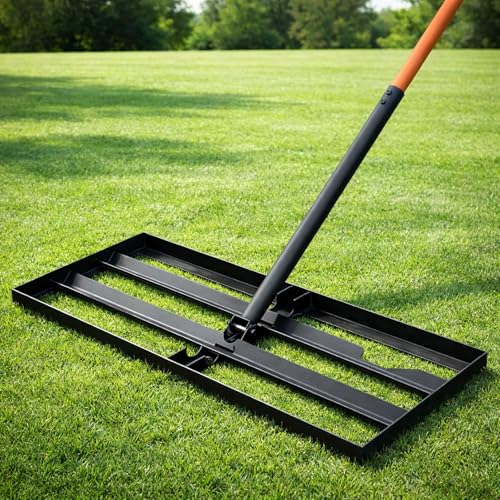
TAORUI’s claim is simple: a 78-inch adjustable handle paired with a 30×10 stainless steel head. That extra handle length is not a marketing afterthought, it directly fixes the most common complaint about leveling rakes, which is that shorter handles force you to bend or kneel. For taller homeowners or anyone with back sensitivity, that detail alone can be the deciding factor.
The stainless construction plays the same role as on the FRIDOU and Dremmt models: it tolerates wet grass, compost, and fertilizer splash without the paint flaking you get on budget tools.
Everyday Wins
- 78-inch adjustable handle accommodates different user heights and reduces back strain.
- Stainless steel head holds up to repeated exposure to moisture and abrasive topdressing materials.
- 30×10 inch head suits tight residential lawns and detail work around beds.
- Adjustable design lets one tool serve multiple users in a household.
Trade Offs
- Longer handle makes storage in small sheds or garage wall hooks a bit more awkward.
- Adjustment mechanism adds a moving part that may need occasional tightening over years of use.
Feature Snapshot
Who It Suits Best
Taller users or anyone with back issues who needs the longest handle in this roundup for a comfortable working posture.
Skip It When
Homeowners who need a wider head for open areas should look at the FEMOND 45-inch model instead.
When your project outgrows a rake, a rotary laser becomes the referee. The Johnson JRT300-RDHV-S shoots a self-leveling red beam with a stated 4,000-foot working range, a self-leveling feature meaning the unit automatically finds true horizontal or vertical without you manually dialing a bubble, plus dual slope capability for setting drainage grades on a driveway or patio base. A rotary laser is a rotating laser head that sweeps a 360-degree reference plane, which a detector on a grade rod can pick up across an entire jobsite.
The kit also includes a magnetic target, detector, remote, tripod, and 13-foot grade rod, so you are not buying accessories piecemeal. For anyone building a shed pad, setting fence post heights, or grading a long driveway, this is the tool that turns “eyeball it” into measurable accuracy.
Standout Benefits
- 4,000-foot range supports large property layouts and long driveways without moving the unit.
- Dual slope function enables controlled drainage grading, not just flat references.
- Full kit ships with detector, remote, tripod, and grade rod for one-person operation.
- Self-leveling design cuts setup time and reduces operator error on rough ground.
Honest Caveats
- Priced well above hand tools and aimed at users with real grading projects.
- Rotary lasers are precision instruments that need protective transport and careful storage in busy work trucks.
Quick Facts
Best Suited To
Property owners, contractors, and serious DIYers setting pads, fences, or drainage lines who need a true reference plane.
Not Your Match When
Anyone only doing a quick topdressing pass should stay with a leveling rake like the FRIDOU or TAORUI instead of stepping up to laser gear.
The FEMOND leans into scale. Its 45×10 inch head is the widest in this roundup, which translates directly to fewer passes across a big lawn, a pasture edge, or a fairway-style stretch. The maker points to a hammer-paint anti-rust coating, a textured powder-style finish known for resisting chips, along with a thickened bottom plate and a non-slip rubber grip. The adjustable handle makes the long head usable for different heights without a custom cut.
For tight urban yards, the head can feel like a snowboard in a hallway, so it really earns its keep on wider, more open ground where coverage per pass matters more than fingertip control.
The Good Stuff
- 45-inch head covers large areas quickly, ideal for open lawns and pasture edges.
- Thickened bottom plate and reinforced handle stand up to heavy topdressing loads.
- Anti-rust hammer-paint coating holds up through wet, humid conditions.
- Non-slip rubber grip improves control during long topdressing sessions.
Points To Keep In Mind
- Wide head is harder to maneuver in narrow yard corridors or around tight bed shapes.
- Heavier build may tire out users working on soft or uneven ground for extended periods.
Feature Card
Who Will Love This
Homeowners with open lawns, hobby farms, or anyone maintaining a stretch of turf larger than a typical city yard.
Another Choice May Suit
Tight, landscaped backyards are better served by the more compact TAORUI 30×10 rake with its adjustable handle.
Switching from lawn to floor, this DBYANAN kit handles self-leveling compound and epoxy work. A spiked roller is a cylinder covered in small plastic spikes that, when rolled over wet self-leveling compound, pops trapped air bubbles that would otherwise harden as pinholes. This set ships with a 9-inch spiked roller plus a pair of spiked shoes that let you walk through the wet pour without leaving boot prints, a small detail that matters when you are stuck in the middle of a garage floor pour.
The 9-inch width is right for tight bathroom and laundry pours, or working around a toilet flange without splashing compound everywhere. You will also want a separate mixing drill and a gauge rake for material distribution, since the spiked roller handles de-airing, not spreading.
The Helpful Details
- Spiked roller pops trapped air bubbles that cause pinholes in cured self-leveling compound.
- Spiked shoes let you walk through wet pours without leaving footprints.
- 9-inch width navigates tight bathrooms, closets, and around plumbing flanges.
- Compact kit stores easily in a small shop or garage shelf.
Practical Considerations
- Spiked roller requires immediate cleaning after each pour, since cured compound destroys the spikes.
- Does not include a gauge rake or squeegee, so plan to buy a spreading tool separately for larger rooms.
Perfect Match For
DIYers pouring a self-leveling underlayment in a bathroom, laundry, or small garage who need the bubble-popping step handled right.
Reach For A Different Pick When
Anyone laying down a larger room should step up to the DBYANAN full kit, which adds a 20-inch roller and a notched squeegee.
The expanded DBYANAN kit bundles the 9-inch spiked roller and spiked shoes from the previous entry with a 20-inch spiked roller, a 22-inch leveling rake scraper, and a stainless steel notched squeegee, a flat blade with notched edges that spreads self-leveling compound to a consistent depth. A metal splash guard on the wide roller keeps slurry from spraying your baseboards during fast passes.
For a basement, large garage, or open commercial space, this combination lets one person pour, spread, and de-air without running back to the shop for a missing tool. Smaller bathrooms still work, just expect a bit more cleanup around the larger roller.
What Earns Its Place
- Wide 20-inch spiked roller covers large rooms quickly during the de-airing step.
- Stainless steel notched squeegee distributes compound to a consistent depth.
- 22-inch leveling rake scraper helps push excess material toward low spots.
- Metal splash guard protects walls and baseboards during fast rolling.
Where It Is Less Suited
- Larger kit has more parts to clean immediately after a pour, before compound hardens.
- Wider roller can feel bulky in narrow doorways and tight bathroom footprints.
Built With In Mind
Homeowners tackling a basement, large garage, or multi-room leveling project who want one kit instead of piecing tools together.
A Better Fit Elsewhere
Anyone working on a small single-room pour should consider the simpler DBYANAN 9-inch roller kit for easier handling.
What Matters Most Before Choosing Tools For Leveling Ground
Match The Tool To The Surface
Yard leveling and floor leveling share the same goal but demand completely different tools. For turf, a wide plate-style rake pushes and smooths loose topdressing without scalping the grass below. For interior floors, you pour a self-leveling compound and use spiked rollers and notched squeegees to pop bubbles and set depth. Picking the wrong category is the fastest way to waste a weekend, so decide first whether you are working on grass, gravel, or cured concrete.
Head Size And Handle Length Drive Comfort
A 30-inch head suits most residential lawns, while 45 inches rewards open spaces where you can take long, sweeping passes without dodging obstacles. Handle length matters just as much: a 78-inch adjustable handle saves your back and accommodates multiple users, while a shorter handle forces bending that compounds over hours of work. Choosing a head that is too wide for tight landscaping creates frustration, and a head that is too narrow turns a big lawn into an all-day grind.
Material And Finish Affect Lifespan
Stainless steel resists rust and chemical exposure, painted carbon steel costs less but chips over time, and anti-rust hammer coatings sit in the middle. For wet climates or gear that lives in an unheated shed, the upgrade to stainless or coated steel tends to pay for itself by avoiding early replacement. The same logic applies to flooring kits: stainless squeegees and metal-cored rollers hold up to repeated wet-compound contact better than plastic-only alternatives.
Plan Around Project Scale
A small topdressing job only needs one rake and a wheelbarrow. A driveway regrade or shed pad calls for a rotary laser with a grade rod, plus the rake, plus a compactor for the base. Floor pours scale similarly: a 50-square-foot bathroom is a 9-inch roller job, while a 500-square-foot basement is a kit-with-a-20-inch-roller job. Lay out the square footage and square edges before buying, and the tool choice usually makes itself.
Smart Choices Across These Picks
Mistakes Worth Dodging
The most common error in this category is buying a tool designed for a different surface. Lawn leveling rakes are too flexible for screeding concrete, and spiked floor rollers do nothing for topdressing a yard. Equally common is underestimating handle length, where a six-foot handle on a 30-inch head still leaves tall users bent over by the end of the project. Measure your reach before ordering, and double-check that handle attachments are compatible with the rake head, since not all threaded handles match every plate.
When Paying More Pays Off
Higher-tier tools in this roundup earn their premium in three places: corrosion resistance, head width, and accuracy. Stainless steel and quality anti-rust coatings outlast painted carbon steel by years in outdoor storage. Wider heads like the FEMOND 45-inch cover more ground per pass, which compounds into real time savings on big lawns. And the Johnson rotary laser trades dollars for measurable accuracy that a string line and eyeball simply cannot match on a sloped driveway. The upgrade makes sense when your project size or precision requirements justify it, and does not when you are doing a single weekend touch-up on a small yard.