Cutting drywall on a wall is rarely one-size-fits-all. A small patch around an outlet calls for a different blade than skimming a freshly hung room, and the wrong tool leaves burrs, blown-out paper, and a finish you’ll sand for hours. This list covers the seven picks that handle the most common cutting and finishing scenarios homeowners and pros face, from jab saws for rough openings to skimming blades that flatten seams in fewer passes.
The Lineup, Simplified

FrogTape Multi-Surface Painter’s Tape with PAINTBLOCK, 2 in Wide

Ceeintee 16 Inch Drywall Skimming Blade

Ceeintee 24 Inch Drywall Skimming Blade

Ceeintee 32 Inch Drywall Skimming Blade
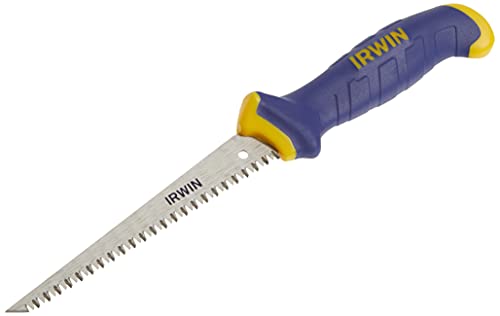
IRWIN Tools ProTouch Drywall/Jab Saw (2014100)

Goldblatt Folding Drywall Saw, 5-Inch Jab Saw

Square Slot Cutter for Oscillating Tools
A Breakdown Of The Leading Choices
Painter’s tape earns its spot on a drywall cutting list because clean cuts deserve clean edges. After a new opening is sawn or a seam is skimmed, the paper face of gypsum board is unforgiving: paint bleeds under ordinary masking tape and leaves fuzzy lines that undo careful work. FrogTape’s PAINTBLOCK is a polymer additive (a water-activated micro-gel that swells at the tape edge) designed to seal the boundary and stop that creep.
The 2-inch width covers a typical seam or a freshly cut drywall edge in a single strip, and the medium-tack adhesive sticks to cured painted drywall, baseboards, and metal without lifting the underlying finish. Roll length is 1.41 inches by 45 yards (the 2-inch reference is the roll’s overall width), which is enough for several rooms on a single pass.
Good Reasons To Consider
- Seals the mask edge with a water-activated gel so paint stops creeping under the tape
- Medium adhesion holds on cured painted walls, trim, glass, and metal without tearing the surface
- Two-inch width is a practical match for standard drywall seams and freshly cut edges
- Removes cleanly within a typical paint window, leaving a sharp paint line without residue
- One roll covers a multi-room project, useful for whole-home repaints after a renovation
Things To Consider
- Activate the gel by brushing on a damp top coat before painting or the seal may be incomplete
- 2-inch width may be too narrow for masking wide baseboards or textured ceilings in a single strip
Key Product Details
Who Should Grab It
Homeowners finishing a patch and repainting a room benefit most, since masking quality makes the smallest patch visible if bleed-through happens.
Skip It When
The Ceeintee 16 Inch Drywall Skimming Blade is a better fit when the priority is smoothing the joint itself rather than protecting nearby surfaces.
Drywall skimming blades (wide, flat trowels used to lay down a thin layer of joint compound over large areas) are usually grouped by width, and 16 inches is the friendly end of the range. It covers a noticeable swath with each pass without feeling unwieldy, which matters the first time you pull a flat blade across a freshly mudded wall.
The blade on this Ceeintee is 0.38mm stainless steel, thin enough to flex slightly and feather compound into a near-flat finish, and the company lists it as replaceable. The handle is shaped for a two-handed grip, which helps when you want a long, even stroke without the tool chattering at the start or end.
Advantages To Know
- 16-inch width is short enough for control, long enough to flatten small patches quickly
- 0.38mm stainless steel flexes just enough to feather compound without leaving ridges
- Replaceable blade means a worn or dented edge can be swapped without buying a new tool
- Ergonomic two-handle layout makes long passes easier on the wrists during a first skim coat
Worth Noting
- Smaller coverage per pass than the 24- or 32-inch siblings, so whole-room skim work takes longer
- Thin stainless steel can flex too much under heavy pressure, leaving shallow dips on the wall
Whose Shelf It Belongs On
First-time drywall finishers patching a small room get the most from a 16-inch width because the learning curve is shorter than jumping straight to a wider blade.
Consider Something Else When
The Ceeintee 24 Inch Drywall Skimming Blade is a smarter match once you’re comfortable flattening seams and want to cover a full wall in fewer passes.
Step up from a 16-inch blade and the 24-inch Ceeintee sits in the practical middle. It flattens a wide enough band to make a full-room skim coat feel manageable, yet it still fits in a tighter space like a hallway bathroom or a closet with a little room to maneuver.
It uses the same 0.38mm stainless steel blade and replaceable-blade format as the 16-inch model, so the flex profile and finishing feel stay consistent across the family. For most homeowners, this width is the one that earns the most use because the trade-off between reach and control leans in your favor.
Where It Delivers
- 24-inch reach is the sweet spot for most interior walls
- Stainless steel flexes enough to bridge seams without leaving a visible line
- Replaceable blade lowers long-term cost when the edge finally nicks
- Two-handle grip spreads pressure for smoother strokes than single-handle flat blades
Points To Keep In Mind
- More demanding on technique than a 16-inch blade and less forgiving on first passes
- Wide enough that reaching inside corners requires a separate smaller knife
Spec Overview
Right Fit For
DIYers repainting a full room or doing a level-4 finish benefit from the 24-inch reach without the size of a 32-inch blade.
A Better Fit Elsewhere
The Goldblatt Folding Drywall Saw is a smarter pick when the work is rough-in cutting rather than finishing a flat surface.
The 32-inch Ceeintee is the wide-format finisher. It covers a generous band on a single pull, which is the whole point on long uninterrupted runs of wall or a flat ceiling. The 0.38mm stainless steel and replaceable blade match the rest of the family, so once you’ve dialed in pressure on the 16 or 24, the wider version feels familiar rather than foreign.
Heavier, yes, and harder to maneuver in tight rooms, but on a 12-foot wall it cuts a long stretch of work into a few passes. For anyone working on a level-5 finish (a skim coat over the entire surface to remove all texture and tool marks) this is the tool that makes that workload feel realistic.
Strengths Worth Knowing
- 32-inch blade flattens a large section of wall in one stroke
- Same replaceable 0.38mm stainless steel system as the 16 and 24 for consistency
- Ergonomic grip reduces hand fatigue across a full skim pass
- Designed for drywall, gyprock, and standard wallboard applications
Honest Caveats
- Tough to control in tight rooms, narrow closets, and inside corners
- Overkill for small patch jobs, where a 16-inch blade is easier to manage
Built With In Mind
Finishers tackling large, open walls or full-room skim coats get the most value from the 32-inch reach, especially on level-5 work.
Where A Sibling Pick Shines
The Ceeintee 24 Inch Drywall Skimming Blade is a smarter choice in tighter rooms, where the 32-inch reach is more blade than the space allows.
Before any skimming starts, openings need to be cut, and a jab saw is the tool that gets called in for rough work. The IRWIN 2014100 is a fixed-blade jab saw with a thicker-than-usual steel body, which keeps the blade from bending when you plunge through drywall or pry a section free.
Tri-ground teeth (each tooth is ground on three edges for a sharper, faster bite) are aggressive on gypsum board, so you can punch in and out of a wall without the blade wandering. The ProTouch rubberized grip on the handle is the real comfort story here. Long rough-in sessions punish bare-hand tools, and a soft-grip handle lets you push harder without that hot-spot ache.
The Upside
- Thick body resists flex for controlled plunges and long cuts
- Aggressive tri-ground teeth bite quickly into gypsum
- ProTouch rubberized grip softens pressure during long sessions
- Suited to rough openings for plumbing, electrical, and HVAC
Trade Offs
- Fixed blade adds length, so it does not fold for tight storage or a tool belt pouch
- Aggressive teeth are great on drywall but rough on surrounding framing if you slip
- Tooth pattern is more aggressive than needed for finish-quality cuts
Best Suited To
Homeowners and trades cutting rough openings for outlets, switches, and supply lines during renovations.
Not Your Match When
The Goldblatt Folding Drywall Saw is a better fit when you need a saw that lives in a tool belt or toolbox and stays out of the way between cuts.
The Goldblatt folding jab saw solves the storage problem that fixed jab saws can’t. The 5-inch blade folds into a 6-3/4-inch handle, so the whole tool slips into a tool belt pouch or a kitchen drawer between uses. For one-off jobs, that convenience matters as much as blade performance.
Under the hood it’s a bi-metal blade (a steel body laser-welded to a high-speed-steel cutting edge) hardened to roughly HRC 66-68 (Rockwell Hardness scale, a standard measure of steel hardness, where 66-68 is hard enough to hold a cutting edge) and cut with 8 TPI (teeth per inch) triple-ground geometry. That’s plenty of bite for wallboard, plywood, and PVC, and the deeper gullets (the curved valleys between teeth) clear dust so the cut stays quick.
What It Does Well
- Folding design protects teeth and saves space in storage
- Bi-metal blade holds an edge across repeated drywall, plywood, and PVC cuts
- Triple-ground 8 TPI teeth cut in both push and pull directions
- Hardened steel rated to HRC 66-68 for durability
Room For Improvement
- 5-inch blade is shorter than a fixed jab saw, so long straight cuts need more passes
- Folding mechanism adds a hinge that requires occasional cleaning to stay smooth
Feature Snapshot
Who Will Love This
Renovators and homeowners who need a jab saw that disappears into a tool bag between jobs, especially for punch-list work in finished spaces.
Where Another Pick Suits Better
The IRWIN Tools ProTouch Drywall/Jab Saw is a better fit for high-volume rough cutting, where a fixed blade and full-length handle speed up the work.
Cutting an electrical box opening freehand with a jab saw is a test of patience. The BRHABO square slot cutter is built for that single job: it attaches to an oscillating multi-tool (a handheld power tool that vibrates a blade in tiny arcs) and cuts a clean 3-3/4-inch by 3-3/4-inch square, which matches a standard single-gang outlet or switch box. The plunge action stays controlled, the corners come out square, and the cut rarely needs patching beyond a thin layer of mud.
The blade has been thickened for rigidity, and the manufacturer rates it as a drop-in fit for common oscillating tool brands. It is, in practical terms, a one-trick tool, but for an electrician, a serious DIYer, or anyone running a row of new outlets, that trick saves real time.
A Few Highlights
- Cuts a 3-3/4 in × 3-3/4 in square sized to a standard outlet or switch box
- Plunge cuts without pre-drilling, reducing setup steps
- Thickened blade resists deflection inside the cut
- Compatible with common oscillating multi-tool brands
- Clean edges mean less mud and patching around the box
Practical Considerations
- Single-purpose blade, so it’s not a general drywall cutting tool
- Requires an oscillating multi-tool to operate, a separate investment if you don’t already own one
Perfect Match For
Anyone installing a row of new outlets or switches, or any DIYer who already owns an oscillating multi-tool and wants cleaner box openings than a freehand jab saw produces.
Look Elsewhere When
The Goldblatt Folding Drywall Saw is a better fit for general rough cutting, since the square slot cutter only handles outlet-sized openings.
What Matters Most Before Choosing Tools To Cut Drywall On Wall
Match The Tool To The Cut Type
Rough openings, finished seams, and paint prep each call for different blade geometry. Jab saws handle plunges and small cutouts, skimming blades flatten joint compound over wide areas, and oscillating attachments do precise box work. Picking by the dominant task in your project avoids buying a tool that only does half the job. A small patch only needs a 16-inch skimming blade; a full-room skim coat benefits from a 24- or 32-inch reach.
Width Changes Everything On A Skimming Blade
The longer the blade, the fewer passes, and the harder the tool is to control. For first-time finishers, 16 inches is the friendliest width. A 24-inch blade is the most versatile for room-scale work. A 32-inch blade pays off on long uninterrupted runs and ceilings but is unwieldy in tight quarters. Match the width to the largest flat area you expect to skim, not the smallest.
Blade Material And Replaceability
Stainless steel resists rust in damp basements and bathrooms, and a replaceable blade saves money when the working edge eventually nicks. With skimming blades, look for 0.3 to 0.4mm stainless or spring-steel, and confirm replacement blades are stocked. With saws, bi-metal construction (a tough steel body welded to a harder cutting edge) holds an edge longer than standard carbon steel.
Edge Control And Grip Comfort
Drywall work punishes bare-hand tools. Rubberized grips on jab saws and ergonomic two-handle layouts on skimming blades reduce fatigue during long sessions. Comfort isn’t a luxury here: it shows up in straighter cuts and flatter seams, because a tired hand drifts.
Accessories Already In Your Kit
An oscillating multi-tool opens up specialty attachments like the square slot cutter, but only if you already own the tool. Otherwise, a quality jab saw and a skimming blade cover the vast majority of homeowner drywall work without a major new investment.
Key Considerations Across These Picks
Wrong Turns To Avoid
The most common mistake is treating all drywall tools as interchangeable. A jab saw and a skimming blade solve different problems, and a single tool rarely does both well. Another misstep is buying the widest skimming blade available, assuming more reach is always better. A 32-inch blade on a small bathroom wall is more hindrance than help. Start with the size that matches the room, not the size that flatters the toolbox. Finally, don’t skip the masking step. Even precise cuts benefit from a clean edge when it’s time to paint.
What The Higher Tier Buys
Premium skimming blades typically offer thicker stainless steel, better-balanced handles, and confirmed replaceable-blade stock. A 0.38mm blade like the ones in the Ceeintee family is a common premium benchmark, and the ability to swap a worn edge extends the tool’s life well past a single project. With jab saws, the upgrade path leads to bi-metal blades (like the Goldblatt’s), tighter tooth geometry, and folding mechanisms that pay for themselves the first time the saw lives in a tool bag for months between uses.
Frequently Asked Questions
What Is The Easiest Tool For A Beginner To Cut Drywall On A Wall?
A jab saw is the most forgiving starting point. The IRWIN ProTouch and Goldblatt folding saw both plunge into drywall with minimal setup, and either one handles a typical outlet cutout in a few minutes. Pair it with a 16-inch skimming blade for finishing and a beginner can cover most small patch jobs without a steep learning curve.
Can A Single Skimming Blade Handle An Entire Room?
Yes, the wider the blade, the fewer the passes. A 24-inch blade like the Ceeintee 24 Inch Drywall Skimming Blade covers most interior walls in manageable sections. For long runs and ceilings, a 32-inch blade reduces passes further but requires more control.
Do I Need An Oscillating Multi-Tool To Cut Drywall?
Not for general work. A jab saw handles rough openings and most cutouts. An oscillating attachment like the square slot cutter becomes worthwhile when you’re installing several outlet boxes and want clean, repeatable square openings, but it isn’t required for typical homeowner projects.
How Long Should A Drywall Saw Blade Last?
A bi-metal jab saw blade, like the one on the Goldblatt folding saw, holds an edge across multiple room-sized projects before noticeably slowing. Standard carbon-steel blades dull faster, especially on plywood or harder materials. Clean cuts in plain gypsum board extend blade life, while frequent cuts through old nails or screws shorten it.
What Width Skimming Blade Should I Start With?
A 16-inch blade is the friendliest starting width. It covers enough area to make progress without the control demands of a 24- or 32-inch blade. Once you’re comfortable flattening seams, stepping up to a wider blade is straightforward and noticeably faster on full-room skim coats.