Working with metal roofing panels asks more of your hands than most jobs. You’re wrestling with rigid steel, dodging sharp edges, and trying to make clean cuts on surfaces that always seem angled just slightly wrong. Picking the right tool for the job means the difference between a tidy seam and a ragged edge that fights you all the way to the ridge.
Most folks in this spot fall into two camps: DIYers patching a shed or carport roof, and pros laying down panels on a full reshingle. Either way, the toolset that gets you through a weekend of straight cuts and notched angles looks different from one suited to daily production. This list walks through nine solid options across shears, knives, and bending tools, so you can match the gear to your project.
A Side-By-Side Look

BETOOLL 3-Piece Hand Seamers Set, 2.4 in Jaws

Crescent Wiss 12″ Bent Handle Industrial Shears W22N

Lizenoz 2PCS Fixed Blade Roofing Knife Set

Lizenoz 2-Pack Green Fixed Blade Roofing Knife

AJC Shingle Shear 093-AJCSS
Lizenoz 2-Pack Silver Fixed Blade Roofing Knife

WILLBOND 4 Pcs Roofing Knife Set, Black

WILLBOND 4 Pcs Roofing Knife Set, Yellow

WILLBOND 4 Pcs Roofing Knife Set, Red
Inside Each Recommended Option
Cutting metal roofing is half the battle. The other half is shaping it, and the BETOOLL 3-Piece Hand Seamers Set leans squarely into that side of the work. Where the Wiss shears in the next slot are built to slice through long sheet runs, this kit focuses on bending and flattening 2.4-inch-wide seams in three common angles.
Each tool addresses a different corner of a panel: straight jaw for closing a Pittsburgh lock, 45 degrees for trim work around dormers, and 90 degrees for hemmed edges. The jaws land neatly on standard standing-seam profiles, and the storage case keeps all three lined up between jobs. The handles grip well, and the build feels solid in hand, which matters when you’re pressing down on galvanized steel all afternoon.
Everyday Perks
- Three jaw angles in one kit removes the need to buy separate seamers for each bend.
- The 2.4-inch jaw width matches the most common standing-seam heights you’ll find on residential panels.
- Carry case keeps the trio organized on a truck shelf or in a contractor bag.
- Handles offer leverage that reduces wrist strain during repetitive bending.
Points To Keep In Mind
- These are hand tools, so very long seams still call for a power seamer.
- Owners commonly report light surface oil on arrival that needs a wipe-down before first use.
Key Specs
Who Will Love This
DIYers and small-shop pros bending trim, flashing, and short panel runs by hand.
Consider Something Else When
Reach for the Crescent Wiss 12″ Bent Handle Industrial Shears instead when long straight cuts across sheet stock are the main task.
Long, straight cuts on sheet metal are where industrial shears earn their keep, and the Crescent Wiss 12″ Bent Handle Industrial Shears (model W22N) is built for that exact motion. The bent handle keeps the bottom blade flat on the material, which makes it easier to follow a chalk line on a full panel.
The construction is what you want when the job is in a shop rather than a one-off weekend project. Hot drop-forged steel gives the blades real backbone, and the nickel-plated finish protects against shop humidity. The SET-EASY pivot, a small tension adjustment at the screw, lets you dial the feel to match the thickness of the stock you’re feeding through. Compared with the BETOOLL seamers above, these are about slicing cleanly, not bending.
Good Reasons To Consider
- 12-inch length handles full panel-width cuts without constant re-gripping.
- The bent handle keeps knuckles up off the work surface, improving visibility and safety.
- Adjustable pivot tension adapts to different metal thicknesses, which is useful when switching between flashing and heavier panels.
- Drop-forged steel construction holds an edge through heavy production use.
Trade Offs
- These are right-handed only, which can frustrate left-handed users.
- Not designed for tight curves or notches, so a nibbler or snips pair better for that detail work.
Right Fit For
Shop-based fabricators and remodelers who cut long sheet runs on a bench before installation.
Look Elsewhere When
The AJC Shingle Shear 093-AJCSS is a better match when cuts happen on the roof itself rather than on a workbench.
Once panels are in place, the cutting rarely stops. Felt, underlayment, ice-and-water membrane, and shingle trim all need a dedicated knife, and the Lizenoz 2PCS Fixed Blade Roofing Knife Set answers that side of the job. Compared with the Wiss shears and BETOOLL seamers, this is a different category: light, hand-driven blades built for roofing materials rather than the metal itself.
The fixed-blade design locks into place with a screw system, eliminating the play that retractable utility knives sometimes develop mid-stroke. Two knives in the pack mean one stays in the belt while the other gets a fresh blade. For installers managing multiple rolls of underlayment in a day, that redundancy is the whole point.
Standout Benefits
- Locking fixed-blade design keeps the edge stable during long, straight pulls.
- Two-knife pack reduces downtime when one blade dulls mid-task.
- Sturdy construction holds up to repeated cuts through fibrous roofing materials.
Small Caveats
- Fixed-blade design means no quick retraction for safe pocket carry, so a sheath matters.
- Not intended for metal panel cuts; pair with shears for that work.
Best Suited To
Roofing installers cutting underlayment and shingle trim during a metal roofing install.
Skip It When
The Lizenoz 2-Pack Silver Fixed Blade Roofing Knife offers a wider blade variety if you cut mixed materials all day.
When you’re up on a roof all day, the grip on your knife matters as much as the edge. The Lizenoz 2-Pack Green Fixed Blade Roofing Knife leans into comfort with an ergonomic, non-slip handle, which is a small detail that pays off across a long shift. It’s a close cousin to the Lizenoz black set covered earlier, with the retractable feature for safer pocket carry between cuts.
The green handle stands out against shingle and felt, so a dropped knife is easier to spot in the grass below. For a roofer balancing sheet metal, underlayment, and shingle work in one visit, the combination of grip and visibility makes this a sensible tool to keep in the pouch.
What It Does Well
- Retractable mechanism adds a layer of safety over fully fixed designs.
- Non-slip handle reduces hand fatigue on long cutting sessions.
- Bright green color improves visibility on busy job sites.
- Two-pack value means a spare is always close.
Honest Caveats
- Retractable mechanisms can loosen with heavy use, so periodic screw checks help.
Key Specs
Made For
Roofers who want all-day grip comfort and a knife that stays visible on the work surface.
Another Choice May Suit
Pick the Lizenoz 2PCS Fixed Blade Roofing Knife Set in black if you prefer a fully locked blade with no retractable parts.
Cutting where the material actually sits is a different problem than cutting on a bench. The AJC Shingle Shear 093-AJCSS is built for the rooftop, with a lightweight aluminum body and rubber feet that grip the surface so it doesn’t skate while you press down. That makes it the odd one out in this list: a stationary shear designed to be planted right on the roof.
It handles steel up to 26 gauge and aluminum up to 20 gauge, so it covers the bulk of residential and light commercial panels. The built-in scales for length and roof pitch angles remove the need to drag a square and tape up the slope, which is one less thing to balance on a ladder. Compared with the Wiss shears above, the AJC trades portability for the convenience of a stationary, measuring-equipped workstation.
A Favorable Mix
- Lightweight aluminum body makes rooftop positioning easier.
- Built-in pitch and length scales speed up angled cuts on the slope.
- Rubber feet and a bracket stabilize the shear during cutting.
- Capable of cutting both common steel and aluminum panel gauges.
Where It May Fall Short
- Bench-style setup means it’s not a grab-and-go shear for one-off snips.
- Limited to thinner gauges, so heavier steel panels will need a different tool.
Feature Snapshot
Who Should Grab It
Roofers who make repeated angled cuts on the slope and want measuring built into the tool.
Where A Sibling Pick Shines
The Crescent Wiss 12″ Bent Handle Industrial Shears handles long straight shop cuts more comfortably.
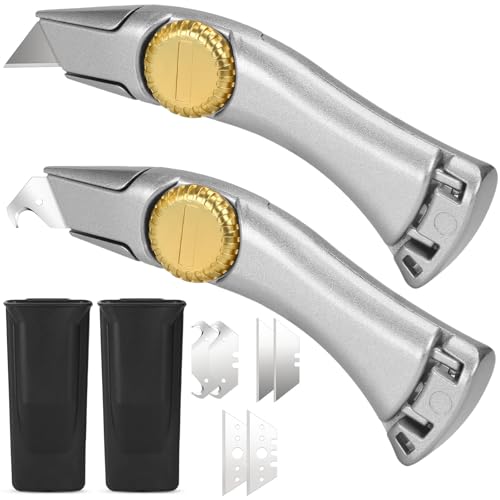
Most cutting jobs on a roof don’t stay in one lane. You’ll pull a knife through felt, then a moment later through vinyl, then through carpet offcut. The Lizenoz 2-Pack Silver Fixed Blade Roofing Knife answers that variety by bundling three differently designed blades (two of each profile) into a single kit. It’s a step up in versatility from the original Lizenoz set covered earlier, where fewer blade shapes were included.
The closed, fixed-blade design keeps the blade locked tight during long pulls, and the included sheaths give you something to slip the knife into between cuts. For someone who wants a single package that handles most non-metal roofing cuts, this is a tidy solution.
Useful Strengths
- Six blades across three profiles cover roofing, vinyl, drywall, and carpet.
- Closed fixed-blade design resists accidental retraction mid-cut.
- Included sheaths add safe carry between cuts.
- Two knives let you swap between tasks without blade changes.
Softer Spots
- Storing two sheaths takes more belt space than a single-knife setup.
Perfect Match For
Tradespeople cutting multiple material types during the same workday.
Reach For A Different Pick When
The Lizenoz 2-Pack Green Fixed Blade Roofing Knife is a better fit when ergonomic grip comfort is the priority.
Outfitting a small crew or stocking a full workshop drawer is a different math than picking a single knife. The WILLBOND 4 Pcs Roofing Knife Set in black lands in that lane, packing four knives in one buy. Compared with the two-packs from Lizenoz, this set doubles the headcount, which works for a two- or three-person crew running parallel cuts.
The blades are sculpted from aluminum and steel, giving the tools a sturdier feel than the all-plastic utility knives they sit alongside. The multiple blade shapes let workers keep a profile ready for felt, vinyl, or carpet without swapping mid-task.
Real-World Strengths
- Four-knife count suits a small crew or a well-stocked workshop.
- Aluminum and steel blade construction adds durability over basic utility knives.
- Multiple blade profiles handle a range of materials beyond roofing.
Less Ideal Details
- Black color can be hard to spot on dark felt or shadowed work surfaces.
Feature Snapshot
Built With In Mind
Small roofing crews and homeowners maintaining a stocked workshop drawer.
Swap It Out When
The WILLBOND 4 Pcs Roofing Knife Set in yellow wins on job sites where a dropped knife needs to be easy to find.
Visibility is a small safety detail that pays off the first time you set a knife down on a dark felt and walk away. The WILLBOND 4 Pcs Roofing Knife Set in yellow answers that practical problem with high-visibility handles that stand out against most roofing surfaces. It shares the same blade variety and four-knife count as the black set covered above, trading neutral looks for easy spotting.
For jobs where multiple workers share tools, the yellow handles make it obvious at a glance whose knife is whose. The aluminum-and-steel blades cover the same material range as the other WILLBOND sets.
Why It Works Well
- Yellow handles improve visibility on dark roofing materials and in grass.
- Four-knife count fits small crews or backup spares.
- Aluminum-and-steel blade build adds durability over plastic utility knives.
Worth Noting
- Bright color can show scuffs and dirt faster than darker handles.
Whose Shelf It Belongs On
Rooftop workers who lose track of small tools and want a knife they can spot from across the slope.
A Better Fit Elsewhere
The WILLBOND 4 Pcs Roofing Knife Set in red is a good fit when you want a color that stands out without going neon.
Color coding knives across a shop is a small organizational trick that makes a real difference when a project has you reaching for the right tool. The WILLBOND 4 Pcs Roofing Knife Set in red slots into that system, sitting between the bright yellow of the previous set and the neutral black earlier in this list. It’s the same four-knife bundle with the same aluminum-and-steel blade build.
For a workshop that already uses red, green, or yellow to sort cutting tools by task, the red version keeps the system intact without buying a different brand. It also stands out clearly on a dark workbench, which is its own kind of safety benefit.
What Earns Its Place
- Red handles stand out on dark benches and roofing materials.
- Four-knife count handles crew use or backup spares.
- Aluminum-and-steel blade construction adds durability over basic utility knives.
- Multiple blade profiles cover felt, vinyl, drywall, and carpet cuts.
A Few Limitations
- Red color can clash with paint-marking systems that already use red ink.
The Right Fit
Workshops that color-code tools by task and want a complete four-knife set in red.
Not Your Match When
Pick the Lizenoz 2-Pack Silver Fixed Blade Roofing Knife if you only need a two-knife set with extra blade profiles.
What To Weigh Before Choosing Your Cutting Setup
The right tool depends less on what’s popular and more on where the cutting actually happens. Most folks make the mistake of matching the tool to the brand instead of to the work.
Match the tool to the material, not the project. A pair of Wiss shears is built for sheet metal, not for underlayment or shingles. Using a metal shear on felt tears more than it cuts, and a roofing knife on steel will dull within minutes. Match the tool to the material you’re actually slicing.
Gauge limits matter more than brand names. Thicker steel panels (anything heavier than 26 gauge) need power tools, not hand shears. Pushing a hand tool past its capacity leads to jagged edges, jammed blades, and tired hands. Check the gauge rating before starting.
Hand tools reward setup and grip. Long straight cuts with industrial shears go faster with a smooth bench, a good straightedge, and a stable stance. Trying to make long cuts on a wobbly surface is the most common cause of crooked seams. Spend a minute on setup before each pass.
Roof work demands stability and visibility. Working on a slope means tools can slide, drop, or vanish into grass. Tools with rubber feet, fixed-blade locks, and bright handles earn their cost on the roof, even if the same features feel optional in a shop. Plan around where you’ll be working most.
Smart Habits For Tool Selection
Where Shoppers Go Wrong
The most common slip-up is buying a single tool and expecting it to handle every cut on the job. Metal roofing work shifts between cutting panels, trimming underlayment, and slicing shingles, and no one tool covers all three. The honest read is that a small kit of two or three tools usually beats one expensive all-in-one.
Another trap is underestimating gauge limits. A hand shear that handles thin flashing well can fold up when asked to cut 24-gauge steel. Match the tool to the thickest material in the project, not the average.
What Separates Premium From Basic
Higher-tier models in this category earn their cost through better materials and tighter pivots. Drop-forged steel blades, adjustable pivots, and aircraft-grade aluminum bodies all translate into longer tool life and cleaner cuts. For a once-a-year shed roof, basic tools do the job. For daily production work, the upgrade pays off in edge retention and reduced hand fatigue over time.
Frequently Asked Questions
What is the safest way to cut metal roofing panels? Snips and shears that cut without generating sparks or heat are generally safer than abrasive saws, which throw hot metal chips. Always wear cut-resistant gloves and eye protection, and secure the panel before each cut.
Can I use a circular saw to cut metal roofing? Yes, with a metal-cutting blade designed for the material’s gauge. Be aware that abrasive saws leave a rougher edge and create sparks, so protective gear and a stable work surface are important.
How do I avoid jagged edges on cut panels? Use a shear or nibbler rated for the panel’s gauge, and let the tool do the work without forcing the cut. Forcing a dull or undersized tool bends the edge rather than slicing it. A light pass with a file cleans up any remaining burr.
What’s the difference between fixed and retractable roofing knives? A fixed-blade knife locks into position and stays there, which gives a more stable cut. A retractable knife lets you slide the blade into the handle for safer carry, at the cost of a moving part that can loosen over time.
How thick of metal can hand shears handle? Most industrial hand shears cap out around 24 to 26 gauge steel. Anything heavier typically needs power tools, since the blade and pivot can’t generate enough leverage to slice through thicker stock cleanly.