Cutting styrofoam with a regular knife or saw is messy business. Tiny white beads scatter across the floor, edges crumble, and your neat rectangle turns into a jagged blob. A purpose-built hot knife melts through expanded polystyrene (EPS) and extruded polystyrene (XPS) cleanly, leaving a sealed edge that resists crumbling. Whether you’re building a stage prop, trimming insulation board, or sculpting a cosplay helmet, the right tool changes the whole experience. Below are seven options worth your attention, ranging from hobbyist kits to workshop-grade cutters built for longer sessions.
The Picks In Brief
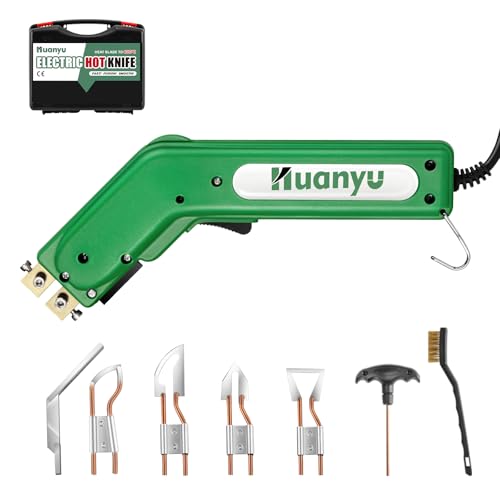
Huanyu Electric Hot Knife 4 Blades Kit 600°C

RONGTER 200W Air-Cooled Foam Cutter
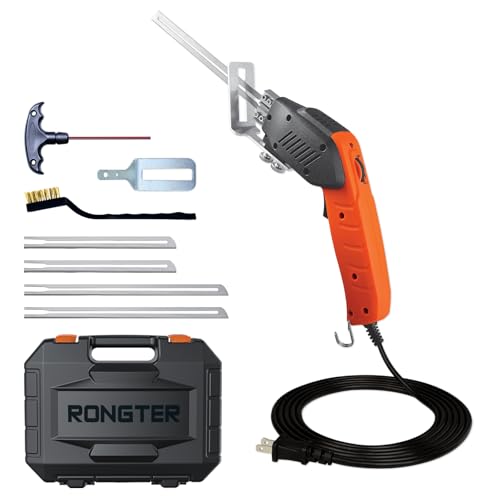
RONGTER 200W Electric Hot Knife Foam Cutter

RONGTER 300W Air-Cooled Foam Cutter

ROMECH 120W Hot Knife Foam Cutter Kit

Preciva Hot Knife Foam Cutter Digital Display 4 Blades

RONGTER Air-Cooled Electric Hot Knife
A Deeper Look At The Lineup
The Huanyu kit arrives with four interchangeable blades and a 600°C (1112°F) maximum temperature, which is enough heat to glide through dense foam and seal synthetic rope edges in a single pass. The copper knife holder conducts heat efficiently from the 100W element to the blade, so you spend less time waiting and more time cutting. In a home craft room, that quick heat-up is the difference between finishing a school project before dinner and watching the kid lose interest.
Compared to the larger RONGTER units covered below, the Huanyu feels more like a precision pen than a workshop tool, and that suits detail work well. Owners commonly report that the sealed edges it produces resist crumbling on EPS and XPS alike, which keeps stray beads off your workbench. For anyone who splits time between model-making and fabric projects, the multi-blade approach removes the need to buy separate tools.
What Makes Sense
- Four blade profiles handle straight cuts, curves, and grooved detail without swapping tools constantly.
- Copper knife holder transfers heat quickly, so you reach working temperature in roughly 6 seconds.
- Sealed edge finish on foam reduces the loose debris that normally litters your workspace.
- Works on rope and fabric too, giving you a single tool for mixed-material craft sessions.
Small Caveats
- Lower 100W rating means longer cuts through thick insulation may feel slower than the higher-watt RONGTER models.
- Storage for the four blades can be awkward; a small parts tray helps keep them organized.
- Like all hot tools, fumes from melting foam call for ventilation in enclosed rooms.
Who It Suits Best
Crafters who split their time between styrofoam, fabric, and rope projects and want one kit that handles all three without buying separate tools.
Where Another Pick Suits Better
For marathon sessions trimming thick insulation boards, the RONGTER 300W Air-Cooled Foam Cutter delivers the extra power headroom that matters more than blade variety.
This RONGTER cutter steps up to 200W and a generous 122°F to 1202°F adjustable range, putting real workshop capability into a hobbyist price bracket. The active fan cooling system supports up to 120 minutes of continuous cutting, which is roughly the length of a long Saturday build session. In a garage workshop, that runtime is the difference between finishing a project and stopping to let a tool cool down.
Where the Huanyu feels like a precision pen, this 200W model behaves more like a small power tool, and the temperature dial gives you finer control over how aggressively the blade melts through different foam densities. Owners commonly report that the wide heat range handles everything from soft packaging foam to firmer XPS insulation without bogging down. It sits in the middle of the RONGTER family, flanked by the lower-power B0CZKDZSFR and the higher-output 300W unit.
The Value In It
- 200W output with stepless temperature control handles both delicate and dense foam cleanly.
- Active fan cooling supports up to 120 minutes of continuous use before needing a rest period.
- Wide 122°F to 1202°F range suits packaging foam, craft sheets, and rigid insulation alike.
- For a workshop tool, the price-to-capability ratio is hard to beat in this category.
Worth Bearing In Mind
- Five-minute rest periods after long sessions mean timing your cuts around cooling windows.
- Larger and heavier than the pen-style Huanyu, so bench space matters in tight craft rooms.
Feature Card
Right Fit For
Home workshop hobbyists who trim insulation board, build theater props, or tackle multi-hour crafting projects and want a tool that won’t quit halfway through.
Swap It Out When
If you mainly do light craft cutting and rarely run past 15 minutes at a stretch, the ROMECH 120W kit offers simpler controls and lighter handling.
This is the sibling model to the previous RONGTER entry, sharing the same 200W platform and active fan cooling but positioned as a more general-purpose workshop tool. The adjustable temperature and power knob lets you tune the heat on the fly, which matters when switching between craft foam sheets and thicker insulation scraps. In a model-making hobby, that dial becomes the most-used control on the entire tool.
Where the Huanyu prioritizes blade variety, the RONGTER B0BBZWGBN4 prioritizes sustained cutting. Owners commonly note that the fan keeps the housing comfortable to hold even during back-to-back passes, and the consistent power delivery avoids the “sagging” effect cheaper tools show when the blade cools. For DIYers and prop builders, that reliability is what separates a fun Saturday project from a frustrating one.
A Favorable Mix
- Active cooling keeps the housing comfortable during extended cutting sessions.
- 200W output handles EPS, XPS, and most craft foams without bogging down on thicker stock.
- Adjustable knob makes mid-project temperature changes quick and intuitive.
- Suited to workshops, DIY builds, model-making, and general craft use in one package.
Trade-Offs To Consider
- Comes with a single blade configuration, so buying extra shapes is on you.
- Rest periods still apply after sustained cutting to protect the heating element.
Made For
DIYers and model makers who want steady, repeatable performance on foam projects ranging from quick repairs to multi-evening builds.
Another Choice May Suit
If precise temperature readout matters for repeatability, the Preciva Hot Knife with Digital Display offers a clearer reference than an analog dial.
At 300W, this is the most powerful option in the RONGTER family, designed for thick insulation board and demanding workshop use. The same active fan cooling that supports the lower-watt RONGTER models carries over here, helping maintain steady performance over longer sessions. For contractors trimming rigid foam on a job site, that extra wattage translates directly to faster passes through dense material.
Where the 200W siblings suit a craft room, the 300W version leans toward a workshop bench or a small contracting business. Owners commonly report that the extra power cuts cleaner through 2-inch and thicker insulation without requiring multiple slow passes, which adds up to real time savings on bigger jobs. It shares the same operating logic as the other RONGTER models, so transitioning between them feels natural.
Benefits That Matter
- 300W rating glides through thick insulation board in single passes, saving time on large jobs.
- Active cooling system supports up to 120 minutes of continuous cutting for demanding projects.
- Adjustable power knob offers fine control across a broad temperature range.
- Built for workshop, DIY, and model-making use at a heavier commercial-adjacent scale.
Honest Caveats
- Higher power means more heat output, so good ventilation matters in enclosed spaces.
- Heavier than the 200W siblings, which may cause hand fatigue on detailed overhead cuts.
- Overkill for casual crafters who mostly work with thin foam sheets.
Spec Overview
Who Should Grab It
Contractors, serious workshop hobbyists, and anyone trimming rigid insulation who needs the extra power to push through dense material without slow progress.
Look Elsewhere When
Casual crafters working with thin foam sheets will find the ROMECH 120W kit easier to handle and more than capable for everyday projects.
The ROMECH kit delivers 120W of power with a fifteen-step graduated temperature dial, which is the kind of straightforward control a first-time user can actually understand. The heated blade melts and seals edges on EPS and XPS foam board while also handling fabric and rope, giving beginners a forgiving entry point into hot-knife work. In a kitchen-table craft session with kids, that simplicity removes the trial-and-error that scares off new users.
Compared to the RONGTER workshop tools above, the ROMECH trades raw power and continuous runtime for ease of use and lower cost. Owners commonly mention that the dial markings make it easy to find a working temperature without burning a test scrap first, which is a real time-saver for someone still learning how different foams respond. The trade-off shows up when you push into thick material, where the lower wattage asks for slower passes.
Everyday Advantages
- Fifteen graduated heat settings help new users find the right temperature without guesswork.
- Sealed edge finish reduces loose foam debris and keeps work areas cleaner.
- Works on fabric and rope too, making it a versatile starter tool for mixed craft projects.
- Lighter and more approachable than workshop-grade RONGTER cutters.
Less-Strong Areas
- 120W is slower than the RONGTER 200W and 300W models on dense insulation board.
- No active cooling system, so longer sessions may require natural cooldown breaks.
Best Suited To
First-time foam cutter owners, parents helping with school projects, and hobbyists who want a forgiving tool without workshop-grade complexity.
A Better Fit Elsewhere
For long sessions with dense XPS, the RONGTER 200W Air-Cooled Foam Cutter provides the continuous runtime and active cooling this kit lacks.
The Preciva kit combines a digital temperature display with four blade sizes (8″, 6″, 4″, and 2″) and 20 settings spanning 200°C to 600°C (392°F to 1112°F). The pure copper base improves heat conduction from the 80W element, and an overheat protection circuit adds a safety margin during long sessions. For a model maker who needs to repeat the same temperature setting across multiple builds, that digital readout removes a meaningful amount of guesswork.
Where the Huanyu and ROMECH rely on analog dials, the Preciva’s screen gives you an exact number to work from, which matters when documenting your process or matching a previous project’s settings. Owners commonly appreciate the overheat protection for unattended rest moments. Compared to the higher-watt RONGTER units, the 80W rating is modest, so very thick material will test your patience.
Real-World Strengths
- Digital temperature readout lets you record and repeat exact settings across projects.
- Four blade sizes (8, 6, 4, and 2 inches) cover everything from broad cuts to fine detail.
- Overheat protection adds a useful safety margin during extended cutting sessions.
- 20 temperature settings spanning 200°C to 600°C offer precise control over a wide range of materials.
Points To Keep In Mind
- 80W rating sits below the RONGTER models, so thick insulation may require slower passes.
- More features mean a slightly higher learning curve than a simple dial-based tool.
Feature Rundown
Who Will Love This
Detail-oriented hobbyists and prop builders who value repeatability and want a digital reference for temperature settings across multiple projects.
Where A Sibling Pick Shines
For sheer cutting power on thick insulation, the RONGTER 300W Air-Cooled Foam Cutter outmuscles this kit by a wide margin.
This RONGTER entry rounds out the lineup with the same active fan cooling platform that runs through the brand’s other models, supporting up to 120 minutes of continuous cutting for steady home workshop use. The adjustable power knob covers the temperature range needed for typical craft and insulation projects without overwhelming a casual user. In a shared-space garage where the tool comes out a few times a month, that balance of capability and approachability is a real asset.
Where the higher-watt RONGTER 200W and 300W models target heavier workloads, this air-cooled unit occupies the middle ground for hobbyists who want cooling and adjustability without paying for workshop-grade power. Owners commonly report that the fan keeps the housing manageable to hold during longer sessions, and the same 5-minute rest advice applies between long runs. It’s the kind of tool you can leave on a shelf and pull out whenever a foam project appears.
Everyday Wins
- Active fan cooling supports up to 120 minutes of continuous cutting for typical hobby sessions.
- Adjustable power knob makes it easy to match heat to different foam types without swapping tools.
- Suited to workshops, DIY builds, model-making, and general craft use across a range of projects.
- More approachable for steady home use than the higher-watt RONGTER siblings.
Practical Considerations
- Lacks the raw power of the 300W RONGTER for thick commercial-grade insulation work.
- 5-minute rest periods after long sessions are still part of the operating rhythm.
Whose Shelf It Belongs On
Home workshop hobbyists who tackle a mix of foam projects at a steady pace and want active cooling without paying for maximum wattage.
Reach For A Different Pick When
If precision and repeatability matter more than runtime, the Preciva Hot Knife with Digital Display gives you an exact temperature reference this dial-based tool cannot.
Choosing The Right Hot Knife For Your Foam Projects
A hot knife works by heating a metal blade until it melts through polystyrene on contact, sealing the cut edge as it moves. That melting action is why clean edges matter so much: a rough or cool blade tears the foam instead of slicing it, leaving those familiar white crumbs everywhere. Understanding a few core attributes will steer you toward the right tool for your specific projects.
Power and Temperature Range
Wattage tells you how quickly a tool recovers heat after each pass. Lower-wattage units like the ROMECH 120W handle craft foam sheets well but slow down on dense insulation. Higher-wattage models like the RONGTER 300W push through rigid board faster. Temperature range matters equally: foam densities vary, and matching heat to material prevents scorching on soft sheets and stalling on thick ones.
Blade Variety and Shape
Different blade profiles cut different shapes. Straight blades handle long lines, hooked blades manage curves, and thin tips allow detail work on miniatures. The Huanyu and Preciva kits ship with multiple blade sizes, which adds versatility for varied projects without buying extras.
Cooling and Runtime
Active fan cooling extends how long you can cut before the tool needs a rest. The RONGTER air-cooled family supports up to 120 minutes of continuous use, while simpler designs rely on natural cooldown between passes. For marathon sessions, cooling capability is the difference between finishing a project and stopping mid-cut.
Handling and Comfort
Pen-style tools like the Huanyu feel light and precise, ideal for detail work. Larger 200W and 300W units weigh more but offer more power. Matching the tool’s size and weight to your hand and project scale prevents fatigue on longer builds.
Smart Shopper Notes For Foam Cutting Tools
Pitfalls Shoppers Hit
Buying a low-watt tool for thick insulation work is the most common mistake, leading to frustration when cuts stall and edges tear. Another trap is overlooking ventilation; melting foam releases fumes that call for an open window or workshop fan. Finally, skipping blade variety means buying a single-shape tool that limits you on curves and detail, often pushing you to buy a second kit later.
Where The Extra Money Goes
Higher-tier models earn their cost through longer runtime, active cooling, and broader temperature control. The 300W RONGTER commands its premium by pushing through dense material in single passes, saving real time on large jobs. Digital readouts on the Preciva add repeatability for documented projects. For occasional craft use, a basic kit handles the job, but regular workshop users recoup the upgrade cost through faster, cleaner cuts and less downtime waiting for tools to cool.
Frequently Asked Questions
What temperature works best for cutting styrofoam?
Most EPS foam cuts cleanly between 200°C and 300°C, while denser XPS often needs 300°C to 400°C. Starting low and raising the temperature in small steps prevents scorching.
Can a hot knife cut other materials too?
Yes, many of these tools handle rope, fabric, and thin plastic cord. The heated blade seals synthetic edges as it cuts, which prevents fraying on fabric and unraveling on rope.
Is ventilation necessary when using a hot knife on styrofoam?
Good airflow is strongly recommended because melting polystyrene releases fumes that should not accumulate in enclosed rooms. A workshop, garage, or open window setup keeps the air moving.
How long do hot knife blades typically last?
Blade life depends on use frequency and material, but quality blades handle dozens of cutting sessions before replacement. Keeping the blade clean and avoiding excessive heat extends its service life.
What’s the difference between EPS and XPS foam?
EPS (expanded polystyrene) is the soft, bead-style foam used in packaging and craft sheets. XPS (extruded polystyrene) is the denser, smoother board used in insulation. XPS needs more heat and power to cut cleanly.