


You don’t need a shop full of gear to get crisp, clean edges on your projects. The right trim router, paired with a bit that matches the material, can replace hours of sanding and hand-fitting with a single smooth pass. This guide focuses on the tools and bits that solve real shop problems: template work, flush trimming, edge profiling, and spoilboard surfacing. You’ll find both standalone routers and dedicated bit options here, because the bit you pair with a router matters as much as the motor driving it.
The Picks In Brief

Amana Tool AMS-177-K Spektra Coated V-Groove Bit Pack
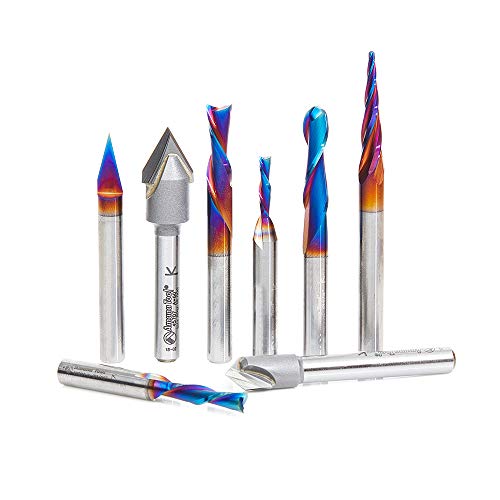
Amana Tool AMS-174 CNC Router Bit Collection

DEWALT 20V Max XR Cordless Router (DCW600B)

BOSCH 1617EVSPK 2.25 HP Router Combo Kit

Trvoxviq 1/2″ Shank Flush Trim Bit with Inserts

Trvoxviq Compression Spiral Flush Trim Bit 1/2″ Shank

Amana Tool RC-2255 Spoilboard Surfacing Bit

Trvoxviq Flush Trim Bit 1/2″ Shank 65mm

Trvoxviq DLC Coated Compression Bit 1/4 Shank
A Breakdown Of The Leading Choices
An eight-piece bit collection built for sign makers, CNC operators, and hobbyists who regularly cut composite or plastic materials alongside wood. The Spektra coating is a nanocomposite layer that resists heat buildup and extends tool life, which matters when you’re running long sessions on abrasive materials like MDF, HDU sign foam, or phenolic composites.
The wooden storage box keeps the set organized, and the 1/4″ shank fits most CNC spindles and trim routers with standard collets. Point roundover profiles (rounded cutting tips that produce softened V-groove edges) handle sign lettering and decorative grooves well, while V-groove bits handle chamfering and fold lines on cabinet backs. If you work across wood and synthetic materials in the same shop, this set consolidates several specialty bits into one kit.
Standout Benefits
- Nanocomposite coating holds up under heat during long CNC runs
- Versatile profile mix covers V-grooves, point roundovers, and sign-work geometries
- Wooden storage box protects bits and keeps the set shop-ready
- 1/4″ shank matches the standard collet on most trim routers and CNC spindles
- Strong fit for sign makers and fabricators working with foam, MDF, and plastic
Things To Consider
- Specialty profiles mean some bits go unused on basic trim work
- Higher cost per bit than single-purpose economy options
Feature Snapshot
Who It Suits Best
Sign makers, CNC operators, and shop owners who need coated bits for abrasive materials and want a single organized set covering multiple V-groove and profile tasks.
Where Another Pick Suits Better
For pure spoilboard surfacing on a CNC, the Amana Tool RC-2255 handles larger flattening passes more efficiently.
A general-purpose eight-bit collection designed to cover the most common CNC cutting tasks from day one. Where the AMS-177-K leans into V-groove and decorative work, this set broadens the scope with spiral plunge bits (cutters that pull material downward as they enter the workpiece, reducing tearout) and traditional profile tools.
You’ll find 60-degree and 90-degree V-grooves, two Spektra-coated spiral plunge bits in 1/8″ and 1/4″ diameters, and additional CNC-specific profiles. The wooden case keeps everything sorted. For shop owners who want a single kit that handles sign work, cabinet door construction, and detail cuts, the AMS-174 fills gaps that single-purpose sets leave open.
Real Benefits
- Includes two spiral plunge bits for clean entry cuts on laminated materials
- Spektra coating on key bits extends working life on hardwoods
- Mix of V-groove angles handles chamfer, fold, and decorative tasks
- Wooden case simplifies bit storage and transport
Worth Noting
- Doesn’t include a spoilboard surfacing bit for table flattening
- Some overlap with the AMS-177-K if you already own that set
Made For
CNC operators running a mix of cabinetry, sign, and detail work who want one organized bit kit instead of buying individual profiles piecemeal.
Consider Something Else When
If your workload centers on plywood and veneer flush trimming, a compression bit like the Trvoxviq Compression Spiral Flush Trim Bit gives cleaner top edges.
A cordless trim router built for users already running DEWALT’s 20V Max battery platform. The brushless motor delivers runtime and power comparable to small corded routers, and the tool-only configuration keeps the cost lower if you have batteries and chargers on hand. Variable-speed control adjusts RPM to match bit diameter and material, and dual LEDs illuminate the cut line on darker stock.
Where corded routers excel at bench work, this one shines in tight spaces, on ladders, and on installs where dragging a cord is impractical. The plastic fixed base keeps weight down, though you’ll want a stable grip for edge profiling. Pair it with the bits from picks 5 through 9 for a complete portable trim setup.
Points In Its Favor
- Brushless motor (no carbon brushes to wear, giving longer life and better efficiency) balances runtime with cutting power
- Dual LED work lights improve visibility on dark or figured wood
- Variable-speed dial matches RPM to bit size and material density
- Quick-release clamp speeds up bit changes during multi-pass projects
- Shares batteries with the rest of the DEWALT 20V Max system
Trade Offs
- Tool-only sale means batteries and charger are extra
- Plastic fixed base feels lighter than all-metal alternatives
Quick Facts
Right Fit For
Trim carpenters, cabinet installers, and DIYers who already own DEWALT 20V batteries and want cordless freedom for edge work and template routing.
Look Elsewhere When
Heavy-duty table-mounted work is better served by the corded BOSCH 1617EVSPK combo kit with its higher-amperage motor.
A workhorse router combo kit that pairs a fixed base with a plunge base on a single 12-amp, 2.25 HP motor. The constant-response circuitry (an electronic feedback system that keeps speed steady under load) maintains RPM under load, which matters when you’re pushing through hardwood or making deep passes in dense material. Variable-speed control covers a wide range to match router bit diameters and workpiece density.
The one-piece armature shaft (the rotating internal shaft connecting motor to collet) reduces vibration compared to assembled designs, and the threaded three-hole base pattern mounts securely to router tables. For shop owners building cabinets, doors, and raised panels, the 1617EVSPK has been a long-standing option because of its power and dual-base versatility.
Benefits That Matter
- 2.25 HP motor handles hardwoods and large-diameter bits without bogging
- Constant-response circuitry holds speed under heavy load
- Includes both fixed and plunge bases for bench and handheld work
- Three-hole base pattern fits standard router table plates
- One-piece armature shaft reduces vibration for smoother cuts
Honest Caveats
- Heavier than cordless trim routers, tiring on long handheld sessions
- Older design lacks some ergonomic refinements of newer models
- Corded operation limits portability on jobsites without power
Spec Overview
Best Suited To
Full-shop cabinet builders, furniture makers, and serious woodworkers who want a powerful corded router with both bases for table-mounted and handheld operations.
A Better Fit Elsewhere
For quick jobsite touch-ups or installs where cordless convenience matters more than raw power, the DEWALT DCW600B simplifies the setup.
A heavy-duty flush trim bit built around replaceable carbide inserts rather than a fixed cutting edge. The 1/2″ shank handles high-volume template work without deflection, and the dual top and bottom bearings (small rotating rings that ride against the template edge) let you work from either side of the workpiece. The bit ships with eight installed inserts plus ten replacements, so you can rotate or replace cutters before scrapping the body.
The trade-off is a 3/4″ cutting diameter, which limits you to thicker stock and larger template work. For cabinet door production or countertop template work where you’re burning through standard flush trim bits, the replaceable-insert design reduces long-term tooling costs and minimizes downtime.
Useful Touches
- Replaceable inserts cut long-term tooling costs on production runs
- 1/2″ shank reduces chatter (bit vibration that causes rough cuts) on deep passes
- Top and bottom bearings allow flipping the workpiece for two-sided template work
- Includes ten spare blades for extended use between replacements
Points To Note
- 3/4″ cutting diameter limits use on thin stock under 1/2″
- Requires a router with a 1/2″ collet (some trim routers only accept 1/4″)
- Insert screws need periodic checking, which adds a small maintenance step
Who Will Love This
Production cabinet makers and template-heavy shops that cycle through flush trim bits quickly and want replaceable-insert economics instead of replacing whole bits.
Skip It When
If you run a 1/4″ collet trim router like the DEWALT DCW600B, a smaller-shank flush trim bit such as the Trvoxviq DLC Coated Compression Bit fits without a collet adapter.
A compression spiral bit (a cutter whose teeth shear downward into the top face and upward into the bottom face, compressing the cut in the middle) designed to eliminate tearout on both veneer faces when trimming plywood and laminated panels. The 1/2″ shank and 1-5/8″ cutting length handle thick workpieces, and the bottom bearing rides along templates or pattern edges.
The geometry pulls chips up on the bottom half of the cut and pushes them down on the top half, which means the cut edge stays clean on both sides of the workpiece. For cabinet builders working with veneered MDF or birch ply, that’s the difference between a glue-ready edge and one that needs edge banding. The solid carbide construction holds up to repeated use on hardwoods and engineered panels.
What It Does Well
- Compression cut prevents tearout on both top and bottom veneer faces
- Bottom bearing tracks templates accurately
- 1-5/8″ cutting length reaches through thick cabinet sides
- Solid carbide body holds an edge through extended production runs
Points To Keep In Mind
- 1/2″ shank requires a router with a matching collet
- Compression design means the full cutting length must clear the workpiece, limiting use in shallow pockets
Feature Card
Perfect Match For
Cabinet builders and furniture makers working with veneered plywood or laminated panels who need tearout-free edges without edge banding.
Another Choice May Suit
For high-volume work where replaceable inserts reduce tooling cost, the Trvoxviq Flush Trim Bit with Inserts is a more economical daily driver.
An industrial-grade spoilboard surfacing bit built to flatten and refresh CNC machine tables. The 2″ cutting diameter and three-flute design remove material quickly, and the 1/2″ shank fits the high-torque spindles common on CNC routers. The bit cuts a clean, level surface across MDF or phenolic spoilboards (the sacrificial surface beneath workpieces that absorbs cutting damage), which is essential for accurate depth calibration on every job that follows.
This isn’t a trim router bit for edges; it’s a shop maintenance tool. Run it across a worn spoilboard when depth calibration drifts, and you’ll reset your table to true in a single pass. Owners commonly use it with a dust collection system because surfacing produces a heavy chip load.
Where It Excels
- 2″ cutting diameter flattens large spoilboard areas in fewer passes
- Three-flute geometry balances chip load and surface finish
- Industrial-grade carbide handles repeated shop use
- Restores consistent depth calibration across the table surface
Practical Considerations
- Requires a CNC router with adequate horsepower and 1/2″ collet
- Overkill for handheld trim work or small-shop bench routing
Built With In Mind
CNC shop operators with phenolic or MDF spoilboards who need to periodically resurface their tables for accurate, repeatable cuts.
Reach For A Different Pick When
For handheld trim and edge work on individual workpieces, a smaller-diameter bit like the Trvoxviq Flush Trim Bit 1/2″ Shank is the right tool for the job.
A pattern/template flush trim bit with double bearings, meaning one rides the template while the other stabilizes the cut, and a 65mm cutting length that handles thicker workpieces. The spiral up-cut geometry pulls chips upward, which keeps the template surface clean and prevents burn marks on the guide edge.
For duplicating shaped parts across multiple pieces, the dual-bearing setup gives you a stable reference point and reduces the wandering that single-bearing bits can develop on long cuts. Pair it with plywood, MDF, or solid wood templates and your workpiece takes the exact shape of the pattern.
Useful Strengths
- Double bearings stabilize the bit on long template passes
- 65mm cutting length reaches through thick stock
- Spiral up-cut clears chips away from the template edge
- Solid carbide body holds up on hardwood and engineered panels
A Few Limitations
- Up-cut design can lift delicate veneers on the bottom face
- 1/2″ shank requires a compatible collet
Whose Shelf It Belongs On
Pattern makers and production shops that duplicate shaped parts from templates and need a stable, accurate flush trim bit for consistent results.
Where A Sibling Pick Shines
For veneered plywood where both faces must stay clean, the Trvoxviq Compression Spiral Flush Trim Bit’s compression design prevents the lifting this up-cut can cause.
A 1/4″ shank compression bit, sized for the smaller collets found on most trim routers, including the DEWALT DCW600B. The DLC (Diamond-Like Carbon) coating is a hard, low-friction layer that resists heat and pitch buildup (resin accumulation that sticks to bit flutes), so the bit runs cooler and stays cleaner during extended trimming sessions.
The 1″ cutting length handles typical cabinet stock without bogging down smaller routers, and the top and bottom bearings let you flip the workpiece for two-sided template work. For detail-oriented trim work where you want tearout-free edges on veneered panels without dragging out a full-size router, this bit fits the bill.
What Earns Its Place
- DLC coating reduces heat and pitch adhesion during long cuts
- 1/4″ shank fits standard trim router collets without adapters
- Compression cut keeps both veneer faces clean
- Top and bottom bearings allow two-sided template work
Some Limits To Know
- 1″ cutting length is shorter than the 1/2″ shank compression option
- Smaller shank has slightly more deflection on aggressive deep passes
Who Should Grab It
Trim router owners working with veneered plywood or panels who want tearout-free edges without switching to a full-size router for every pass.
Swap It Out When
For thicker stock or deeper cuts where deflection becomes an issue, the Trvoxviq Compression Spiral Flush Trim Bit 1/2″ Shank offers more rigidity.
What To Weigh Before Choosing A Trim Router Setup
Router choice and bit choice work as a system, so the first call is what kind of work dominates your shop. Handheld trim work, table-mounted profiling, and CNC operations each push toward different tools. Cordless trim routers like the DEWALT DCW600B make sense for installs and quick setups, while the BOSCH 1617EVSPK handles the heavier bench work where power and dual-base versatility matter more than portability.
Matching Shank Size To Your Router
Router collets typically come in 1/4″ and 1/2″ capacities, and the bit shank must match. A 1/2″ shank bit like the Trvoxviq Compression Spiral Flush Trim Bit resists deflection better in deep cuts, but you need a router that accepts that shank. Smaller trim routers often accept only 1/4″ shanks, which is where bits like the Trvoxviq DLC Coated Compression Bit fit without adapters. Before buying bits, confirm your router’s collet size and pick accordingly.
Bearings And Template Work
Flush trim and pattern bits use bearings (small rotating rings) that ride along a template edge to guide the cut. Top and bottom bearings let you flip the workpiece for two-sided work, while bottom-only bearings keep the design simpler. For duplicating shapes across multiple pieces, a stable bearing setup matters more than a slightly faster cut, because wandering bits multiply error across every repetition.
Coatings And Bit Longevity
Coatings like Spektra (a nanocomposite layer) and DLC (Diamond-Like Carbon) reduce heat, resist pitch buildup, and extend bit life. They cost more up front but pay off on long production runs, abrasive materials like MDF, and hardwoods that dull standard bits quickly. For occasional hobby use, uncoated solid carbide is fine. For daily shop work, the coated options are worth the difference.
Profile Geometry And Cut Quality
The cut direction matters. Up-cut spiral bits pull chips upward, leaving clean bottom edges but risking tearout on top faces. Down-cut spiral bits push chips down, which is the opposite trade-off. Compression bits combine both, shearing downward on top and upward on bottom, so both faces stay clean on veneered panels. The right choice depends on whether your project shows one face, two faces, or none.
Common Slip Ups Worth Dodging
Where Shoppers Go Wrong
One frequent mistake is buying a bit before confirming the collet size. A 1/2″ shank bit won’t fit a 1/4″ collet, and step-down collets (sleeves that let smaller shanks fit larger collets) don’t always seat properly, causing runout (wobble in the spinning bit that ruins cut quality). Match shank to collet first, then pick profiles.
Another common error is assuming all “trim router” bits are interchangeable across CNC and handheld use. CNC bits like the Amana Tool RC-2255 run at lower RPMs and higher torque than typical trim routers, so using them on a small handheld router can overheat the motor. The reverse problem happens when hobby bits can’t survive the feed rates (how fast the bit moves through material) of a CNC.
Why Premium Coatings Cost More
Coated bits command higher prices because the coating process adds manufacturing cost and the coatings themselves use advanced materials. Spektra and DLC coatings extend working life on abrasive materials, reduce heat during long cuts, and resist the pitch that clogs uncoated bits.
For shops running bits daily on MDF, plywood, or hardwood, coated bits reduce replacement frequency and downtime. For occasional weekend projects, uncoated solid carbide is more cost-effective because the workload doesn’t justify the coating premium. Spending up makes sense when your time spent changing bits and the cost of frequent replacements outweigh the upfront price difference.
Frequently Asked Questions
What Collet Size Do Most Trim Routers Use?
Most handheld trim routers accept 1/4″ shank bits, while full-size routers and CNC spindles often handle 1/2″ shanks. Some routers include interchangeable collets for both sizes. Always check your router’s specifications before buying bits with a different shank size.
Can A Trim Router Handle Full-Size Cabinet Doors?
For smaller doors and light use, a trim router works fine. For raised panels, deep cuts, or large production runs, a full-size router like the BOSCH 1617EVSPK delivers more torque and stability. The motor size and bit capacity matter more than the tool category.
How Often Should Flush Trim Bits Be Replaced?
Replacement depends on material and usage. Coated bits on MDF last longer than uncoated bits on hardwood. Replace when cut quality drops, edges show tearout, or bearings stop spinning freely. Coatings like Spektra and DLC extend life significantly on abrasive materials.
Are CNC Bit Sets Worth It For Hobbyists?
A CNC bit collection like the Amana Tool AMS-174 or AMS-177-K covers the most common profiles in one purchase, which beats buying individual bits at higher per-piece cost. For hobbyists who run a small CNC occasionally, the upfront cost pays off as projects require different profiles over time.
What’s The Difference Between A Compression Bit And A Standard Flush Trim Bit?
Standard flush trim bits cut in one direction, which can cause tearout on the opposite face. Compression bits cut downward on the top half and upward on the bottom half, keeping both faces clean. The trade-off is higher cost and the need for the full cutting length to clear the workpiece.




