


A flat tire never picks a convenient moment. Whether you’re topping off a sedan before a road trip, airing up a bike for a weekend ride, or keeping a small workshop humming, a dependable compressor saves a call to roadside service. The trick is finding one that does the job without paying for features you’ll never touch. This roundup pulls together eight options spanning pocket-size inflators, quiet workshop models, and heavy-duty dual pumps, each picked for a specific kind of user.
How The Shortlist Stacks Up

WarWolf Smart Tire Inflator with Auto Shut-Off

Aproca Hard Storage Case for Powools Inflator
Anthalo 2026 Tire Inflator 40L/min

KUXISA Tire Inflator with Digital Gauge

Makita MAC210Q Quiet Series 2-Gallon Compressor
HOTO Air Pump ADV with LED Light

dormzie 2026 Upgraded Tire Inflator with Type-C

VIAIR 444C Dual Air Compressor 2-Pack
More On The Choices That Made The List
The WarWolf Smart Tire Inflator suits the kind of driver who checks pressures in the driveway, not at a service station. Preset your target between 2 and 160 PSI (pounds per square inch, the standard tire pressure unit), and the unit stops itself the moment that number is hit, removing the over-fill risk that comes with eyeballing a gauge. The display reads in PSI, Bar, kPa, or kg/cm², which is handy for anyone juggling different vehicles or imported equipment.
For commuters running a quick top-up before work, the auto shut-off is the real time-saver. You clip the hose on, walk away for ten seconds, and come back to a properly aired tire. It sits between the Anthalo 2026 and the KUXISA on price and capability, leaning more toward ease-of-use than raw airflow.
What It Does Well
- Auto shut-off at preset PSI prevents over-inflation during routine top-ups
- Four unit readouts (PSI, Bar, kPa, kg/cm²) cover most vehicle and equipment standards
- Compact form factor stows in a trunk or hatch without eating cargo space
- Real-time digital sensor gives a clear readout while inflating
- Wide 2–160 PSI range handles bicycles, motorcycles, and car tires from one unit
Trade Offs
- Not built for high-volume continuous duty, so workshop use wears the motor faster
- Cord and hose length may feel short for some truck and SUV wheel wells
Key Specs
Whose Garage It Belongs In
Daily drivers and commuters who want a set-and-forget inflator for monthly top-ups without a trip to the gas station.
Where Another Pick Suits Better
Road-trippers running larger SUV tires will find the Anthalo 2026 Tire Inflator 40L/min a faster match for high-volume fills.
The Aproca Hard Storage Case is an accessory, not an inflator on its own, so it earns its place here for a specific scenario: anyone who already owns the matching Powools tire inflator and needs a safe way to keep it. Built from high-density EVA (a rigid foam that absorbs shock) and 1680D fabric (a tight-weave ballistic nylon), the shell shrugs off the scuffs that come with a trunk full of groceries or tools.
A mesh inner pocket holds the nozzle attachments and charging cable, while a sturdy handle keeps the grab-and-go simple. It’s the kind of thing you forget you need until your inflator rattles around in the trunk and a nozzle cracks.
Everyday Perks
- Hard EVA shell protects against drops, scuffs, and trunk cargo pressure
- Inner mesh pocket keeps nozzles and cables from getting lost
- Double zipper glides smoothly even after months of use
Points To Note
- Custom-shaped for the Powools inflator, so fit on other brands is not guaranteed
- Only useful if you already own a compatible inflator
Who Should Grab It
Powools inflator owners who keep their gear in a trunk or cargo bin and want the accessories organized in one place.
Skip It When
You don’t own the matching Powools unit, in which case a generic soft pouch like the one bundled with the WarWolf Smart Tire Inflator may serve you fine.
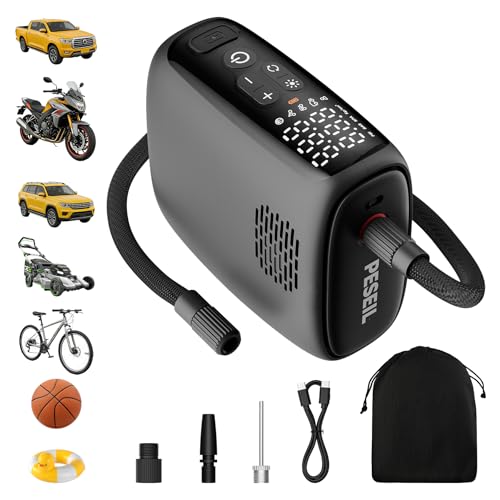
The Anthalo 2026 is built around airflow rather than just maximum pressure. A 28mm cylinder (the chamber where air compresses) paired with a permanent-magnet motor and a two-stage compression structure (air squeezed twice before exiting) pushes 40 liters per minute, which matters when you’re filling a tire from low rather than topping off a few PSI.
For drivers who actually have to wrestle an under-inflated tire back to spec on a roadside shoulder, that throughput is the difference between a two-minute job and a ten-minute one. Compared to the WarWolf at the top of this list, the Anthalo trades some pressure-range polish for raw speed.
Strong Points
- 40 L/min airflow speeds up fills from low pressure significantly
- Two-stage compression design reduces heat buildup during longer runs
- Permanent-magnet motor handles repeated cycles without bogging down
- High-efficiency cylinder suits SUV and light-truck tire volumes
Less Ideal Details
- Larger motor means more bulk than pocket-size inflators like the HOTO Air Pump ADV
- Heat during extended use can shorten run times before a cool-down pause
Built With In Mind
SUV owners and frequent road-trippers who refill from low pressure often enough that fill speed matters more than compact size.
Swap It Out When
You mostly top off a single sedan or bike once a month, in which case the WarWolf Smart Tire Inflator is the simpler tool for the job.
The KUXISA inflator leans hard into the “first time using one” crowd. Five smart modes cover the usual suspects, and the digital pressure gauge takes the manual reading out of the equation. Set your target PSI and walk away, the same way the WarWolf works, but with a different button layout and a black housing that hides scuffs in a shared garage.
You get up to 150 PSI of headroom and an auto shut-off that stops the pump at the preset number, useful for avoiding the slow leak that comes from an over-stretched sidewall. The trade-off versus the Anthalo 2026 is fill speed; this is a measured, calmer unit rather than a sprint specialist.
Well-Handled Touches
- Five preset modes remove the guesswork for car, motorcycle, bike, ball, and custom fills
- Auto shut-off at target PSI protects against over-inflation on sidewalls
- Clear digital gauge displays live pressure in PSI
Soft Spots
- Fill speed trails the Anthalo 2026 by a noticeable margin
- Preset modes work best when your tire pressure matches the standard chart
Best Suited To
First-time inflator owners who want a no-learning-curve unit for occasional top-ups across different vehicle types.
Not Your Match When
You fill larger SUV tires often; the Anthalo 2026 Tire Inflator 40L/min gets you back on the road faster.
The Makita MAC210Q is a different category of tool from everything else on this list. This is a plug-in workshop compressor: a 1 HP motor, 2-gallon tank, oil-free pump, and a Quiet Series design that drops operating noise to a level where you can run it indoors without a headache. It pairs naturally with brad nailers, finish nailers, and small spray guns in a garage or basement shop.
Where the WarWolf or Anthalo inflators are grab-and-go, the MAC210Q sits on a bench and serves a fixed space. The 2-gallon reserve handles short burst tool work without constant cycling, and the oil-free pump cuts the maintenance routine down to a quick air-filter check.
Useful Touches
- Quiet Series design keeps noise low enough for indoor residential use
- Oil-free pump removes the oil-change step common to older shop compressors
- 2-gallon tank handles short bursts from brad nailers and trim guns
- 1 HP motor balances output with a manageable 15-amp household draw
Honest Caveats
- Not a portable unit, so inflating a flat on the road is not its job
- 2-gallon reserve runs short for high-demand air tools like impact wrenches
Quick Facts
The Right Fit
Garage and basement workshop users running finish nailers, small spray guns, or hobby tools who need a low-noise, low-maintenance stationary unit.
Look Elsewhere When
You need something to toss in a trunk; a portable inflator like the HOTO Air Pump ADV is the better tool for that job.
The HOTO Air Pump ADV earns its travel-friendly reputation through a quick-attach nozzle and a built-in LED that turns a dark parking lot into a workable space. The 4+1 mode setup covers car, motorcycle, bike, ball, and a custom PSI preset, so the same unit handles a soccer ball in the morning and a sedan tire on the way home.
Claimed fill times place a 29-to-36 PSI car top-up at around two minutes, which keeps pace with the KUXISA but lands behind the Anthalo 2026’s higher-output cylinder. The trade-off shows up in size: the HOTO is closer to a water bottle than a brick, so it lives in a glovebox rather than a trunk bin.
A Few Strong Suits
- Built-in LED light handles nighttime tire checks without a phone flashlight
- Quick-attach nozzle locks on without manual threading
- Five modes cover car, motorcycle, bike, ball, and custom PSI
- 150 PSI ceiling handles high-pressure bicycle and sports equipment
Worth Bearing In Mind
- Fill speed lags the Anthalo 2026 on larger SUV tires
- Compact housing means a shorter internal battery runtime per charge
Perfect Match For
Multi-vehicle households that want one inflator to share between a car, a bike, and weekend sports gear.
A Better Fit Elsewhere
Drivers who frequently refill large SUV or truck tires will appreciate the Anthalo 2026 Tire Inflator 40L/min for its higher airflow.
The dormzie 2026 Upgraded leans into the road-trip use case. Type-C charging means the same cable that juices your phone tops off the pump, and the bundled 12V car adapter and storage box give it a place to live when it’s not in use. Auto shut-off at the preset PSI keeps you from babysitting the gauge.
For anyone who already carries a Type-C brick in the glovebox, the dormzie removes the extra wall adapter. The maximum of 150 PSI in custom mode matches the HOTO and KUXISA, so the difference here is convenience rather than raw capability. The included storage box, similar in spirit to the Aproca case earlier on the list, keeps the nozzles and cable from disappearing into the trunk abyss.
Standout Benefits
- Type-C charging removes the need for a separate proprietary cable
- Included storage box keeps the inflator and accessories in one place
- 12V car adapter allows fills away from a wall outlet
- Auto shut-off at preset PSI prevents over-fills during distraction
Where It Is Less Suited
- Heavier than the HOTO Air Pump ADV when packing light
- Storage box adds bulk for users who already have a pouch system
Feature Snapshot
Who Will Love This
Road-trippers and multi-day drivers who already carry Type-C gear and want one less wall adapter in the bag.
Reach For A Different Pick When
You want the smallest possible glovebox footprint, in which case the HOTO Air Pump ADV is a tighter fit.
The VIAIR 444C sits at the opposite end of the spectrum from the pocket inflators earlier in the list. This is a 12V dual-compressor setup sold as a 2-pack, designed for continuous duty on air suspension systems, onboard air tanks, train horns, and the kind of pneumatic accessories that would burn out a consumer inflator in a week.
Each unit reaches 200 PSI with a 100% duty cycle at 100 PSI, which means the pumps can run for extended periods without overheating. The chrome housing is purely cosmetic, but it does match the under-hood look of most custom builds. For air-ride installers and truck owners running onboard accessories, the 444C pair is the kind of tool you wire in once and forget about.
What Earns Its Place
- Continuous-duty rating supports long run times for air tank fills
- 200 PSI ceiling handles suspension bags, horns, and pneumatic tools
- Dual-pack configuration balances air delivery across paired accessories
- 12V design wires directly into a vehicle electrical system
Practical Considerations
- Requires permanent installation with wiring, relays, and a pressure switch
- Not a portable tool, so it can’t serve as a grab-and-go inflator
- Setup complexity far exceeds a plug-in consumer inflator
Core Details
Made For
Custom vehicle builders and air-suspension owners running onboard air tanks, horns, or pneumatic accessories that need continuous-duty pumping.
Consider Something Else When
You need a portable inflator for a daily driver, where the WarWolf Smart Tire Inflator or Anthalo 2026 Tire Inflator 40L/min fits the use case more directly.
What To Weigh Before Choosing A Value Air Compressor
Match the tool to the job, not the other way around. A pocket inflator is a maintenance tool, while a workshop compressor is a power tool, and the line between them runs through how often you fill, what you’re filling, and whether you need the unit to be portable.
Portability versus tank size. If you’re airing up a sedan tire in the driveway once a month, a portable inflator like the WarWolf or HOTO Air Pump ADV is the right call. If you’re running brad nailers in a basement shop, a stationary unit like the Makita MAC210Q with a 2-gallon tank handles burst work without the pump cycling every few seconds. Choose based on where the work happens.
Pressure range versus airflow. Pressure ceiling, measured in PSI, sets the maximum output, while airflow, measured in liters per minute, sets how fast you get there. The Anthalo 2026 prioritizes airflow at 40 L/min, which matters for low-pressure fills on larger tires. The WarWolf prioritizes a wide 2-to-160 PSI range, which covers everything from bicycle tubes to light truck tires. Both metrics matter, but their balance depends on what you fill most.
Duty cycle and use case. Consumer inflators are built for short bursts, not continuous operation. The VIAIR 444C is the only pick here rated for continuous duty, which is why it suits onboard air systems rather than driveway top-ups. Running a consumer inflator for ten straight minutes risks overheating the motor.
Noise, power, and storage. Oil-free pumps like the one in the Makita MAC210Q cut maintenance but don’t always run quiet, though Makita’s Quiet Series design specifically targets lower noise output. Storage boxes like the dormzie 2026’s bundle or the Aproca Hard Storage Case keep accessories from disappearing into a trunk or garage bin.
Key Considerations Across These Picks
Pitfalls Shoppers Hit
A common mistake is buying on maximum PSI alone. A 150 PSI ceiling sounds impressive, but most car tires run between 30 and 35 PSI, and most bicycles sit between 60 and 100. What actually affects daily use is fill speed, sensor accuracy, and the auto shut-off that prevents over-inflation. A lower-rated unit with a tighter sensor will serve a daily driver better than a high-rated unit with a sloppy gauge.
Another trap is underestimating the difference between a portable inflator and a workshop compressor. The Makita MAC210Q and VIAIR 444C live in completely different categories from the WarWolf or HOTO, even though they share the word “compressor.” Buying the wrong category means ending up with either a workshop tool in your trunk or a pocket inflator trying to run a paint gun.
Where The Extra Money Goes
Higher-tier models like the Anthalo 2026 and VIAIR 444C spend their premium on motor quality, airflow output, and continuous-duty ratings. The Anthalo’s two-stage compression and 28mm cylinder reduce heat buildup during longer fills. The VIAIR’s 100% duty cycle at 100 PSI is the difference between a pump that runs and a pump that runs all afternoon. You pay more for the ability to fill faster, longer, or under heavier load, and the upgrade pays off when your use case actually stresses those limits.
Frequently Asked Questions
What PSI should a typical car tire be inflated to? Most passenger car tires run between 30 and 35 PSI, though the exact figure is printed on the door jamb placard, not molded into the sidewall. Always cross-check before setting a target on any auto-shutoff inflator.
How often should tire pressure be checked? Monthly checks catch slow leaks before they affect fuel economy or tire wear, and seasonal swings of 10 degrees or more can shift pressure by a few PSI. Carrying a portable inflator in the trunk makes those monthly checks a five-minute job.
Are portable inflators powerful enough for truck or SUV tires? Most portable inflators handle standard SUV tires, though fill times stretch for larger volume fills. High-output models like the Anthalo 2026 cut that fill time significantly compared to standard pocket units.
What is oil-free versus oil-lubricated pump design? An oil-free pump uses permanently sealed bearings and self-lubricating materials, removing the need for routine oil changes. Oil-lubricated pumps run quieter and cooler but require periodic oil checks. The Makita MAC210Q uses an oil-free design for lower maintenance.
Can one inflator work for cars, bikes, and sports balls? Yes, as long as the unit has multiple pressure presets and a flexible PSI range. Models like the HOTO Air Pump ADV and KUXISA Tire Inflator include dedicated modes for cars, bikes, and balls, so a single unit covers a household’s range of inflation needs.




