


Hanging a TV, mounting a floating shelf, or running a new cable line all start with the same quiet question: what’s actually inside this wall. A solid wall scanner turns guesswork into a confident pencil mark, and the difference between a basic edge-finder and a multi-mode radar unit is the difference between a small repair and a shocked electrician visit. This shortlist focuses on the models that consistently deliver for homeowners, renovators, and working tradespeople. The goal is simple, match the tool to the walls you actually live with.
How The Shortlist Stacks Up

FNIRSI WD-01 6-in-1 Rechargeable Stud Finder
Zircon MultiScanner A200 Stud Finder

WALABOT DIY 2 Wall Scanner for Smartphones

Franklin Sensors ProSensor MAX 13-Sensor Stud Finder

Bosch D-tect 120 Professional Wall Scanner

Zircon MultiScanner A250c Stud Finder

Walabot DIY 2 Wall Scanner with Carrying Case

FNIRSI WD-02 6-in-1 Stud Finder with TFT

Bosch GMS120-27 12V Max Wall Scanner
Inside Each Recommended Option
First-time renovators tend to reach for the simplest tool they can find, and the FNIRSI WD-01 fits that brief nicely. A small positioning hole on the housing lets you mark stud edges and centers with a pencil tip right where the sensor sees them, so the guesswork that ruins picture frames largely disappears. The rechargeable body is a quiet upgrade over battery-swapped units for anyone who forgets spares in a drawer.
Six scan modes cover the usual targets: wood studs, metal framing, copper and iron pipe, and live AC wiring. The body sits comfortably in either hand, and the audio tone shifts as you approach a target, which is helpful when your eyes are on a level line. It is best viewed as a confidence-builder rather than a deep-scan specialist.
Notable Gains
- The on-housing positioning hole makes accurate pencil marks faster than a marker stuck on the wall.
- Six scan modes cover wood, metal, pipe, and live wire in one unit.
- Rechargeable battery removes the cost and clutter of cell replacements.
- Audio cue intensity changes as you approach a target, so you keep your eyes on the layout marks.
Things To Consider
- It will not see as deep through plaster or thick tile as the multi-sensor options later on this list.
- Owners commonly report that repeated calibration on denser walls takes patience.
At A Glance
Who It Suits Best
New DIYers mounting shelves, mirrors, or a first wall-mounted TV in a typical drywall home.
Where Another Pick Suits Better
For thick plaster or tile walls, the Franklin Sensors ProSensor MAX reads deeper with less calibration fuss.
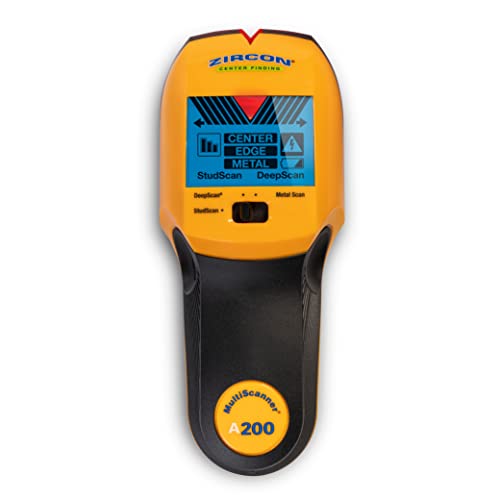
The Zircon MultiScanner A200 sits in that middle band where weekend warriors land, with enough capability to handle real projects without a learning curve that takes all Saturday. Center-finding is the headline feature, so you identify the middle of a stud rather than guessing between two edge signals, and the A200 also shows stud direction across a short run. The on-screen display is small but readable in normal room light.
Metal and live-wire modes help when you suspect old wiring or plumbing inside a wall you did not build. The A200 targets the same household tasks as the FNIRSI WD-01 above but with Zircon’s center-finding logic, which tends to feel more deliberate in tight mounting layouts. It runs on a 9V cell, so factor in replacements if you forget to switch it off.
Bright Spots
- Center-finding reads the middle of a stud, not just the edge, so anchor placement is more accurate.
- Dedicated metal and live-wire modes add safety for older homes with mixed wiring.
- The audible and visual target indicators make for a clean learning curve.
Worth Noting
- A single 9V battery powers it, so long sessions mean carrying a spare cell.
- Reading depth on dense plaster is shallower than the radar-based units in this list.
Feature Snapshot
Made For
Homeowners hanging cabinets, mirrors, and handrails who want a clear center mark and live-wire warning.
Look Elsewhere When
For visual pipe and wire tracking inside tile or masonry, the WALABOT DIY 2 shows the path on a phone screen.
Where traditional stud finders beep and blink, the WALABOT DIY 2 turns your phone into the display, which changes the experience more than it sounds. The unit pairs with Android and iOS devices, and the app draws a live map of studs, pipes, and wires as you slide it across the wall. You see the path, not just a point. Two scan modes, an Images setting and an Expert view, let you choose between a simple picture and a more detailed read.
This is a different kind of tool, one that rewards people who like reading screens rather than audio cues. It finds the center of wood and metal framing, tracks the route of pipes and wires, and can even reveal movement behind the surface. For anyone who already uses their phone as a tape measure and level, the WALABOT fits the same kit.
Practical Advantages
- Live visual map of studs, pipes, and wires on the phone screen.
- Two scan modes let you toggle between a clear image and a detailed read.
- Works with both Android and iOS, so you are not locked into one platform.
Trade Offs
- You depend on a phone, the app, and a working connection, which is one more thing to charge before a project.
- Calibration against textured walls occasionally needs a second pass to lock onto targets.
Best Suited To
Homeowners and remodelers who want a visual readout over audio tones and already carry a phone to every project.
Swap It Out When
On a noisy jobsite where pulling out a phone is impractical, the Bosch D-tect 120 stays in the hand without a screen.
Most electronic stud finders use one or two sensors, and you can feel it when the wall is thick or layered. The Franklin Sensors ProSensor MAX uses 13 sensors in a single bar, lighting up across the array as you sweep it, so the stud presents itself in a wide band rather than a narrow beep. Max detection depth reaches 2.5 inches, which is generous for residential walls built with two layers of drywall, plaster, OSB, plywood, MDF, or large tile.
The unit needs no calibration; you press it to the wall and slide. For thick or older walls where single-sensor finders stall, the ProSensor MAX is a meaningful upgrade, and it reads more like a confident partner than a fussy instrument. It handles the kind of construction a 1960s renovation throws at you without complaint.
Where It Delivers
- 13 sensors read a wide strip of wall at once, so a stud shows up as a clear band of LEDs.
- Up to 2.5 inches of detection depth through two drywall layers or thick tile.
- No calibration step means you press and slide, which speeds up repeat scans.
Points To Note
- The wide sensor bar is harder to maneuver on narrow wall segments than a compact finder.
- Metal-only and live-wire alerts are less detailed than the multi-mode Bosch units.
Right Fit For
Homeowners with thick plaster, tile, or layered drywall who want a wider, calmer read on every pass.
A Better Fit Elsewhere
For deeper pipe and cable tracking on a real jobsite, the Bosch D-tect 120 covers more material types.
The Bosch D-tect 120 steps into radar territory, which is the same family of sensing used on professional concrete scanners. The unit detects plastic pipes, wooden studs, live cables, magnetic metal, and non-magnetic metal with a clear Spot View on its display, so the wall is laid out in object shapes rather than a single dot. Max detection reaches 120 mm in magnetic and non-magnetic metal, 60 mm in plastic pipe, and 38 mm in wooden studs, which covers most of what a renovation can throw at you.
It runs on four AA batteries, comes with a protective bag, and is built for repeated site use. The D-tect 120 is heavier and pricier than the weekend-warrior models earlier in this list, so it lands as a serious upgrade for working tradespeople or anyone remodeling a kitchen or bath where surprises hide in every wall. Pair it with the FNIRSI WD-01, and the small tool reads common drywall while the Bosch handles the tricky areas.
Where It Helps
- Radar sensing covers five object types including non-magnetic metal and plastic pipe.
- Spot View display shows object shape, not just a point, for confident marking.
- Generous detection depth on both magnetic and non-magnetic metal.
Room For Improvement
- Cost and weight are clearly above consumer-grade finders in this list.
- Most useful with some training, so first-timers may underuse the Spot View detail.
Technical Sheet
Who Should Grab It
Working tradespeople and serious remodelers who need a single tool across drywall, concrete, and masonry.
Consider Something Else When
For casual drywall projects, the Zircon MultiScanner A250c is friendlier and easier to learn.
The A250c is the step up from the A200, and the difference shows up in two places. Center-finding reads the middle of wood and metal studs, and a WireWarning alert flags live, unshielded AC wiring up to 2 inches deep before you commit a drill bit. The display is brighter and the icons are clearer, which matters in a dim hallway or a basement where lighting is less than ideal.
It is a Zircon through and through, so the workflow assumes you are the kind of person who mounts a lot of things over time. The A250c is a more capable companion than the FNIRSI WD-01 for daily use, yet not as specialized as the WALABOT DIY 2. For homeowners who hang shelves, mirrors, and a wall-mounted TV a few times a year, the A250c covers the work with very little fuss.
What Stands Out
- Brighter LCD with clear mode icons reads well in low-light rooms.
- Live AC wire detection up to 2 inches deep adds a useful safety check.
- Center-finding on wood and metal studs reduces the guess between edges.
Honest Caveats
- Runs on a 9V cell, so long projects need a spare within reach.
- Plaster and dense wall assemblies need a slower sweep than on bare drywall.
Perfect Match For
Homeowners handling frequent mounting and hanging tasks who want a clear screen and live-wire warning.
Not Your Match When
For deep masonry or concrete scanning, the Bosch D-tect 120 reads further with radar sensing.
The Walabot DIY 2 bundle answers the practical question of where this thing lives between projects. The carrying case has a mesh pocket and an elastic strap, so the scanner, cable, and any adapters stay together rather than rattling in a kitchen drawer. The unit pairs to your phone over Wi-Fi, which means you do not need a cellular signal or a working data plan on a remote site.
The built-in rechargeable battery keeps your phone’s own charge from being eaten by a long scan, which is a small but real frustration-eraser. The two scan modes from the standard DIY 2 carry over, so you still see stud, pipe, and wire paths on the screen. If you already like the visual approach of the DIY 2, the bundle simply makes the tool easier to grab and go.
Features That Help
- Carrying case keeps the unit, cable, and accessories together for transport.
- Wi-Fi connection frees the tool from depending on a phone’s cellular data.
- Internal rechargeable battery protects your phone’s own charge during a long scan.
Points To Keep In Mind
- You still need a compatible phone, so the bundle is only as portable as your device is charged.
- The mesh pocket is helpful but not rigid, so the case fits best in a tool bag rather than a coat pocket.
Built With In Mind
Mobile renovators and prosumers who move between sites and want a scanner that travels clean.
Another Choice May Suit
For all-in-one site work without a phone involved, the Bosch GMS120-27 handles most jobs in a single hand.
The WD-02 takes the WD-01 formula and adds a color TFT screen, which is the sort of upgrade you do not realize you wanted until you use it. The display shows mode details, target strength, and battery level without squinting at a single row of icons, so you learn the tool faster. Three detection gears cover studs, metals, and AC wires, with the same positioning hole that made the WD-01 easy to mark with.
It is still a 6-in-1 tool at heart, so wood and metal studs, pipes, and live wires all fall inside its range. Where it pulls ahead of the WD-01 is feedback: you see what the sensor is doing, not just hear it. For detail-oriented DIYers who like reading the screen, the WD-02 makes every pass feel less like a guessing game.
The Value In It
- Color TFT display shows mode, signal, and battery state at a glance.
- Positioning hole on the housing keeps marking quick and accurate.
- Rechargeable battery removes the need to keep spare cells on hand.
Softer Spots
- Detection depth on dense walls is shallower than the multi-sensor options earlier in this list.
- The richer display pulls a bit more power, so charge cycles come faster than on simpler finders.
Whose Shelf It Belongs On
DIYers who like data on screen and want mode details during every scan without a phone.
Reach For A Different Pick When
For wider sweeps across thick tile and plaster, the Franklin Sensors ProSensor MAX 13-Sensor covers more wall per pass.
The Bosch GMS120-27 closes the list as the pro-grade multitool of the bunch. It detects wood studs, metal framing, copper pipe, and live AC electrical wiring behind drywall, with a clear color ring on the housing that lights up in a pattern to tell you what is hiding and roughly where. You get a confident read with one hand, no phone required, and the interface is simple enough to teach in a minute.
Running on the 12V Max platform puts it in a different power category than consumer AA and 9V units, so the body is heavier but the runtime is longer. For contractors and remodelers, that trade matters: a single battery platform across drills, saws, and scanners cuts down on what you carry to the truck. It feels like the natural end of the line if you want one tool that handles the common targets across drywall, framing, and rough-in work.
Real Benefits
- Locates wood, metal, copper pipe, and live AC wiring in one pass.
- Color ring indicator on the housing gives an at-a-glance material read.
- Shares a 12V Max battery platform with the broader Bosch pro tool line.
Worth Bearing In Mind
- It is the heaviest unit on this list, and the platform battery adds to the carry weight.
- Cost runs higher than most consumer-grade finders, so it suits recurring professional use best.
Who Will Love This
Contractors and remodelers already invested in the Bosch 12V Max system who want a matching scanner.
Skip It When
For one weekend a month of home projects, the Zircon MultiScanner A250c is lighter and easier to store.
What To Weigh Before Buying A Wall Scanner
Know Your Wall Build First
Drywall on wood studs is the easiest surface to scan, and almost every model in this roundup handles it with calm. Older homes with plaster, lath, or large tile are a different story, so depth and sensor count matter more than mode count. Multi-sensor units like the Franklin Sensors ProSensor MAX handle layered walls more confidently, while single-sensor finders tend to stall on the second pass. Before choosing, identify the wall type you actually live with, then match the tool to it.
Decide Between Audio, Visual, Or Both
Audio tone finders like the FNIRSI WD-01 keep your eyes on the layout, which is helpful when marking a long run. Visual mapping units like the WALABOT DIY 2 show the path of a pipe or wire, which is more useful when chasing a problem. Some users will prefer one, some the other. A small LCD like the Zircon A250c sits in the middle, and is often the most learnable for newer DIYers.
Match Power To Your Routine
Rechargeable batteries in the FNIRSI units cut down on cell waste and last weekend projects on a single charge. 9V cells in the Zircon A200 and A250c are simple to replace but cost more over years of use. AA cells in the Bosch D-tect 120 are universally available, and the Bosch GMS120-27 trades weight for a 12V Max platform that dovetails with pro drill systems. Pick the power style you will actually keep charged and ready.
Shopping Smarter In This Category
Slip Ups To Skip
A common error is trusting the first reading on a textured or papered wall, where wallpaper paste and surface variation can fool a single-sensor scanner. Running the tool in two directions across the same spot catches most false positives, especially on plaster. Another frequent miss is assuming a green or clear indicator means no live wires, when in reality the wire mode only flags unshielded AC. In any wall you did not build yourself, scan twice, then scan again before drilling.
Where The Extra Money Goes
Premium units like the Bosch D-tect 120 and the Bosch GMS120-27 add radar-based sensing, multi-material detection, and a more durable housing. You pay for deeper reads through masonry, longer runtime, and clearer object shapes on the display. For a homeowner hanging one shelf a year, the jump is hard to justify. For anyone chasing pipes, wiring, and rebar across a remodel, the extra cost tends to earn itself quickly.




